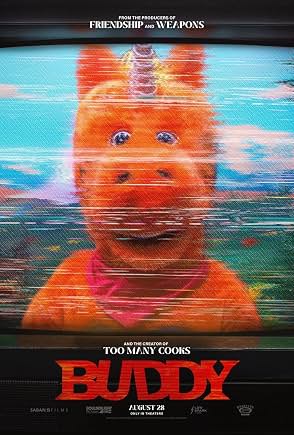

“Buddy” (2026) is a sick bastard’s delight. “It’s Buddy” appears to be a children’s television show from the Nineties styled after “Barney” with a few major differences. When Grace (Cristin Milioti) sees the show flash on her flat screen television, she cannot find a trace of it anywhere. When one of the kids goes off script, the other kids notice that Buddy (Keegan-Michael Key as the voice and Sergey Zhuravsky in the suit), an orange unicorn with a purple heart occupying most of his stomach, a fuchsia bandana tied around his neck, and blond hair, is acting strange, and Mr. Mailbox (Eric Bauza) is missing his door and cannot talk. Everyone tries to keep a brave face, but gradually cannot fake the cheery, sing song demeanor. Will they find a way to escape and survive? Director and cowriter Casper Kelly, who also did the segment called “Fun Size” in “V/H/S Halloween” (2025) and wrote “Mandy” (2018), and cowriter Jamie King’s feature debut collaborate to make a demented take on already bizarre popular cultural phenomenon and stick the landing.
“Buddy” starts with a dark screen and alarming sounds before the opening theme song starts an episode. The movie mostly consists of episodes of the television show in varying lengths depending on how smoothly the episode goes. Buddy is stuffed animal size until the kids call his name, and he expands to teach lessons. Scene transitions are heart shaped wipes. Eventually it becomes obvious that Buddy gets really invested in people acting a certain way and sticking to a routine, or he loses his crap. Most of the kids and adult characters like Mailman Miles (Bennie Taylor) and Nurse Nancy (Phuong Kubacki) act as expected for people who appear in such shows, but they begin to act normally as they notice disruptions in the cheerful façade. In between episodes, a blue sky and glimmers of images from another place appear, but it is not obvious what is going on until the third act. Pay close attention to the credits, especially the copyright.
When Josh (Luke Speakman, “Weapons”) goes missing, Freddy (Delaney Quinn, “If I Had Legs I’d Kick You” and “The Roses”) begins to suspect foul play. Her talking bookbag, Strappy (Patton Oswalt) tries to convince her that everything is fine, but eventually she confides in Wade (Caleb Williams in his film debut) who is initially reluctant to believe her but is convinced with more evidence after seemingly oblivious Betty Bunny (Jimmica Collins as the voice and Cedwan Hooks in the suit) contradicts one of Buddy’s cover stories. Oliver (Tristan Borders) is clueless, and Hannah (Madison Skyy Polan) replaces Josh in the next episode.
By the third episode, the proverbial crap hits the fan, but before it ends, “Buddy” shows what is happening in the real world and the logistics of how everything happens. The mythology is seamless, and it is a case of show, not tell, which makes it even more of a success. A lot of filmmakers prefer gimmicks, but do not think through the details. While it is not exactly spelled out, it feels solid and grounded with an implicit homage to “Poltergeist” (1982). Grace feels a disruption in her world, and the rest of the family, her husband, Ben (Topher Grace), older son, Derek (Bryson JonSteele), and younger son, Timothy (Seamus Flynn), is a little off. This sequence is a relief and a terrific pressure valve because the real world in many ways uses similar tonal conformity to pretend that everything is normal, but it does not work. It is important to stick to scripts in both worlds. Miloti and Grace are a great team, and even though Grace plays the standard husband that does not believe his wife, when the movie reveals that the scales are weighted against believing her, it becomes slightly less egregious. Brooke Bloom plays a pivotal role in uncovering the mystery, and after having an “Insidious” marathon, her character felt essential.
“Buddy” works on multiple levels. With what is now known about children in entertainment, the horror metaphor is almost unnecessary. Kids are expected to be professionals while predators harm them. It makes these shows horrifying in retrospect, and they were always a little off. On a lesser level, how many kids can relate to knowing something is wrong but not having a trusted adult to go to or witness that adult fail to successfully intervene. Buddy’s feelings matter more than the actual harm that he inflicts. Buddy always deflects and changes the goal post. While the abuse is extreme, the idea of children unable to escape resonates. The most chilling part is when the story reveals whether someone knew about Buddy’s nature and just fawned to appease him to remain safe. Also, the lessons groom the children into becoming more defenseless than they are, and they must disobey and learn how to do things without an adult to survive.
The moral of “Buddy” is also scalable. When something is wrong, it is better not to ignore it because it will not help. The lesson is to trust your instincts, question authority and become immune to pressure to conform to the script that society pushes on everyone otherwise you will become complicit to your own abuse. The special effects are top notch, especially a scene when Grace first discovers the looking glass. The violence in Buddy’s world is incessant, but it passes muster because it often occurs to the fantastical characters in his realm though human beings fare no better. It is only a matter of when, not if, Buddy will hurt them. Only the extent of the abuse varies. Also, the filmmakers understand the long-term consequences. There is no way to escape the psychological ramifications even if they defeat Buddy. It makes them vulnerable to drug use, further exploitation and a loss of community who relates to you and shares those horrific experiences. Hear about Hayden Panettierre (RIP), and it will feel less like fiction than a documentary.
Shout out to Tory Jacqui Malone who plays Tyler for being the comedic relief during the last act. Michael Shannon and Clint Howard share an amazing scene that feels like a riff on the “Toy Story” franchise meets Ang Lee complete with auto tune. Will you be afraid? No. Is “Buddy” disturbing? Oh yes. It is always nice to add another kind of vampire to the mix. Is a sequel necessary? No, but if there was another way to get more details about how this world functions or originated, it would be a cherry on top. For adults, it would make a terrific opener before seeing “Coyote vs. Acme” (2026).