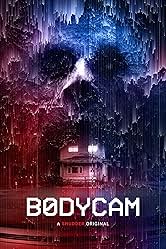

“Bodycam” (2025) is a found footage horror film that prioritizes horror. On October 13, 2025, Officer Jerome Anthony Jackson (Jaime M. Callica) and Officer Bryce Anderson (Sean Rogerson) get called to a house in Henderson, but when they get there, things go wrong, instead of reporting it, they try to cover it up. Instead, they get sucked into a supernatural phenomenon that affects the community that they patrol and live in but knew nothing about before that night. Will they be able to revert to life before they found out that the zoned-out people are not “tweakers,” but in the thrall of an entity that hijacks their body and mind, i.e. their lives? By the end, I’m not exactly sure if I understood what happened, but the ambiguity worked for me because I believe that the Christensen Brothers did.
While no character is likable per se, they are not the kind of characters that you are rooting against. Jerome is from the neighborhood, is not ashamed of it, but also feels no deep connection to it. He suppresses his instinct to get more help and do the right thing and prioritizes his partner. While they clearly like each other, the bond is not so palpable that this choice makes visceral sense. Also, Jerome is Black so he should know better than to get caught up in someone else’s mess, especially when things get weird, and at that point, he was not culpable. Callica does a solid job of never making Jackson seem stupid even though he absolutely does stupid things.
Bryce is not a walking red flag like most people in similar situations. He is just some guy who cares more about preserving his life than fulfilling his public duty and possibly facing any consequences for a mistake. Based on their conversation, the coworkers socialize after hours, and Jerome has been to Bryce’s home, but Bryce thinks of Jerome as different from the people that they surveill He is definitely someone who enjoys the minor power that he holds over people but is not innately sadistic or violent. His flaw is dehumanizing others and overvaluing/distinguishing himself as if he could never trip over the same problems that hurts the people whom he demeans. Much of “Bodycam” is about him paying the overdue bill of consequences without any true reflection of his role in that night’s events. Rogerson has a heavier lift because based on the facts, Bryce is someone who seems easy to hate on paper, but never quite reaches that level.
To be fair, the incident would rattle anyone. If you see the trailer for “Bodycam” and think that it will be a zombie movie, nope. People are standing in front of a house as if they are NPCs or people who are high and disassociating. When the pair go inside the house, their radios stop working, and the electricity is off. They separate. Upstairs, there is a woman standing in the corner of a baby’s room covered in blood. In the basement, a man stands in the corner adjacent to a hole in the ground that looks more like a wide uncovered well with “Rise” written above it in red spray paint. The house has lots of spray painted weird symbols on the walls. After they leave the house, they encounter people familiar with this phenomenon and give them a wide berth. These scenes convey that everyone knows more about what is really happening in the neighborhood, and it is not drugs.
The Christiansen Brothers prior film, “Night of the Reaper” (2025), had John Carpenter references, specifically “Halloween” (1978). Everyone leans heavily on Carpenter’s brilliant slasher classic and neglect his more esoteric supernatural siege staging. “Bodycam” does not copy his staging precisely, but in spirit. They take people who are othered like people suffering from substance abuse, unhoused people and people in support groups, then amplifies that otherness as if they are tapped into a frequency from being exposed to some quotidian horror which makes them vulnerable to an outside force hijacking them. While the Christiansen Brothers reveal the entity, which has a creepy pasta aesthetic over being instantly recognizable, the horror is still ambiguous. There is no prose dump that explains everything, but there is enough there to imply that they do know the rules of this universe and chose not to fill their audience in. It did not just feel like atmosphere distracting from a lack of substance.
Jerome’s mom, Ally (Catherine Lough Haggquist), seems to have all the answers though not as many as she thinks that she does, which reframes Jerome into a frustrating character because he clearly did not pick up anything when he lived at home. “Bodycam” does a better job than “Night Patrol” (2025) in addressing the tension between being a part of a community and wanting to separate from it to prioritize himself without betraying his legacy. Everyone wants to make it out, not make it better, though making it better seems unlikely at this stage in the game. His mom is the closest to a force of good in opposition to the evil, hijacking chaos that they stumble across. There is a reference to God and hell, but do not expect any conventional intervention or punishment. The devil would take one look at this situation and say, “WTF,” then scurry away.
There is the idea of a descent into madness and surrendering to impulses that may not have been tempting before. Encountering the entity seems to cause electrical interference and disruption which affects electric frequencies, the bodycam and brains thus causing mind control. A sign of mind control is the person starts to bleed from their mouth or nose. There are rules, but the parameters are unclear as is its actual agenda other than the usual scary, consuming monster so maybe apocalyptic. In the final act, the story loses some of its focus, but is still coherent if you pay attention to the entire story, even casual blink and miss it moments such as a framed photograph, a garbled word, etc. An eagle-eyed viewer and keen listener with a talent for symbiology will have an advantage over more casual movie goers.
Occasionally it feels like a video game or a spin on “Dark City” (1998), a movie that “The Matrix” (1999) eclipsed though it shared similar visual themes. The coolest aspect of “Bodycam” is that if a person is hallucinating and wearing a body cam, the footage reveals what they saw because the same wavelength affects biological and technological electrical impulses. It is a fresh take on an aging genre that I adore, but many are finding stale. The Christensen Brothers found a way to make it fresh even if the ending may leave you with more questions than answers and shares some similarities with “A Stranger in the Woods” (2024) except there are no easy answers to “What does it want?”