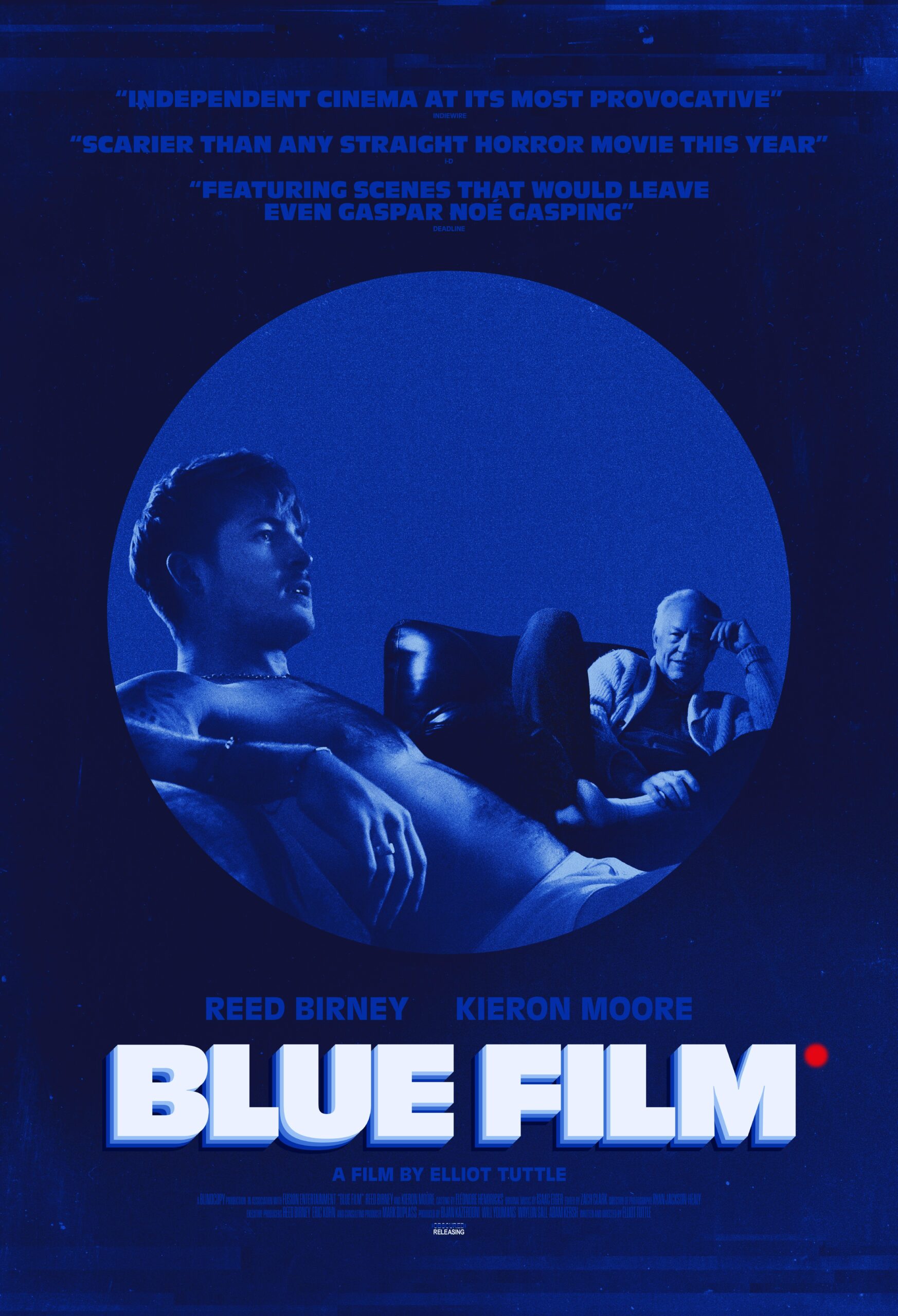

One night, two characters, limited locations and a provocative premise turn “Blue Film” (2025) into a tough sell for audiences to choose, but the exact reason that movies should exist. Where else can you safely explore topics that rightfully enflame the least bellicose person into calls for violence without pulling punches or excusing inexcusable behavior. It makes “Pillion” (2025) seem like a safe, family friendly pick. Camboy and findom (financial domination) Aaron Eagle (Kieron Moore) goes to a house in exchange for $50,000. The john wears a balaclava, brandishes an old-fashioned camera and starts asking personal questions before revealing that he knows Aaron’s real name, Alex McConnell. Aaron/Alex rips off his mask and discovers that his john was his detention teacher, Hank Grant (Reed Birney), who lost his job and got in trouble for assaulting a twelve-year-old boy, Alex’s classmate. It is a hard film to watch, but it is also quite effective in the way that it portrays two affronting people without reducing them to their worst traits or whitewashing them.
Since most people watching “Blue Film” may not be familiar with this world, Aaron’s first impression is annoying. He uses slurs to beckon his customers, acts as if he is God’s gift to men and reflects a demeanor as if he is a hetero masking self-hater doing it for the money and ready to turn on the people that he depends on. It is obvious that it is all an act, but Moore basically challenges anyone to want to get closer to a character who clearly holds everyone at arm’s length then undergoes a nuanced, gradual transformation into his less guarded, truer self. Once the sex worker’s real identity emerges, specifically after he allows Hank to shave him, he gradually begins to seem younger and more sensitive.
Casting Birney as the teacher has the effect of the viewer empathizing with Aaron/Alex’s shock at seeing his teacher. Talk about a swing. It is really bold and brave to take a job like this one. Very few actors can play characters who are pedophiles attracted to boys without worrying that a stigma will follow them into the real world. Philip Seymour Hoffman is one rare example. Most actors would consider this character to be the personification of a third rail. Birney plays it straight as if he was buying a newspaper and talking about the weather with enough emotion infused to show whether Hank is lying to himself or his private dancer or is being his truest self. “I’m a trustworthy guy,” may cause a few nervous, full belly laughs because at the time that Hank utters that line, his face is still covered, but once unmasked, it gets worse in terms of the objective veracity of that statement.
“Blue Film” is a great film because it focuses on two men that most of polite society would give a wide berth to then shows them as three-dimensional people with a past, present and future and makes them as ordinary as possible before exploring their sexuality. It may remind older viewers of the golden, gritty era of Nineties films when underworlds would emerge in a quotidian setting and give a glimpse into a life that one would never want or have. There is value to seeing people as people without the tunnel vision of alarm and horror. Everyone’s villainizing muscle is well developed, but the idea of seeing the most abhorrent person as a person that you could potentially spend a pleasant evening with is a radical concept. It is so easy to see certain behavior as normal or believe that someone’s flaws are worn on their sleeves. Instead, these characters are disruptive without the mask because they are so disarming. It is a great lesson in observing the mere-exposure effect.
Writer and director Elliot Tuttle had to walk a tricky tight rope to make this premise work. Again, if you are a certain age, you may recall that homophobes would equate gay people with pedophiles, a prejudice that sadly did not go away but shifted down the alphabet to trans people. Since then that kind of rhetoric has (hopefully) moved away from the mainstream or gets fierce backlash. See the justified vitriol directed at the timing of Kevin Spacey’s coming out. No one should want to go back to that time, but here this movie fearlessly explores the intersection head on, which frankly makes “Blue Film” into a daring film. The two men discuss a lot of topics, including sex, and the generational divide is as broad as the divide between perversion and normal desire. Here is where Moore gets to reflect his character’s tenderness and back story.
Tuttle manages to flesh out the characters’ past without trucking in overt tropes about sexuality. What makes someone a sex worker? How does someone become a pedophile: nature or nurture? Is there a danger to LGBTQ+ people for using that language? A lot of filmmakers conflate being provocative with being prurient, gynecological or exploitive, but Tuttle handles everything as delicately as possible except for Aaron’s online persona. Also, it is a very clever move to find a way to depict a pedophile’s sexuality without involving children. At varying intervals, there is home video footage of a child, and they are real life home videos of Tuttle. Within the context of “Blue Film,” it is unclear if child Tuttle is supposed to symbolize child Alex or child Hank, and it does not need to be clear. A gay child is innately off limits and should be. Tuttle does not just truck in the idea of a child but makes the concept of a child into an ever-present reality. It is not a theoretical conversation. Consent does not come with the sexual orientation. There is a brilliant scene where Hank is grooming Aaron/Alex in the shower, and it does look like a parent caring for his child except that Birney projects hunger and focus on his face.
“Blue Film” creates enough space for desire to humanize and refresh one person without pardoning the other. Hank may be using redemption as a pickup line to fulfill his most perverse desires, but Hank also functions as a device that makes Aaron remember his less coarse, more authentic self. Who does not want to be a kid again before condemnation and loss set in? (A lot of people, including likely Hank’s first, always off-screen victim.) The analog aspects of the film harken back to this retro vibe as does the title, which refers to porn during the early days of cinema. Tuttle also uses blue lighting in the intimate scenes to make the title literal. In the nineteenth century, laws that address morality were referred to as Blue Laws. The characters’ melancholy also can be seen as blue. Existing in a liminal space where their humanity can be the focus, it is an image of two men being honest, not necessarily gentle, but not actively disrespectful of each other.