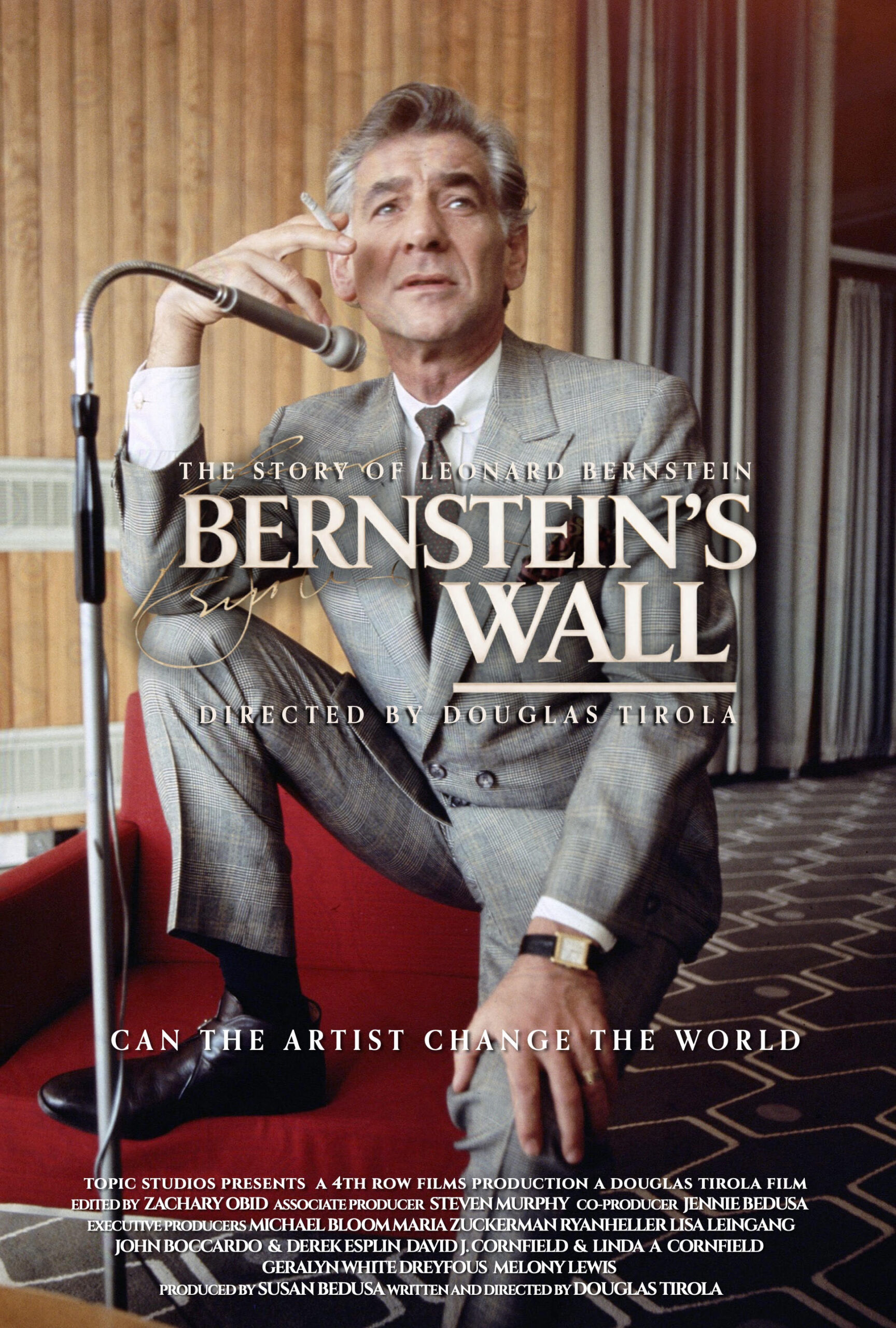

If you are looking to get your composer and conductor Leonard Bernstein fix and must choose between watching Bradley Cooper’s biopic, “Maestro” (2023), and Douglas Tirola’s documentary, “Bernstein’s Wall” (2021), definitely choose the latter. If you feel full after watching Cooper’s sophomore film and do not believe that you have room for more, try at least two times before giving up because it may seem like well-trod ground, but it is richer because it is about the man, not the ostentatious filming technique though a more subtle skill is on display in the documentary. Tirola’s stab at the direct cinema genre is an utter success and a triumph of dedication and hard work.
“Bernstein’s Wall” mostly tells the titular man’s life story in chronological order while exploring whether an artist can change the world and how Bernstein attempted to do so. Tirola exclusively uses archival film, clips from televised broadcasts, concert footage, montages of photographs, illustrations of personal letters using different font to express emotion, and clips from movies like “On the Town” (1949), the best, and “West Side Story” (1961). Tirola restricted himself to only covering the story if Bernstein talked about it onscreen. Fortunately, Bernstein was not a shy man and was often in the habit of reflecting on his life and career. Imagine pouring over every piece of media about Bernstein then narrowing it down to a one hour forty-five-minute runtime.
There are no talking heads. “Bernstein’s Wall” feels more intimate and franker because it is almost exclusively told in Bernstein’s voice and words. The only other interviewees are his wife, Felicia Montealegre Cohn Bernstein, and his sister, Shirley Bernstein. When his life intersects with even more famous figures, the spotlight temporarily cedes to them. During a concert, Louis Armstrong appears next to Bernstein to speak to the audience and reciprocate Bernstein’s kind words about their musical collaboration. During a discussion about protests, Harry Belafonte appears briefly to discuss how they are organized and who is invited. When Bernstein discusses the first US President whom he admired, Tirola cuts to a clip of President John Fitzgerald Kennedy (JFK) delivering a speech. After Bernstein receives massive criticism for a fundraiser held at his house, an audio recording of President Richard Nixon gossiping with his Chief of Staff H.R. Haldeman about the scandal clutching their collective pearls about Bernstein kissing men on the mouth after a performance.
While Bernstein was just being authentic, not making a grand statement, with his sexuality and relationships, it is a frequent touchstone for “Bernstein’s Wall,” which is geared towards showing how Bernstein used his life to declare his stance on a variety of hot button issues. His religious and cultural identity as a Jewish person comes to the forefront when he refuses to conform and Anglicize his name though it could have hurt his career. There is a brief allusion to how Senator Joseph McCarthy’s war on communism impacted Bernstein, but it is disappointing that “Bernstein’s Wall” never reveals whether his father’s national origin contributed to the blacklisting. The issue of war runs a wide spectrum because Bernstein was not a pacifist, but he also was not reflexively pro-war just because the US picked a side. With respect to World War II, in part, because Bernstein is Jewish, he felt an urgent need to contribute to the war effort but could not meet the physical requirements. Instead, his music career takes off. With respect to the Vietnam War, he sees it as a continuum of the entrenched military industrial complex.
With the backing of the US State Department, Bernstein uses music to tear down borders and assumptions of what it means to be an American by touring the world with the New York Philharmonic Orchestra and prioritizing visiting regions that could be hostile because of the Cold War. He also lends a hand to various permutations of the twentieth century Civil Rights Movement either by providing an example of integration through music with jazz or blues greats appearing alongside him onstage or ceding the spotlight to a mixed race, young pianist Andre Watts. Showing rather than telling is always a good move in a film, but Tirola may be putting a lot of faith in his audience’s ability to glean the right lesson from Bernstein’s life rather than letting it wash over them: dedicate your vocation to taking a stand.
If you recall the documentary explaining how Bernstein discovered music, which was a matter of random luck and opportunity, it is important not to take for granted the educational value of Bernstein democratizing and popularizing music education to reach the masses. He did not have to do that. “Bernstein’s Wall” devotes time to Bernstein as a pioneer in the televised education industry, which predates PBS television shows such as “Sesame Street” or “Mister Rogers’ Neighborhood.” If the documentary has a flaw, it does not provide context for the events being discussed but notes the place and time of the interview. Bernstein started to televise lectures on CBS’ “Omnibus,” but it was commercially sponsored. Usually a pupil would need money and musical talent to get access to the knowledge contained at exclusive institutions of higher education. Bernstein was democratizing that gatekept knowledge and culture.
Music education is still largely still like that with music mostly no longer taught in schools even private ones. There are clips from CBS’ “Young People’s Concerts.” “Bernstein’s Wall” does not reveal the origin of the program, which predates Bernstein, but he did elevate it by getting it on broadcast television in 1958. While it is no longer televised, it is still offered. Unlike Cooper’s depiction, the documentary leans on his fame not just as self-indulgent, campy fun, but as a tool for anti-fascism, labor, civil rights, prison reform and environmentalism.
“Bernstein’s Wall” also dwells on the cost of leveraging his persona and opening himself up to personal attacks. His response to Mike Wallace, “Oh please,” while smoking and without missing a beat suggests how tiresome the toll was on the great man. Tirola includes clips in which Bernstein suggests that it affected the reception of “Mass” (1971) or “MASS: A Theatre Piece for Singers, Players, and Dancers”, a musical theater work that opened the John F. Kennedy Center for the Performing Arts in Washington D.C. Unlike his aforementioned works, “Mass” is not widely known, and it is unfortunate that one of the goals of the documentary was not to emulate Bernstein and educate its audience about art as well as Bernstein.
If Bernstein’s social consciousness failed, it was evident in his shortcomings with his wife and children as he adhered to heteronormative, gender norms. Again, “Bernstein’s Wall” is just trying to depict his life accurately, but Bernstein could not resist the benefits of patriarchy. How many women could hold forth on how a nap is a crucial part of creativity? (It is.) Also while there is only one clip of him shouting at a singer and a person giving elocution lesson, it exhibits another way that Bernstein was unable to entirely escape the gravity of his times. His creativity may have hit its limit in those areas, but ye without sin, cast the first stone.