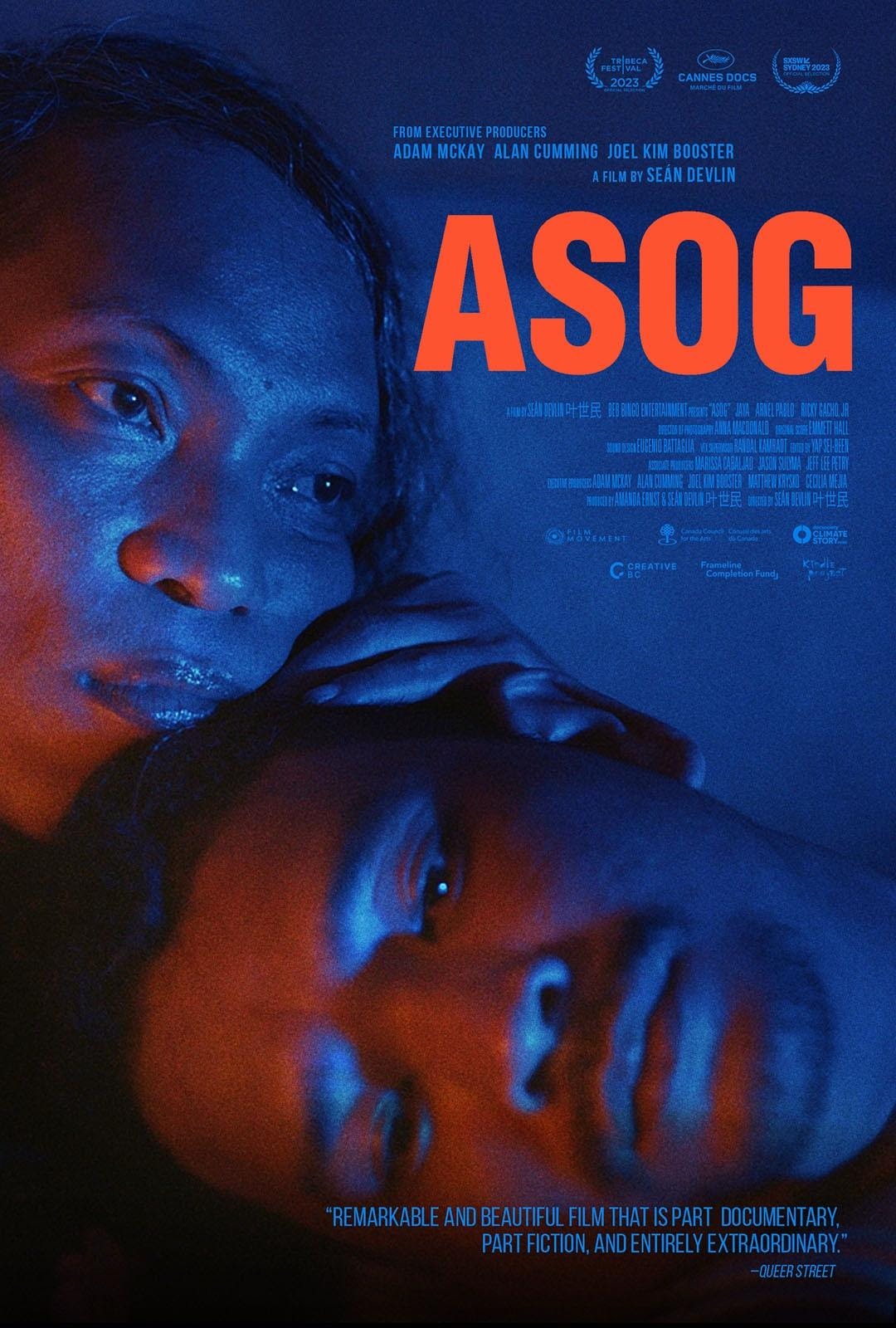

Set in the Philippines, “Asog” (2023) is a genre defying, autofiction film about a former television personality, Rey “Jaya” Aclao, who hits hard times and must return to their day job as a teacher in Anibong. The aftermath of Typhoon Haiyan or Yolanda has created scores of orphaned children or kids with one parent, including Arnel Pablo who is not handling the one-year anniversary of his mother’s death well. This ocean of loss triggers Jaya into a career crisis, and they decide to be bold and head to Sicogan Island to compete in Ms. Gay Sicogan duo contest, but without the financial and moral support of their boyfriend, Cyrus (Ricky Gacho), who stays home to work, the journey is more difficult than expected, and they can barely get through Tacloban City to get to their destination. Arnel sees his teacher on his way to visit his dad at the same location and asks his teacher to help him get there safely. Together, they make their way to the island and learn that it is more than a resort island. Thanks to the hospitality of the locals, they find a way to move forward as a community and individually.
Normally when a movie leads with promotional material boasting that many of people who appear in the film are playing themselves, it is a reason to run in the opposite direction, but here, it works. They are survivors of the aforementioned strongest recorded tropical typhoon, so it does not feel exploitive when their loss comes up. Arnel is a quiet and withdrawn person. The genre of “Asog” changes depending on his mood. When he is trying to escape family members, it can be an action film, a thriller or a horror movie. A high-octane soundtrack accompanies a sedate chase that involves two tuk tuks and ends with a person walking alongside. Because his voice opens the movie and periodically narrates with a fairy tale about a Crab King that cannot sleep, it is easy to think that he is the main character, but he is not. The fairy tale ends up being more important than just a child’s story. As he goes about his daily routine, suddenly the dynamic exterior shots explode with life and reveal the infrastructure’s ruins reflecting that if the landscape has not moved on, including the trees, then neither has Arnel. When his friend tries to interact with Arnel, he remains quiet and sullen.
Now imagine a classroom of kids like Arnel. Jaya is burnt out in a profession that they never even wanted but just took to survive, but they are great at their job. There is a tenebrous montage of Jaya working with each student having a nervous breakdown, which is not in a part of their job description. In a later scene, outside the classroom, with Arnel, Jaya gives a rousing history lesson. The psychological burden is beginning to affect them after work. Many teachers will resonate with their need to go out and party every night as a way to self-medicate against the depressing quotidian secondhand trauma. While the nightly jaunts do not interrupt Cyrus’ morning routines, it is disrupting Jaya’s sleep, but instead of getting more rest, they lean into further embracing their party girl side.
Jaya is an AMAB (medically designated male at birth) nonbinary character, and while their gender is an integral part of their identity and affects how they are treated in the world, it is refreshing that their storyline is a complete surprise and ties in perfectly with Arnel’s. Jaya keeps it light as an entertainer, but like their Stonewall pioneering ancestors, they are capable of being the tip of the spear that changes the world by being themselves. The love story between Jaya and Cyrus is a rare convincing one because they are deeply attracted to each other, have problems that threaten to tear them apart, but do not transform them into villains. It is so strange as an American to watch a movie where a trans character gets to be an accepted part of the community and teach children at such a polarizing time in our nation when baseless accusations of misconduct are levied at trans people for existing while actual pedophiles and rapists are lobbing the defamatory grenades. If you are a TERF or one of those people, “Asog” is not for you. They teach Arnel how to stand up for himself, and a brief lesson in drag finally brings a smile to the child’s face. If you insist on watching it with the intention of being offended, wear a cape and pearls so you can be super mad while clutching them. Then watch “Some Like It Hot” (1959), you Philistines!
“Asog” is a film with an original, oneiric, circuitous narrative structure that may be more challenging than “The Phoenician Scheme” (2025), but if you trust it, it lands smoothly, and the end is emotionally powerful. Trust the process! Imagine if Savage Steve Holland—” One Crazy Summer” (1986), Barry Jenkins— “Moonlight” (2016), and Glorimar Marrero—“La Pecera” (2023) decided to work with one pupil. That person would be Filipino/Chinese Canadian cowriter and director Sean Devlin, whose writing partners are the stars, Aclao and Pablo. Devlin plays with the subject matter in a sensitive, comedic way, and once the viewer can decipher the film’s storytelling style and has the key to the visual structure, it should be easy to follow when you are watching a dream, a flashback, the present or a fantasy. It is mostly hilarious, but one scene unexpectedly had me weeping when Jaya finally confides their backstory to Arnel. My main complaint with “The Tundra Within Me” (2023) was that the interiors were not equal to the outdoor shots whereas “Asog” does not have that problem. There is so much attention to detail that often the wardrobe echoes the dominating colors of every scene. Cinematographer Anna MacDonald has a painter’s eye except her brush is light. The exterior shots are colorful, lush and verdant, but also necessarily overwhelming as the scope of loss seems impossible to grasp. There is an emphasis on how quickly a life or home can be destroyed versus how long it takes to recover yet it is not a pessimistic film.
“Asog” is a movie with a message, but not the one that you think. It is not a call for LGBTQ+ rights. While climate change and colonialism play an integral part of the backdrop, it is not the propelling force of the film though it is a catalyst for oppression and exploitation. The people of Sicogan City end up being the town folks in need of a couple of unlikely outsider champions. Because Jaya and Arlen are unfamiliar with their plight, but they share a common struggle of needing to shelter from life threatening storms, they get to hear the people’s struggle then decide whether to or pick a side or continue living for themselves without concern for the broader moral implications of being complicit in their oppression. No one would blame a child or a queer person for prioritizing themselves over a bunch of kind, sympathetic strangers.
While “Asog” can get didactic towards the end as it gets on its rightfully righteous soapbox and come to an abrupt stand still, it is so earnest and powerful that it is easy to overlook in such an original, surreal film. It is so nice to mix things up and watch a Filipino film that is not about crime, government corruption or vampires. If you are wondering what the title means, you will have to wait to watch the movie to find out. There are subtitles, but it is worth the trouble. It is a story of paradise lost and reclaimed and finding the motivation to survive loss and stand alone when necessary.