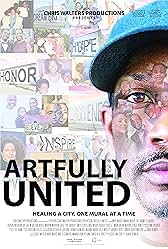

“Artfully United” (2025) refers to artist Michael Norice’s nonprofit mural community project to paint positive messages alongside his animated mascot, Powerful Paul, in communities known for having high gang presence within LA, often near his hometown. Director Dave Benner’s first feature, a documentary, covers the Artfully United Tour and functions as an autobiography for Norice and his family and indirectly a socioeconomic chronicle of Watts.
Benner primarily interviews Norice, his mother, Dorcas Morrow, his sisters, Dr. Carmelle Tabitha Norice and Joy Green, and his maternal uncle Marvin in undisclosed locations though one is Dr. Norice’s living room in her house on the East coast. His wife, Amaris, gives a single interview and their three children make occasional appearances, but do not speak on camera and are unnamed. His friends, Hubert Mark, Mad Moody, Stacee Arnett and Jason Murray, appear outdoors alongside his murals to supplement Norice’s statements about the tour’s goals or the neighborhood’s conditions. His first-grade teacher, Gwendolyn Laurent, gives a speech about Norice at an unidentified event.
At mural unveilings, Benner shows who is there but does not often name them. Norice references the government officials awarding honors. Michelle Chambers, the Senior Field Deputy for State Assemblyman Mike Gibson, is one of the few who is shown delivering a speech at the event. Dominique Milton from Sunnyside Baptist Church and Norice stand alongside the mural that they commissioned for him to paint on their community center’s exterior walls. Other than Norice’s family, the rest pop in without a lot of context, and it feels more like memorializing events after they are completed than getting a sense of how the process works from soup to nuts with the exception of office discussions anbout how they have to get local gangs to approve of the project so they can proceed. There are allusions to people testifying about how the mural helped them and business owners requesting a mural, but Norice only describes these moments. Benner neither catches it on film nor has anyone on screen explain why they can only relay the information but not show it. It is mostly an anecdotal account of the nonprofit’s activities, not capturing events as they unfold.
Initially “Artfully United” format seems to be to show the murals in the order that they were made intercut with interviews about the family story and how Norice became an artist. There is a big assumption that viewers already know who Norice is since it opens with a brief glimpse of Norice in his sneaker shop and a discussion of how he makes custom artwork for celebrities. It would have been nice if there was a portion devoted to how his career evolved from school to a store to commissions to the nonprofit, but the story bounces all over the place, and the total is not comprehensive even if pieced together. It does not have to be comprehensive considering that the nonprofit is the focus, but it would have been helpful. There are montages of the famous people that he worked for and his paintings, but those people are not identified. A lot of documentarians forget that their films may be viewed decades later, and it is possible that no one will recognize these people, so it is important to include context. As the movie continues, it becomes obvious that the narrative is not structured in mural chronological order as it bounces around then begins to omit it altogether until the closing credits. This lack of rhythm and depth and the monotony of having one person talk instead of show what is happening makes it challenging to stay focused without seeking distraction while watching it. Benner does not succeed at doing what he set out to do, but he did accomplish something else.
“Artfully United” becomes an unofficial biography of Norice’s father, Celine Norice, a Vietnam vet, who does get a chronological narrative if the interspersed clips of family interviews are collected. The family talks about living in Watts, homelessness and lack of financial security. They do not blame Celine for the lack of support even though he is not present because of systemic factors, but in crafting a story of the family biography, they make him the central focus, and their efforts to offer support. Nothing that I write is intended to be a condemnation or validation of complex personal histories, just observations that offer insight as a specific microcosm that explains broader systems without intending to comment on them. The private space shown is not Norice’s, but Dr. Norice as the unofficial matriarch of the family. Morrow is divorced from their father. The family story of personal community overshadows Norice’s story of uplifting a general community, and Norice is depicted as playing a passive role in that story. The women are portrayed as doing the hands-on work while the men are recipients of their largesse without the men articulating if and how they support the women who support them. Instead Norice does talk about how he proactively looks for father figures and keeps his private space shielded from the public eye while the women in his life act as a public facing surrogate for any private insight into his personal life.
Dr. Norice and Morrow are depicted as the people who work to keep Celine loved and a part of their community, a community that he left because of the US forcing a separation of the family through a draft, i.e. state authorized violence against another country regardless of whether that state violence was proper or not. (History seems to be landing on not, but I am not making any authoritative, declaratory statements.) Then the drug epidemic, which systemically is met with sympathy, care and concern when substance users of a certain demographic become addicted, touches Celine. Celine did not receive systemic care despite being a veteran and does not fit that demographic. Regardless of the reason, Celine did not proactively support his family until they looked for him while he was incarcerated for life for a nonviolent crime though it did include a threat. It is only after confinement that he offered psychological support to his family. Multiple things can be true at once. The women in the family worked to free him so they could care for him because they wanted to and love him. Implicitly, once it became harder to care for his medical needs, the State of Texas was willing to let him go. The family sees it as a happy ending.
It is another example of the state’s systemic unwillingness to care for a person that they repeatedly and lawfully (do not conflate with morally right) claimed as property then put that burden on people who never received support from him until they proactively had to initiate contact and do not have a duty to support depending on the laws of the state where Dr. Norice lives., i.e. filial responsibility laws. Remember Morrow is divorced. Norice lives on the East Coast so it is logistically impossible for him to provide daily support, and he did not state how he supports his mother and sister as his father’s caretakers. It is the women’s tax that women are groomed to believe that it is our duty to care for everyone first, not ourselves, which is innately not a bad thing. It makes community exist, but Norice has been able to create his own family and live his life fully. There is no discussion of whether Dr. Norice or Morrow have personal lives with partners or however they deem fit to spend their free time. They will likely be devoting personal time and funds to caring for Celine, who has dementia. These dynamics are assumed, not interrogated, not fixed, not adjusted to ensure that everyone shares the loving burden equally and protect their well being so they can have a life. In the interest of full disclosure, I would make similar choices and have, but the idea that the individual or families take the brunt of responsibility is another way of divesting resources from communities that should be shared collectively since everyone will go through it. It is a systemic failure and another way to ensure that Black communities do not accumulate wealth that can be passed down.
“Artfully United” ends up being a documentary about how systems work and how families fill in the gaps of those systems even when those systems do have a duty to individuals because those people are their veterans or wards of the state. These people do not ask for the state to be their guardians, and when that guardianship comes with benefits to the state, the state takes away their autonomy, but when that guardianship becomes expensive, they want to remove any state obligations to their wards. Then society grooms mostly women into taking over that caretaking role thus exacerbating unequal pay and opportunities according to gender. This documentary is a perfect example about how some community work is invisible, and other community work is rewarded. It is not a surprise that visibility also falls along gender lines. While both types of community work are beneficial, if it was not for the documentary, Dr. Norice and Morrow’s work would go unsung. There is still room for another documentarian to make a more comprehensive film about Norice and his work.