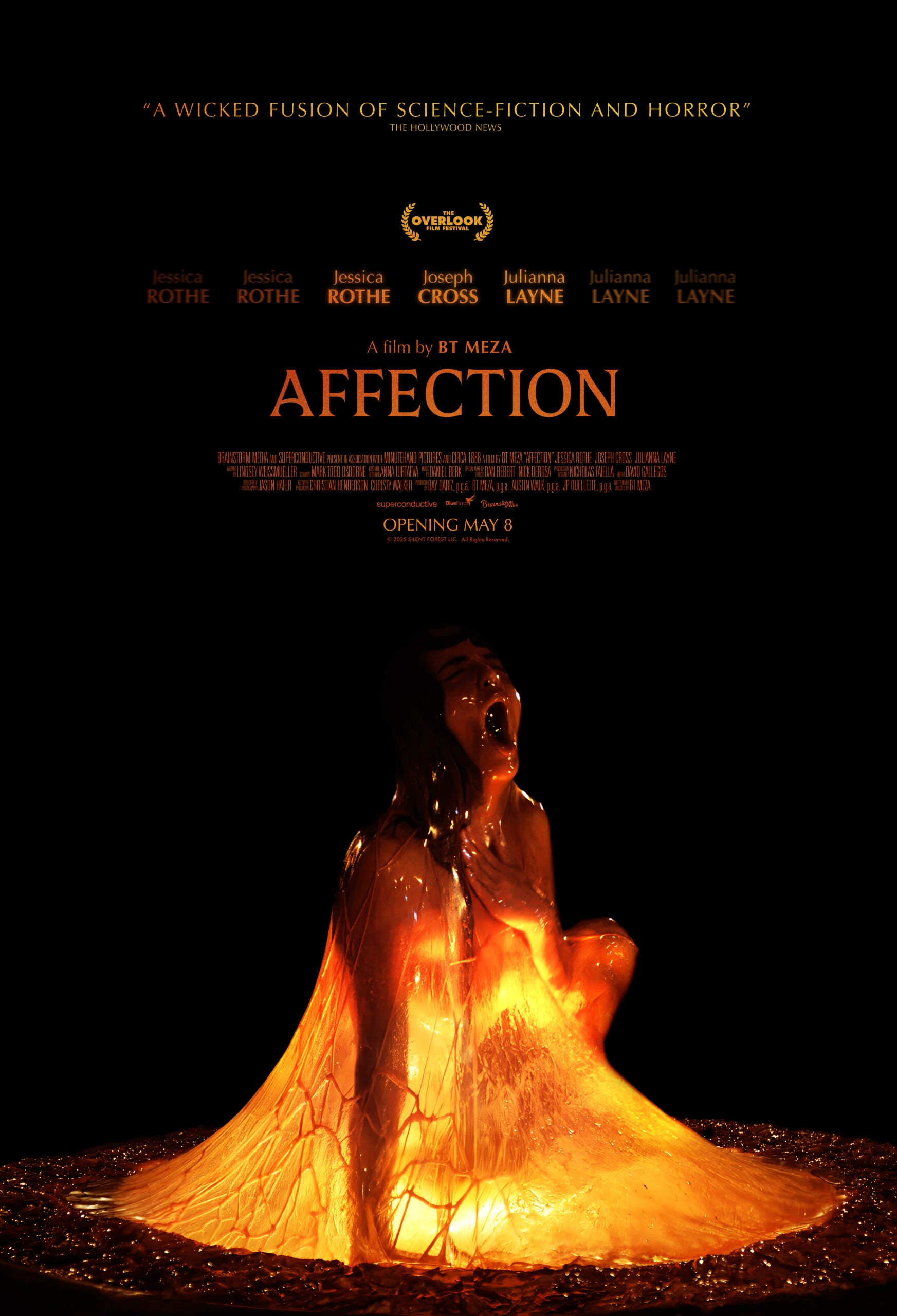

While living with their daughter, Alice (Julianna Layne), Bruce (Joseph Cross) tells his wife, Ellie (Jessica Rothe), that she has a medical condition which causes tremors, fits and false memories and requires isolation as a treatment. Ellie would accept this explanation if she did not see weird things on the property, including a building containing recordings and strange technology. What is going on? Once the answer is given, “Affection” (2025) suffers from losing momentum that shocking violence cannot solve and has more movie at the end of the story. Writer and director BT Meza’s feature debut shows promise with his blend of sci fi and horror but needs to reduce his fence sitting to sharpen the story’s focus.
It is no surprise that Rothe brings an innate credibility to her roles after appearing in the “Happy Death Day” franchise. Even when playing a character that initially feels like an unreliable narrator, Rothe knows how to ground them, which is a good thing because what Ellie sees is either distressingly delusional or puzzlingly real. Every time she begins to settle into her life and return to some level of normalcy, the calm is shattered, but she cannot fully give in to her panic because she is compelled to remain a stable force for Alice and not disturb her. Whatever the truth maybe, she accepts her role as a mother.
Either Ellie is really sick, and Bruce is a crap husband and father, or she is not, and Bruce is a crap husband and father. Through no one’s fault but my own, I could not stop associating Cross with Jared Padalecki, the “Supernatural” and “Gilmore Girls” star, whom Cross resembles. Cross is fine and does nothing wrong, but American actors are notorious for swinging in opposite directions instead of playing the entire emotional spectrum ranging from soft-spoken and calm to complete screaming psycho. It is the nature of the character who is fairly sympathetic for a huge swath of “Affection” after the big answer is revealed. On one hand, Meza is correct to approach all his characters as if they are the heroes of their own story. On the other hand, alternating between Ellie and Bruce’s perspective drags the plot down since most of “Affection” has the audience holding Bruce at arm’s length, which makes them suspicious of him because they relate to Ellie. Meza should have made Bruce more relatable earlier so the switch effectively works in terms of empathizing with Bruce, not just seeing his side, but feeling it. It does not quite work because Meza relies on shock value. Perhaps Meza should have revealed the answer first before Bruce started acting erratically.
Layne is a good little actor given a role with a character facing an untenable situation. Layne nails it and has considerable range. Alice knows something is wrong, but she is not old enough to know who to believe or what is happening. Her mother is visibly sick, but her dad’s words do not match his actions. Meza does create suspense regarding the nature of what is happening. Did a person cause it? Is it supernatural? Is it alien? If it is confusing for an adult, it would be impossible for a child to navigate. “Affection” was at its strongest while the ambiguity existed.
Normally a revelation makes a movie more interesting, and the viewer will want to rewind and watch repeatedly. “Affection” had the opposite effect. It actually created more questions, and it was apparent that either there were no answers to those questions, they were not considered, or they were not clearly conveyed. It felt like an unsustainable though creative plot device for Meza to create a situation where both sides had a point. It may have worked better as a “Black Mirror” or a “Twilight Zone” episode or a short. It also had the effect of watching a couple of people take turns being alone in a room staring at a screen for a long period of time with flashes of violence; thus, making the brutality the draw, not the answers. Mythology is tricky and not being believable could result in the audience disengaging and waiting for the dust to settle.
It also does not help that the screener could not play on the television, only a smaller screen like a desktop or smaller, which leads to the “Game of Thrones” lighting problem. To be fair, filmmakers make movies to be shown on big screens in theaters, but not every movie is so lucky. After the movie leaves the theater, more people will see it on the small screen so while it should not be the first priority, more filmmakers need to check that their movie will work on a smaller scale. In “Affection,” the night scenes were often indiscernible, and Meza is in good company with a lot of great directors who never bothered to test whether their movie would be visible to at home viewers and if their movie turned into a glorified radio drama. It renders the remaining fifty minutes of the film a challenge to stay visually invested.
The limited cast and location do an excellent job of keeping the story afloat despite its shortcomings. The practical effects were chilling and well done. The found footage elements worked well, and the technology seemed convincing despite the pairing with analogue devices. There is too much suspension of disbelief required about the ease of using such technology. People have more trouble clearing the jam out of a photocopier or using the microwave to make popcorn.
While “Honey Bunch” (2025) has different goals, it bears enough of a similarity to “Affection” that it is more obvious where Meza’s film falls short. Meza’s film has more of a “Gift of the Magi” tenebrous spin whereas “Honey Bunch” prioritizes the emotion while gradually dropping clues about the explanation. It is interesting how horror and sci-fi films are exploring the nature of marriage and family taken to extremes. In theory, the story features a good mother, a good wife, a good father and a good husband considering the sacrifices they are willing to make to fulfill their respective roles, but the actions’ ethical implications are glaring and denote the opposite.
“Affection” is a movie with terrific ingredients that never quite come together. Meza is promising but needs to work on his pacing and proportions. After watching the movie, I reviewed the press notes, specifically the director’s statement, which addresses what he was trying to convey. Without spoiling anything, he succeeded but should have added another character because he may have inadvertently conflated two characters into Bruce or Ellie, which explains the proportion and momentum issues.
S
P
O
I
L
E
R
S
So, there are two news headlines doing the heavy lifting. One says “Echo Labs Beta Testing Consciousness Digitization Successful.” I did not catch the second one but basically it was shut down because of ethics concerns. Valid.