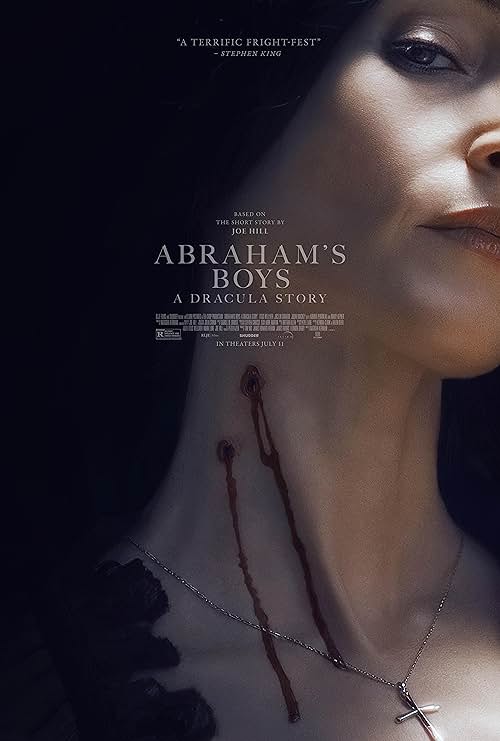

Come for the vampire. Stay for the monster. “Abraham’s Boys” (2025) adapts Joe Hill’s short story which appears in “20th Century Ghosts” (2007), but was originally published in the 2004 anthology, “The Many Faces of Van Helsing.” Set in 1915, eighteen years after Count Dracula’s death, the Van Helsing family, local doctor Abraham (Titus Welliver), his wife, Mina (Jocelin Donahue), their older son Max (Brady Hepner) and younger son Rudy (Judah Mackey), lives on an isolated hill in Central Valley, California, but with railroad tracks getting laid in their vicinity, an old threat reemerges like rats on a ship. Abraham is determined to prepare his family to continue his work. Will evil finally be defeated?
The character Abraham Van Helsing is an educated immigrant character that Bram Stoker conceived and wrote about in his 1897 horror novel, “Dracula.” Van Helsing has knowledge about random ailments, which is why he is consulted and becomes a vampire hunter. He is a man with a tragic backstory: a dead son, which results in an insane wife, but as a Catholic, he does not file for divorce. Lucy Westenra, one of Dracula’s first London victims, has a fiancé, Arthur Holmwood, who resembles his dead son. I have not read Hill’s short story so while the story uses the novel as a jumping off point, there is not an explicit reference to his prior family. Do you need to know any of this lore to enjoy “Abraham’s Boys?” No, but you do need to know that he is a respected figure renown for defeating a possible extinction level epidemic that threatened to consume everyone: vampires. If you live in a vacuum without Stoker, you will not know Van Helsing’s back story. Even though everyone knows about vampires, my confidence is waning that people are familiar with the original concept or even movies, especially with “Nosferatu” (2024) in the limelight. People are surprised that Superman is an undocumented immigrant so you’re getting this primer.
“Abraham’s Boys” is an ensemble work. Television iconic actor (the Man in Black in “Lost,” and no, he did not play Johnny Cash or a government agent who handles aliens) Welliver is aging like fine wine and is quite striking with his contrasting appearance: tanned skin with light blue eyes and white hair. As Abraham, he is an old school father which means more stern than loving. Abraham has an authoritative tone and manner but seems solicitous of his wife. Donahue plays Mina as a haunted, skittish, hot Goth girl type, which felt anachronistic, and the movie could have worked better if she was given more to do. Her character feels unfinished considering this work is about deconstructing myth. Mina is someone who adores and trusts her husband and feels a sense of betrayal when the terror returns. If there was going to be a protagonist, the perfect onscreen audience surrogate would have been Rudy (Judah Mackey), whose role explodes out of the blue in the second half of the film. He is a curious, budding intellectual kid who feels alone despite his big brother’s promises. He intuits more to the family mythology, interrogates it and often lashes out in frustration at his circumstances.
Instead, the default protagonist is Max (Brady Hepner, who appeared in another movie adaptation of a Hill short story, “The Black Phone”), a quiet, stern boy who is reflexively obedient to his father, but when he does talk, which is infrequent, to anyone besides his parents, a deep well of burning resentment and questioning emerges. Max is supposed to tie together all the different threads into one cohesive story, but Max is too underwritten to execute that function, and Hepner is not at the required Michael Fassbender levels required to fill the gaps in the translation from page to screen. Hepner is a good actor who was nuanced as the nemesis in “The Holdovers” (2024) so perhaps it is the direction. Hepner plays Max in the way that Abraham sees his first-born son: a bit dull and flat, but he is supposed to be more like Rudy, just better at camouflaging his suspicions. “Abraham’s Boys” also raises the father-son relationship to Biblical levels that it is a shame that Max did not have a different name, and Hepner and Welliver carry out that tension effectively.
After Welliver, Aurora Perrineau is probably the next most famous actor who appears in “Abraham’s Boys,” and the movie deliberately makes her character, Elsie, feel as if she was in an entirely different movie. While the creative decision was wise to function as the measuring stick of normalcy to measure the Van Helsing family against, it also did not work because she is written anachronistically in the opposite of an intersectional way: the lone Black woman in the area. Um, forget vampires, she would be in danger in at least two ways. First, racism, and while it is a relief not to get surprised with racism in a Dracula movie, which “Sinners” (2025) is not, it is also unrealistic considering how anecdotally white Californians describe the unique, rabid racism that exists in parts of California today. Second, she lives at the camp that the railroad workers occupy, which would be predominantly male. Dressing like a guy but still being visibly a woman would put her at risk today. She serves as a foil to Mina since she lives a completely fearless life with a brow free of worries.
“Abraham’s Boys” is a good movie if you cannot guess within the first five minutes what the twist is going to be. If you are familiar with Hill or Welliver’s work, you are going to figure it out and get bored pretty quickly, so do not plan to do anything except go to bed after watching the movie. If you are unfamiliar with their work, then this movie may blow your mind because it is a very provocative concept. Even if your mind is blown, you may find it challenging because the mix of oneiric imagery and realism could result in dissatisfied moviegoers who were expecting a more conventional horror movie. The oneiric imagery undercuts the overall story because it reinforces the moviegoers’ expectations as opposed to developing critical thinking. Director and writer Natasha Kermani builds tension with the camera movement and daytime horror whereas the oneiric, nighttime scenes are triter and more traditional. If Kermani had stuck to a more realistic filming style of a Gothic narrative, it would have laid the foundation more. The filming style reflects Max’s inner world, torn between believing and questioning his father. There is nothing wrong with the filmmakers knowing more than the characters in the story. and the point is to deconstruct sacred stories. This mythology does not need more reinforcement with imagery.
There is a lot more talking than showing, and characters make claims without depictions supporting their assertions. For instance, Max theorizes alternate reasons why the Van Helsings had to leave Europe. There are no objective markers to indicate which story may be valid until the final act. When “Abraham’s Boys” does show practices that would be questionable outside of a horror movie, shooting it like a drama would have made it more terrifying and given three acts to movie goers instead of a one-note trajectory. The film is disappointing and a soporific when it could have been a complete shock. If the first act was devoted to establishing the normal dynamic before transitioning into paranoia and madness, it may have been a stronger film. Great concept, gorgeously shot and room for improvement if another creator wants to take another bite.