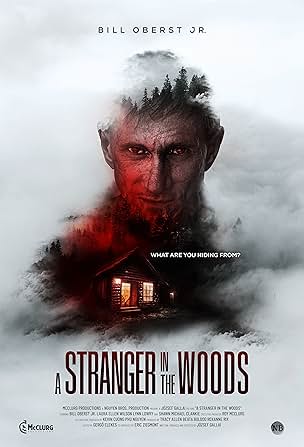

On October 9, 2023, Edith (Laura Ellen Wilson), a film student arrives at a recluse’s home in the middle of the forest after her tutor, Gregory (Shawn Michael Clankie), suggests it. After two decades in isolation, Victor Browning (Bill Oberst Jr.) is willing to pay Edith to make a documentary about him. “A Stranger in the Woods” (2024) is a found footage film about the time that Edith and Victor spend together. Why would Victor decide to stop isolating?
Found footage films are fun because it gives viewers a chance to live vicariously through someone else’s stupidity, brush closely to death without danger and pat yourself on the back for not being in the situation. “A Stranger in the Woods” fits perfectly into that model while omitting most of the other annoying characteristics of the genre: shaky camera, lack of character development, obnoxious characters. The British Ellen is a bright-eyed film student who is in that era of life where a young person rationalizes why something is normal and tries to go with the flow instead of trusting her instincts and getting the hell out of there. The first mistake is meeting a man in the middle of nowhere. The second is probably agreeing to stay the night, which is when things get even weirder. The third is not thinking that the accommodations are strange, especially the lack of food. The fourth is not leaving at the first inappropriate reaction to a normal kindness.
To be fair, Victor could be odd for a lot of reasons. His accent is reminiscent of Werner Herzog. Unplugging from the world probably sounds ideal nowadays. There is a guy (József Gallai, who is also the cowriter and director) stalking his place, and given Victor’s history, which he reveals in one of the interviews that Ellen records, anyone would be paranoid in the same situation. Plus Oberst plays the role with a gentle voice and seems like a slight man, but anyone who has heard of old man strength—not that Oberst is old—would not fall for his harmless appearance, especially since he is a hugger, has random outbursts which include breaking things, leaves the refrigerator door open, and really wants her to stay. He also often refrains from blinking and is quite intent on Edith when he is not reminiscing about the past. When he moves forward, it seems as if he has enough energy to bridge the distance rapidly with little effort though he never does. He seems coiled.
With a runtime of eighty-three minutes, the only time that “A Stranger in the Woods” loses steam are the driving shots establishing the surrounding location, and the night vision scenes because it is hard to see anything, especially when nothing is happening. Those sections could have been trimmed. The daytime interactions between Ellen and Victor are riveting because how Ellen acts with him compared to when she is alone is dramatically different. She is reassuring and gentle, but alone, she voices all her reservations and suspicions about Victor. Fans of horror will be able to predict fairly early what Victor is hiding based on Oberst’s physicality and the dialogue. One hint: while Victor’s name may be an homage to Mary Shelley’s famous doctor, it is unrelated to the substance of the story.
Also, if you work in a profession that pays you to be suspicious, then you will have the skill of comparing what someone says at one time with what they say later. Inconsistencies plague Victor’s story versus the image that he wants to paint of himself. While Ellen notices it, she does not act until it is too late, and the delay puts others in danger, which leads to an unexpected chain reaction with widespread consequences. You know that Ellen is in trouble when she has to ask her grandma, Nana or Violet Dietz (Lynn Lowry from “Shivers,” “The Crazies,” “A Hard Place”) to investigate Victor on the internet. If your grandma is not Thelma or a member of the Thursday Murder Club, don’t bother.
“A Stranger in the Woods” is crafted using the footage that Ellen shot, which thankfully is mostly steady, phone recordings, screen recording, body cams and black screens showing the dialogue between dispatch and the officer on duty. The phone recordings were unexpected but worked because it was nice to get a sense of what Edith was like with someone that she knows. How they were available is a mystery. Also, it added a Little Red Riding Hood quality to the proceedings. Some people did not like the sections involving the police, but it adds unexpected bite to the intimate story after getting sucked into Edith’s world. It also gives perspective regarding how Edith fared versus professionals who are supposed to be able to handle threats better. It also may explain why Edith decided to stay. While it is easy to admire Edith’s moxie, the part that seemed most ridiculous was her willingness to confront the man watching Victor without any fear for her own safety. If Victor is crouched on his bed staring into the distance, then why is she running around doing Victor’s job. Stay unbothered. It is the part of the film that seems most unbelievable but is used to elicit some important information.
While Wilson and Oberst nail their roles, the rest of the cast’s acting suffers from wooden delivery as if they are reading their lines. Oberst is deliberately referencing a silent film actor, which is explicitly referenced within “A Stranger in the Woods,” which makes an innocuous comment about changes in technology seem retroactively important.
S
P
O
I
L
E
R
Victor is that guy who says that he does not watch television as if he is above it, but that bitch is watching everything. I do not know why that aspect of his personality irritated me the most, but it did. How dare you watch the news and own a television? He is a little fame whore. It was not enough to pop off a vampire apocalypse (chef’s kiss), but you want to be famous. I do not understand disliking the denouement. Vampire apocalypse! While I’m greedy and want more information about the masters, the plan and endgame, Gallai and cowriter Beáta Boldog were probably right to leave it mysterious, especially considering the budget limitations. Leave us wanting more.
Basically “A Stranger in the Woods” feels like a contemporary reimagining of Dracula except Jonathan and Nina Harker had a spiritual heir in Edith. Retroactively based on the ending, I wondered if there was a connection between Victor as the one who killed her father considering how the assailant wanted the police to come. Maybe I’m reading too much into it. At the very least, Edith is the latest version of the British unfazed wanderer who thinks that they can handle any situation but are in over their heads. Also, because the film is supposed to take place in the US, there is also the idea of two immigrants giving each other grace for a possible cultural divide that loses something in translation, and Edith finally finding a home where she can be herself, except based on my reaction to “The Witch” (2015), if Victor killed me and ruined my life, I’d be pissed and spend eternity planning payback, not chilling. He lost me when he touched the food in the fridge and hated my cooking.
Ellen gets one demerit. When visiting someone, if they are up in the middle of the night, a guest should leave that person alone. They are trying to do something without you while you are sleeping. Don’t ruin it for them.
When I watch a film, I occasionally ask who I would be in “A Stranger in the Woods.” No one! When I heard Officer Williams (Marvin Maddicks Jr.), and he immediately knew that everything was off, I knew he had to be Black. At least he dies last. If I had to choose, it would be him. I loved how the glitch in the recording meant that Victor was up to his preternatural tricks of appearing and disappearing.
Side note: given the high rate of predation on campuses without consequences, it is totally believable that an administrator would be funneling students into danger without anyone catching on. Gregory, you piece of shit indeed!