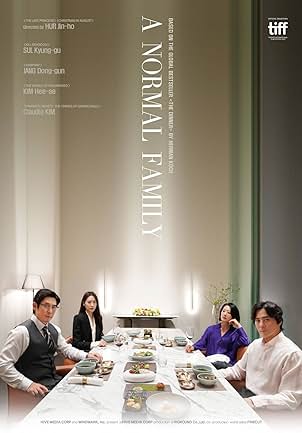

“A Normal Family” (2023), originally titled Botong-ui Gajok, is the fourth film adaptation of Dutch Herman Koch’s novel “Het Diner,” which translates to “The Dinner.” It was adapted in the Netherlands, Italy, US and now South Korea, and it still feels fresh. A road rage incident in Ilsan, Gyeonggi changes the lives of everyone in an ideal family and challenges their sense of self and morality. Jae-wan (Kyung-gu Sul), a criminal defense attorney hired to defend Hyung-cheol (Sub-bin Yoo), Osun Group’s third son, realizes that his younger brother, Jae-gyu (Dong-gun Jang), is the doctor treating the survivor and working with the victims’ family. The Yang family are unaware that their children are watching the dashcam footage leaked online and taking the wrong lessons from this tragedy. Will this family be able to look away from this car crash and get back on track together?
Jae-wan seems easy to peg, especially as he plays macho man in his leisure hours hunting wild boar instead of being with his family. He is the classic image of a man in a midlife crisis with his young second wife, Ji-su (Claudia Kim), who understands the assignment: look gorgeous and stay fit. He has a daughter, Hye-yoon (Ye-ju Hong) from his first marriage and a baby, Sa-rang, from his second. He is a showoff and plays the big man at the family dinners, but in quieter moments such as the privacy of his office, he reveals his reservations about the implications of his job and considers refusing the latest assignment. The chaos of the opening scene, which shows the road rage incident, contrasts with his quiet, calm, soothing, spacious home, which reflects his cool and deliberate demeanor. He mistakenly believes that he has kept his family separate and above the cesspool of the streets, but he hands money to his daughter instead of truly parenting her. In crisis, he and his wife reveal that they are not just a base match, but have a real, united relationship that could survive this crisis.
Jae-gyu presents as the goody-two shoes. He has a real, daily relationship with his wife Yeon-kyung (Hee-ae Kim) and only child and son, Si-ho (Jung-Chul Kim). As a professional, he cares more about his patients than their wallets and teaches his residents to do the same. Yeon-kyung has a wall devoted to her charitable work at Heritage Club: a light hangs over framed photographs showcasing her good deeds. They care for the matriarch in their apartment, which is humble compared to Jae-wan. Their resentment bubbles over as they gossip about their family and eventually emerges as open contempt of Ji-su. They are envious snobs who think that they are better than everybody. Yeon-kyung wants more rewards for their good deeds, which Jae-gyu resists and prefers to reflexively do the right thing, but when no one is looking, he too can be careless, hit a deer and drag it to the side of the road.
In South Korea, usually, the eldest son takes care of the parents, and Jae-wan shoving that responsibility on to his younger brother then a facility reveals that he does not have a conventional morality. His instinctual nature is to choose himself first. During that first dinner, he lobs that bomb into the room. Regardless their mother prefers the older son and warns about her younger son, “He may look gentle, but he’s cruel. Be careful.” Is it just the ravings of an elderly person whose medical condition makes them disproportionately hostile and nasty to her caretakers or an insight that most people miss? As “A Normal Family” unfolds, the outcome becomes slightly predictable but will keep moviegoers shocked and at the edge of their seat. It is a bleak unrelenting movie that does not forget to keep its moral tale entertaining.
The brothers are more alike than they think and not as depraved or good as they present. Hye-yoon has everyone pegged as a keen observer of family dynamics on both sides and plays them off each other, getting money from everyone. She presents as a studious good girl, but she is just as callous and depraved as Si-ho. Hyung-cheol seems like their future—rich kids who think that they can do anything without repercussions. Si-ho has the excuse of being bullied, but it is a flimsy one. The ensemble cast deliver pitch perfect performances, but Jung-Chul Kim may stand out as a future character actor to be reckoned with in the vein of Paul Dano and early Barry Keoghan because of his ability to appear chilling in his first appearance with his dead eyes and blank stare.
Out of the three adaptations preceding “A Normal Family,” I’ve only seen “The Dinner” (2017), and this one gave the stepmom, Ji-su, a lot more to do, and she becomes the true moral center of the story. Claudia Kim does a great job conveying that she is worried about her child and Hye-yoon instead of just a slavish primal instinct to protect her kid because if she did, she would have left once she understood that she did not want her child in this environment. She creates visceral stakes that even if there is a way to have a happy ending, the family’s soul is in danger. She is the only one trying to keep Sa-rang from repeating the sins of the preceding two generations once she realizes the real-world impact of her affluent life.
Director Jin-ho Hur is deft at heightening and releasing tension throughout “A Normal Family.” He nails depicting the furtive violence of polite society, especially at these family meals in private rooms at haute-cuisine restaurants. He keeps switching things up to shift viewers’ empathy so no one is right or wrong. There are no easy answers. One of my favorite unofficial genres is nightmare dinner parties, and this movie makes the list. Not one repast whether with family or friends is uneventful or just a casual way to catch up. Someone should have stopped that tradition ages ago.
Another favorite unofficial genre is parents wondering if their child is a monster and what that says about them. “A Normal Family” joins the ranks of such greats as “Carnage” (2011), which is a Roman Polanski film and the most optimistic in the bunch, “We Need to Talk About Kevin” (2011) and “Eric LaRue” (2025). Having a doctor and lawyer in the family sounds as if they had the ideal upbringing, but it feels as if something went wrong even before they existed. It is virtually Biblical to have brothers at war with each other, and there is a spiritual theme.
The characters are emotionally constipated. Jae-gyu and his medical entourage are taken aback when a recent widow and mother at the bedside of her ailing daughter exhibits normal emotions when she cries. She is advised to go to the chapel. Later Jae-gyu goes to the chapel to cry then in a moment that is kind of humorous, he crawls out so no one can see him have a good private cry. His son makes a cross of fries. The brothers’ father is never discussed. He could be long dead, but he is absent, not even in photos. They are now failed fathers. Yeon-kyung sees church as insurance to guarantee that their children are well. Family and spiritual relationships are transactional and do not exist for their own enjoyment.
“A Normal Family” is a rousing drama which treats one family as an incisive indictment on a callous and jaundiced society that lacks empathy. It is almost perfect except for any CGI involving animals. If you do not like subtitles but may be willing to give a foreign movie a chance, start with this one, and you will not be disappointed. South Korean filmmakers are the best, and this movie proves that rule.