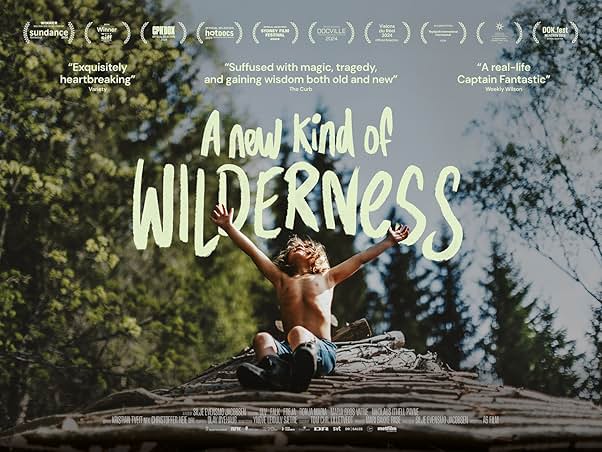

“A New Kind of Wilderness” (2024) comes in two different formats: one hour that will appear on PBS’ POV, which airs independent nonfiction films, and the eighty-four-minute version shopped around different film festivals. I saw the prior. Norwegian Maria Gros Vatne and ex-pat Brit Nikolaus “Nik” Ithell Payne decided to move to a farm in the forest and have three children. Maria’s first child, Ronja, whom she had prior to meeting Nik, comes along for the ride. When Maria dies, the title refers to having to return to civilization and leave the only home that that their children knew at an already difficult transition in their lives. It also involves the children going to school with other children for the first time. Are they abandoning Maria’s dream for her family or are they finding a way to keep it alive and survive?
It is rare to find love, a soulmate or a person who shares the same dreams, but tree huggers Maria and Nik found each other with the goal of living in harmony with nature and having the least amount of negative environmental impact on the world. In one scene, their little boy wants to pull the bark off a tree, but course corrects because he wants to preserve the insects’ home, and the insects are woodpecker’s food. They have more of a conservationist spirit and understanding of the food chain than the average person.
Because Maria was a photographer and a blogger, there is footage of everyone during happier times, which includes voiceovers of Maria’s perspective of her life. In a sense, Maria is still collaborating and making films beyond the grave. Through the magic of film, Maria is still alive. The audience can get to know her without it being filtered through another person’s perspective. It also means that witnessing her physical deterioration puts the viewer in the family’s shoes of feeling the loss, which is universally relatable. The greatest works of art often start when a child losing their mother. Maria was the breadwinner while Nik managed the farm and homeschooled the kids, which means the farm must be sold. The overarching structure of “A New Kind of Wilderness” is linear, but it occasionally jumps back in time with a photo montage or older footage to contrast how life was before or the family’s view of their circumstances and how they adjust.
Ronja Maria, Maria’s first child, is going through layers of changes besides the loss of her mother. She lives with her biological father and is separated from her siblings except for visits. Plus, she is back to typical teen life and yearns to return to a quieter way of life. Quick, someone show “Folktales” (2025) to her and tell her about folk high schools. Through glimpses of Ronja’s new life, “A New Kind of Wilderness” frames her as alone in her grief and being shoved back into a way of life currently incompatible with her emotions even if it is appropriate for people in her age group. It is also time for her to move on to the next stage of her life.
Nik has the burden of remaining faithful to that vision and do what is best for the family. Maria’s voiceover indicates that she chose Nik because she was confident that he had the courage to stick to it. The suspense is how and where he will do it. It is an observational documentary, which means there is no narrator, and footage is offered with no explanation apart from what the participants offer. Nik offers his insights into his predicament. He does not have a home in Norway or other adults to socialize with, but he has a gentle approach and checks in with his children about what they want. He describes school as a “prison,” but school in Norway is much more intimate with better teacher-student ratios than here. On the other hand, despite the arboreal surroundings, it still feels separate from nature with education dependent on apps and screens, including encouraging the children to watch television. It is not long before he regulates their screen time for family time.
When the family visits the United Kingdom for the holidays, Nik’s father articulates all of Nik’s internalized reservations about continuing according to plan. Unlike Reddit AITA posts, when his father talks about the possibility of future romance, it implicitly makes Nik more resolute to make it work. “A New Kind of Wilderness” features lots of intimate scenes showing Nik discussing the family’s future with Freja, the oldest of his three children. Of all the children, she is having the hardest time adjusting as shown in these one on ones with her dad or standing alone leaning on a tree while children play around her. She just looks at the camera, the only familiar aspect in her new environment. Freja has permanently internalized her parents’ lessons and acts as a living accountability partner. The relationship between the two is sweet, soft-spoken and emotionally intelligent, but as she adjusts, she casually modifies her desires in a car ride with the family.
“A New Kind of Wilderness” depicts a healthy, balanced family that adheres to their principles in spirit without being so rigid that they refuse to change in ways that would benefit them. It also shows the value of children participating in decision making for their future. The other two children, Falk and Ulv, are young yet they never do the ear-piercing kid screech or throw tantrums…on screen. Every shot is peaceful and calm whether outdoor in nature, during long car rides or inside their home. Even when the children disagree or disobey, the volume is suitable for spa levels. The father leads by example in providing a soothing environment that encourages frank discussions about difficult emotions. No stiff upper lip here. There are sequences showing how they integrate and acknowledge Maria’s death through new rituals.
Even if you are a city person and the idea of watching a movie with subtitles sounds like a chore, it may still be a good idea to watch “A New Kind of Wilderness.” The title comes from one of Maria’s blogposts about having to confront her mortality and also encapsulates her surviving loved ones having to enter an unknown, unwanted future without her. As thoughtful and functional, not reckless, adventurers, the wilderness is not a threat or inherently bad, but a place that could also become idyllic and comfortable. The movie’s lesson is that while loss is immeasurable, and there is no room for toxic positivity, it is still possible to create a beautiful life and find new, alternate countercultural ways to live outside the mainstream when embracing grief and loss.
Director Silje Evensmo Jacobsen’s second feature length documentary succeeds because she becomes a part of their life. Though likely intrusive because how could they forget that a camera is constantly pointed at them, possibly Jacobsen was a subconscious maternal figure as another woman with a camera watching over them during this transition. She finds a way to fit in and harmonize with environment instead of looking at them as a curiosity or with a jaundiced eye. Movies are empathy machines, and by conveying the family as an ideal rather than an oddity, Jacobsen has excelled at her craft.