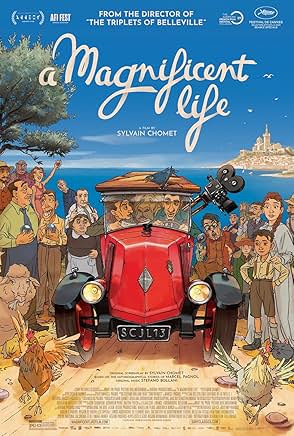

The English dubbed version of “A Magnificent Life” (2025), the original title in French translates to “Marcel et Monsieur Pagnol,” is an abomination and demonic (in the Prince defined sense) because it talks about “the true accent of Marseilles” thus robbing every scene of its originally intended meaning. It is an animated autobiography of Marcel Paul Pagnol, who would have hated this film, as a playwright, filmmaker and writer who devoted his life to not only preserving French culture, but centering the Marseilles culture, which is implied to be working class and usually marginalized. Even without the dubbing, the story’s pacing is clumsy and baffling though the underlying sentiment and visual crafting of the film may make people forgive the ham-fisted way that it recounts his life. If you care about integrity in art, do not see this film if it is dubbed and insist that a French language version be substituted. Disgusting!
I often get on my soapbox to discuss how films have historically used British accents to depict anything foreign whether Roman soldiers and the local Israelites that they persecute in Bible movies, Germans in World War II movies, etc., but generally my complaint never rises to the level of eliminating the movie altogether. Also, I urge people to watch movies in their original language, but I also do not shame people who take another path. Yes, no one wants to read while watching a movie, but the actor’s emotion gets conveyed in the original language whereas in voice over, not so much. There will always be a disconnect between the physical and vocal performance and the original intention of the writer.
In “A Magnificent Life,” to understand Pagnol, within the text of the film, Pagnol asserts that he is inseparable from Marseilles. I know nothing about Marseilles or Pagnol, but based on what the movie shows, this movie fails to uphold the legacy of the man that it praises and sells out to make it more palatable for English speaking audiences. The film adapts his memoirs. I cannot believe that his estate permitted it. His grandson, Nicolas Pagnol, Asharfin Poiré and Valérie Puech had the original idea behind this movie but hopefully gave it and did not know how it would be warped. Everyone has bills, but if they knew and did it, then hopefully they are outliers otherwise French culture is in crisis. Most of the voice actors have British or Scottish accents. Normally the French and English cast information is available, and I reference the actors using that information. If it is not available, and I have a screener, I rewind and pause the recording as often as it takes to get the information. Sometimes when a screener is paused, an image comes up with the title that blocks the screen. In this case, the latter happened, but when I looked at the credits, all the actors seemed French. In the press packet, actors are listed but not next to their characters. If I do not give appropriate credit, it is not from lack of trying.
“A Magnificent Life” starts just before Pagnol decides to write his memoir and is contemplating retiring because he feels out of step with the world and as if his finger is no longer on society’s pulse. When he finally writes, his twelve-year old self appears to help him remember the past starting in 1905 then stopping in the Fifties before fast-forwarding to his funeral. It travels at a breakneck speed with no rhythm in the way that it introduces characters. The average movie goer will find it challenging to recall when a character reappears elsewhere without the benefit of a rewind button, a pen and a notebook. Perhaps the movie was made for an audience who already knows Pagnol thus writer and director Sylvain Chomet only felt that he had to make the Cliff Notes version of Pagnol’s life, but the goal was to reintroduce him to contemporary audiences, so he mostly failed because he did not keep the spirit of Pagnol alive.
For instance, Pagnol’s daughter, Estelle, gets roughly the same amount of time as a sheep named Bullock. While I believe that it is specist to prioritize people over animals in the story, considering their (hopefully) different relationships to the protagonist, it is a baffling creative choice. A conflict with his father threads throughout the narrative, but when he is no longer estranged, the turning point is elusive. It is as if a hatchet man did the editing either during writing or shooting. Chomet seemed to take the approach of dipping in and out of scenes as if the animation captured snippets of Pagnol’s life and was not trying to create a cohesive, comprehensive whole.
Visually, Chomet gets a lot right. The interactions between spectre of past selves and dearly departed brings a magical realism to normal proceedings. Eagle-eyed movie goers should pay attention to how the child Marcel intervenes, so adult Marcel finds his creative path to become the “immortal.” One sequence explains how the players at Paramount are classified and the work that they do. The World War II sequences make the spectre of his youth into a spirit that not only advances Pagnol’s career like a guardian angel but additionally protects France’s culture from German aggression. The movie projects the time, place and play being worked on so while you may not know who any of the supporting characters are, you will know the stage of Pagnol’s career. The post-World War II sequence is striking as Chomet creates a tableau of the grotesque Americanization of the French so sensitive souls should skip it. Actual clips from live action movies, many from Pagnol’s, are inserted seamlessly into the animation and was quite amazing. One sequence was staged as if it was a silent film and emphasized the transition to talkies.
But that brings us back to Chomet’s unforgiveable sins. These classic, renown French films no longer have the original sound, which was French dialogue likely in the Marseilles accent, and are dubbed in English. While there may be room for debate over the absurdity of characters discussing the Marseilles accent while sounding as if they live in Liverpool, “French literature bloody leaves me in peace,” dubbing over a classic French film in English will make audiences unfamiliar with these films confused and walking away with the wrong impression. It misrepresents the entire point of French cinema. Apparently it does not go without saying, but French cinema should feature the French language unless there is a specific, organic reason that the characters would not speak French in the story. It is always inappropriate to take an existing French film and dub over it if the filmmaker explicitly said that they wanted it to be French.
“A Magnificent Life” is a magnificent mess. If I never knew that a dubbed version existed and only saw the original, I would probably still have issues with the film but give it a favorable rating. Unfortunately, the dubbed version is the one that they chose to distribute. It is Esau selling his birthright for a meal all over again, and the idea that an American can see this obvious desecration, but not the people in charge of preserving Pagnol’s production company, Les Films Marcel Pagnol, is horrifying to me. I am disappointed and disgusted. Please do better next time, close your studio or rename it. How in the world is this movie the worst of the week!?! If Pagnol was alive, he would die again after watching this movie.