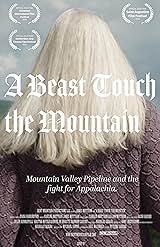

“A Beast Touch the Mountain: Mountain Valley Pipeline & The Fight for Appalachia” (2025) is a documentary title that references Hebrews 12:20 and alludes to Mount Sinai, which is commonly known as the Mountain of God because Moses met God there to liberate Hebrews from slavery and received the Ten Commandments. Touching the mountain, which was considered holy ground without permission, could lead to execution, but the passage is in the New Testament, which parallels Mount Sinai with Mount Zion, which is also holy ground but without the sword of Damocles hanging over people’s heads because of a new covenant. Mount Zion symbolizes a heavenly image. In the context of Bent Mountain, Virginia, the beast is the Mountain Valley Pipeline (“MVP”) endangering the people and natural environment. MVP is framed as unleashing pollution in the area and potentially a crack in the pipeline could lead to incinerating the surrounding area much like the image of the fiery Mount Sinai. Prior to MVP, the residents called it Paradise. Documentarian James Mottern looks back at the locals’ plight starting with deciding to live there through their protest and their loss. It is a film that does not pull punches on how the locals lost the battle. While no interviewee references God or theology, there is a sense that MVP only won a Pyrrhic victory because of the nature of the region and the people’s resilience.
“A Beast Touch the Mountain” mostly features interviews taken after everyone knows that they have no civil, legal recourse. When they are introduced, context is not offered until later in the film, which means that the audience gets to know them as locals, experts and talking heads. It is a great move because then more viewers will find them relatable. It is only later that some of the academics and residents are revealed to also be activists, and some claim that the government classified them as domestic terrorists. Most of these people are older women with an occasional farmer or veteran. Mother and daughter, Theresa and Minor Terry, are famous for sitting in their trees to protect their property and are galled when a trip gets chopped down, and Theresa has no idea where it was taken. An Appalachian Studies Scholar Emily Satterwhite chains herself to equipment. Jammie Hale gave up farming to protest full time.
Other residents provide moral support to their neighbors like Robin Austin, Roberta Bondurant, Jenny Chapman, Tammy Belinsky, Mary Beth Coffey and Kathy Chandler. Some are listed as activists or community advocates without detailing their actions. Aimee Hamm tells the story of her father, Fred Vest, a Vietnam vet, who moved to the region as an antidote to PTSD. It is heavily implied that MVP allegedly tried to exploit and aggravate Vest’s condition by using dynamite when they knew he was there. Other talking heads explain why the region is a spectacularly poor choice to place a pipeline and the legal backstory to their fight. Jacob Hileman, an environmental hydrologist and scholar, describes the region as prone to landslides and noted that the pipes are already weathered from a decade of sitting outside exposed to the elements. Weathered means prone to fissures and holes.
Jon Sokolow, an attorney, writer and activist, described the pipeline as a bomb and links this majority White protest with the communities of color, especially the indigenous, who are not featured except through news clips. He also segues to resident’s testimony about the intersectionality of younger activists, including from the LGBTQ community, who assist with the protests. Only a montage of photographs and an interviewee’s testimonial substantiate this involvement, but it is convincing considering the demeanor and demographics of the interviewees. They are not virtue signaling because in their community, it would be counterintuitive to flaunt the diversity of outsiders coming in. Historically the expectation would be that people would usually deride the younger participants as “outside agitators.”
Chief Counsel of Niskanen Center Megan Gibson provides the big picture understanding of what these people are experiencing on the ground. Gibson explains the logistics of eminent domain, which is the government taking of private property for public use, and how it has been perverted to government taking of individual’s private property then redistribute it for corporate private use through a federal agency, Federal Energy Regulatory Commission (FERC). It would have been dry, but helpful to receive more context about FERC’s origins, the original intent behind its creation, how it became corrupted if Gibson’s account is correct then how to stop FERC from perverting the original intent of eminent domain. According to Gibson, once FERC gives a certificate of public convenience to MVP, they have the power of their private security and federal, state, county and municipal law enforcement to levy against locals, which include property owners. Law enforcement primarily exists to protect property owners, but it becomes apparent that this protection is proportionate to the property value.
“A Beast Touch the Mountain” touches on how this issue has broader societal implications for climate change, campaign financing, the proliferation of carcinogens, pollution of finite natural resources, and deliberate targeting of vulnerable communities such as veterans, elderly, women, people of color and uneducated. Mottern is more taken with the idea of women being at the forefront of the protest since the interviewees are mostly women and reference the incursion as gendered, sexual violence. If it sounds dull, watching the film is incredibly peaceful, verdant and bucolic. Most of the interviews occur outside, and Mottern devotes a lot of screen time to capturing the beauty of the region and the existing, growing wounds on the land. So even though it is shot after they lost, nature is still holding the line…for now. At least this film will be a memorial if it does not.
“A Beast Touch the Mountain” also features cell phone footage of construction work, montages of newspaper and magazine headlines, tons of archival news clips and photographs. The most harrowing news montage is of pipeline bursts in different regions such as Lincoln County, Kentucky; Loving, New Mexico; Piedmont, Oklahoma, Audrain County, Missouri and an area in Texas. Mottern only shoots the aftermath of the Lincoln County, Kentucky, but it is devastating. There is speculation over the effect of an explosion in their region and who would get hurt. Mottern makes it seem like a real possibility, especially in the way that he pairs the rocky terrain with the commentary that it will be impossible to properly cover the pipes with dirt. Theresa Terry says, “I don’t want to see this mountain burn.”
If “A Beast Touch the Mountain” has a villain, it is Senator Joe Manchin, who appears to give an exclusive interview to Mottern. A brief clip of Manchin at the Harvard Kennedy School displaying a taste of the on the ground aggression that residents feel at home. It is unclear if Mottern asked anyone from MVP if they would have a representative interview, but they do not have to considering that they won. While the private interests are listed, and their main representatives are briefly referenced, it is barely memorable. The outrage is reserved for the people who are supposed to be public servants. Gibson describes it as “captured governments, captured economy, captured regulatory schemes.” The oligarchy is entrenched and here.
No one mentions the lore about the Appalachian folklore other than the strength of the people and nature. Mottern opens the film focusing on the untouched beauty before pulling back to show the blue rocks and brown, muddy, exposed earth for the pipe to thread through. At the end, he reverses the shot as an implicit visual manifestation of reversing the damage through the power of film. It is a symmetry modeling the Biblical text and almost a prayer for restoration. As it is on film, so shall it be on earth if an aspirational, informative and educational documentary that prioritizes the human interest angle has its way.