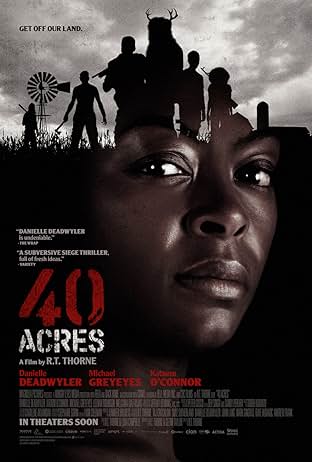

If “Civil War” (2024), “Arcadian” (2024), and “Never Let Go” (2024) left you feeling ripped off or dissatisfied, then “40 Acres” (2024) is the dystopian movie of your dreams with a special appeal to indigenous and Black audiences. Since 1852, the Freemans have lived on a Canadian farm, but can the latest generation keep it amid a fungal pandemic that caused a second civil war with people killing for functional farmland. US Army veteran Hailey Freeman (Danielle Deadwyler) trains her family like soldiers to face this world with a new terrifying threat decimating neighboring farmers. Even if they survive, will they live?
Deadwyler is one of the best living actors, but you probably do not know her unless you recognize her from “Till” (2022), “I Saw the TV Glow” (2024), “The Piano Lesson” (2024) and “The Woman in the Yard” (2025) She probably will not get any Academy Award nominations for “40 Acres,” but as the commanding, strict disciplinarian who almost holds a mythic, distant and indomitable presence for her eldest, Emanuel (Kataem O’Connor), nicknamed Manny. Cowriter and director and cowriter R.T. Thorne in his feature directorial debut introduces her through the eyes of the trespassers trying to take her land. She is a phantom army of one, but as the movie unfolds, it becomes obvious that the mother of three is simply in mama bear mode, but her focus makes it impossible for her children to have anything resembling a normal life. It is impossible to blame her. You can’t socialize when every stranger that crosses their path tries to kill them.
Cue the weakest link, Manny, who is unfailingly obedient, but a teenage boy who wants to expand his horizons, which is natural. It is kind of eerie that these kids are trained to efficiently kill any intruders but cannot cuss. “40 Acres” challenge is to frame Emanuel’s rebellion as beneficial and not a danger to the family, which is where cowriters Thorne and Glenn Taylor along with fellow story conceiver Lora Campbell work overtime to hyper structure the narrative with details about supporting characters and scenarios to make it seem as if he is wise, not letting his second head determine the fate of the family. One of those details are a CB radio of farmers asking Hailey for help then going silent as she ignores their pleas. O’Connor sells it by generally seeming innocent and dependable instead of leering and gross like a lot of adolescent boys can be. The isolationist policy has the effect of leaving the good people to die and have the bad guys outnumber them.
The Freeman family also consists of (step) dad, nicknamed Sarge, Galen (Michael Greyeyes), who speaks Cree and has a bio daughter, Raine (Leenah Robinson), who is more openly, but benignly rebellious. Greyeyes is hotter in this one than the recent “Firestarter” (2022) and on the same level of hotness as he was in “Woman Walks Ahead” (2018). In a meritocracy, this man would be famous with people swooning over him. His character is not shabby too—another example of positive masculinity: unafraid to defer to his mate, a loving father and a complete badass who is the most riveting aspect in the denouement. The other two sisters, Denis (Jaeda LeBlanc) and Cookie (Haile Amare), are not given a lot to do though they have moments to shine. There is a war after all.
“40 Acres” stands out because even though the family disagrees and occasionally almost get everyone killed, they still love each other. The film uses a dystopian landscape to examine classic intergenerational conflicts about how parents raise their children and how they treat their children when they choose a different path. It does not quite stick the landing because it is impossible to ignore all the havoc wreaked because of Manny’s choices. The real lesson is that if you do not communicate and find common ground to coexist, the consequences will be just as bad, if not worse, than you imagine, so do not encourage rebellion by making it impossible for your kids to disagree with you.
“40 Acres” also found a way to drop a lot of books casually in the dialogue during the first act: Octavia Butler’s “Parable of the Sower,” “The Proletarian’s Pocketbook” (2021), “The Autobiography of Malcolm X,” and “Black against Empire: The History and Politics of the Black Panther Party” (2016). The filmmakers basically said that if you will digitally burn books and outlaw free speech, we will take it to the big screen. It is also a nice way to give credit for some of the film’s themes and situations, which will hopefully arrest any complaints about it being derivative, which it can be, especially the threat, which I will not spoil. Only one point of assurance: no sexual violence though one character does say something that will inspire disgust and is a microaggression. Embedding an American history lesson in the family lore is a bit heavy handed but is necessary to explain the stakes. Losing their lives is a big threat, but Black property owners lose their land all the time even in ordinary times, so it is not just about the people on screen, but an over a century old legacy. Think an unofficial sequel to “Silver Dollar Road” (2023). “40 Acres” is probably unaware, but the threat also has roots in history if you read Nathaniel Philbrick’s “In the Heart of the Sea” though it was also a systemic practice during antebellum slavery. The horror works as a metaphor but is also sadly literal.
The deliberate pacing of “40 Acres” could have been curtailed but be patient because once the physical conflict begins in earnest, the film does not let up on torturing the Freeman family. The flashback scenes provided essential context to show germane details about the history of the farm, the Freeman family relationship to their neighbors and each other. It is not simply an isolationist policy against strangers, but people they know and like, including Augusta Taylor (Elizabeth Saunders), a famer and fellow vet, former Marine. The dialogue alludes to neither woman having faith that their government will help, and it is possible that there was more subtext to their exchanges, especially in the flashback, that I missed about past mistakes getting repeated in the future regarding their service. When the attacks start happening, it is extra rude because these vets must fight at home and endure indignities.
The only thing subversive about “40 Acres” is a family that loves each other despite their differences in their posture to the outside world. It is just a nice touch that they are an interracial and intercultural family set in Canada though to many, those demographics are radical. It is a deeply conventional film about living in a dystopia that will feel familiar but satisfying in the way that it is executed. It feels very realistic except for surviving so much violence.