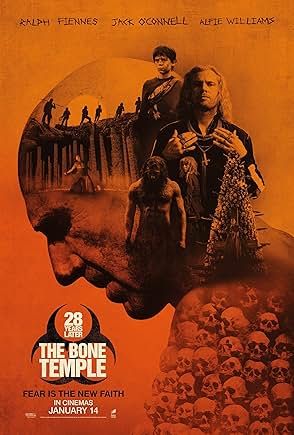

“28 Years Later: The Bone Temple” (2025) is the fourth of potentially five movies in the “28 Days Later” franchise and the second in a proposed trilogy if it does well in the box office. Set soon after the closing of “28 Years Later” (2025), it shows what Spike (Alfie Wiliams) and Dr. Ian Kelson (Ralph Fiennes) have been doing with the latter taking center stage. Kelson establishes a new routine besides working on his memento mori, and Spike is regretting to know Sir Lord Jimmy Crystal (Jack O’Connell) and the Jimmys, an Old Nick, aka Satanist cult. In a struggle for each person’s mind, heart and soul, who will win? Writer Alex Garland returns and director Nia DaCosta keeps Danny Boyle’s chair warm in the latest “28” sequel. DaCosta appears to be on a roll. It is also the first of two movies starring Fiennes thus inaugurating Happy Ralph Fiennes Week to those who celebrate. You need to see “28 Days Later” (2002) and “28 Years Later” to fully appreciate the film. There will be spoilers for those two movies.
Garland and Boyle use this universe as a backdrop for the human condition without cheaping out on the horror, and DaCosta definitely got the memo. Looking at you, “We Bury the Dead” (2025). There is an ideological war going on, but it stems from people’s mindset that they use to interpret the world around them at the time of the outbreak. During the introduction of the prior movie, when Sir Lord Jimmy Crystal was eight years old, and the rage virus spread, he explained the world through the language that his father bestowed upon him, which results in a twisted way of navigating the world. In a riveting scene with Kelson, it is obvious that his beliefs stem from some combination of childhood trauma and psychosis. In another world, his symptoms would be managed, and the damage that he could inflict would be minimal. “28 Years Later: The Bone Temple” finally reveals who is behind the graffiti and carnage from the prior film and what their rituals are. It is incredibly twisted and messed up. Even with DaCosta keeping as much blurred as necessary, it is still a demented ride. O’Connell is a great actor, and it was long overdue for his work to be recognized. Apparently, he needed to play over-the-top villains to get critical acclaim.
The most puzzling question is how he got seven people to sign up for his murder and mayhem cult. Most of his seven-member crew is not individuated because of their wigs and tracksuits, but the ladies make the biggest impression. Jimmima (Emma Laird) wears feather wings, does a Teletubby dance and seems to enjoy her job. Jimmy Ink (Erin Kellyman in a much better role than the truly horrifying “Eleanor the Great”) is a true believer born out of desperation and reason. Initially she seems kind, but it is scarier to think that she has a moral compass and is completely on board with Jimmy’s beliefs. (Disclaimer and apologies to twenty-first century Satanists who have a completely different and wholesome ideology than their predecessors or onscreen fictional counterparts.) The others are mostly interchangeable sadists who get joy from suffering. Spike wants to survive but is unable to buy into the Jimmys’ ideology even with his life on the line. He gets repeatedly tested, and while he does not fail, he also does not pass and receives a harsh judgment. Is redemption possible?
The previews and poster for the prior movie set up Kelson as a potentially terrifying figure, but the execution was much more poignant and tender. Fiennes is in his letting it all hang loose era literally and figuratively. There is a lot of full-frontal nudity from Fiennes and Chi Lewis-Parry, the Alpha, now known as Samson. Fiennes is rather famous for his mournful roles, but this stage of his career has been relatively lighter. If DaCosta is brilliant, it is for knowing how to remain faithful to the story and let Fiennes swan around as much as he wants. He transforms some truly astonishing and dangerous scenes into pure comedy, specifically buddy comedy. Fiennes also gets the best needle drops of 2026. Yes, it is only January, but “28 Years Later: The Bone Temple” wins the year. It already feels impossible to top what DaCosta and Fiennes accomplish.
“28 Years Later: The Bone Temple” signifies Kelson’s importance in the world, the one true church in this universe. There are scenes with Kelson at an altar, but instead of wafers, he has medicine. Sir Jimmy Crystal dismisses a belief in science as atheist much like the Romans once dismissed Christians as atheists before throwing them in the ring with gladiators or predators. Kelson is a humanist with a mindset rooted in medicine and compassion for the human condition, but the pomp and circumstance set him up like a Jesus figure interested in healing, willing to risk or sacrifice his life to do so though with great reluctance and motivated to erase fear of death. It is a beautiful continuation of his story with zero missteps. He offers a communion and mercy that perfectly sets up the final chapter of this trilogy. If the first in the trilogy showed a society built on lies, the second offers a crossroads between cruelty and kindness. Spike’s choice will hopefully determine which one will be the bedrock of last in the trilogy.
Samson will also likely play a pivotal role. Lewis-Parry appeared briefly in “The Running Man” (2025) and was terrifying in the prior movie, which does not stop here. DaCosta and editor Jake Roberts finally show moviegoers what the infected see, and it feels well-earned and rewarding because the writing does not get reduced to logistics of solving a disaster but still prioritizes the human experience. It is one of the most compassionate depictions in horror and offers valuable lessons in how to depict mental health without stigma and humanizing a person. Lewis-Parry finally gets to do some nuanced work. The horror is always at the forefront and is respected while never losing sight of his internal journey. Also “28 Years Later: The Bone Temple” makes him an unexpected foil to Sir Lord Jimmy Crystal.
This trilogy proves that you can make a cinematic movie that also feels as if it could be an episode in a television series without torturing audiences with growing run times (looking at you, James Cameron) and while delivering contemplative meditations on the nature of humanity, the stories that we tell ourselves to survive and the unlikely beauty of a world gone mad. Long time fans of the franchise will want to scream in the last scene. Boyle will direct the final movie in the trilogy, but if Garland can remain consistent in balancing horror with humanity, there will be far more movies in the future because the audience is begging for it. Crappy January movies may be a relic. Movie and horror fans are mostly eating well this month.