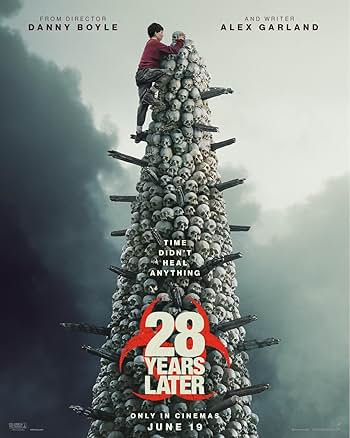

“28 Years Later” (2025) is the third of four, potentially five, movies in the “28 Days Later” franchise. The fourth, “28 Years Later: The Bone Temple” (2026), is already shot and will be released on January 26, 2026. Set 28 years after the Rage Virus outbreak in 2002, Jamie (Aaron Taylor-Johnson) and his twelve-year-old son, Spike (Alfie Williams), leave their isolated island for the mainland to instruct him how to kill the infected, but Spike learns an unexpected lesson that makes him eager to continue to explore the world despite it being fraught with danger because a more frightening development awaits him at home. Will Spike learn how to face this threat and become an adult? Director Danny Boyle and writer Alex Garland reprise their roles behind the camera from the original movie.
Fun fact: you do not have to see “28 Weeks Later” (2007), the sequel to “28 Days Later” (2002), to understand “28 Years Later” (2025), but you could understand this movie without watching the first movie too. “28 Years Later” is going to be a polarizing movie, but I’d like to make a case why it is a brilliant subversive sequel in a way that I could not with the “Joker” franchise. Unlike the disappointing “28 Weeks Later,” it is more concerned with character development and story than the innate sensational nature of a virus that turns people into homicidal maniacs oblivious to their need for self-preservation. Boyle and Garland used the franchise’s dystopian universe as a backdrop for a coming-of-age story in the same way that people combine fantasy with drama or magical realism to depict harsh truths about adulthood without descending into the pablum that these movies could fall into if the story is played straight. After much reflection it reminded me of “A Monster Calls” (2016) if it had combined a manhood ritual. Basically, the filmmakers got commercial level financing to tell a story that may not have garnered a lot of attention if it simply focused on a prepubescent boy in contemporary times, and they got to also show how men are created in different types of society in a post-apocalyptic world, and it is not a binary.
Williams is a perfect actor at such a young age that it is impossible to imagine what he will be like with more life experiences to add texture to his performances. Spike is eager to impress his Dad and community, but he is sensitive and recognizes the difference between the tall tales being told, the real life-and-death stakes that are being avoided and his no-fault shortcoming that make him unable to bridge the chasms without adult guidance. The journey does not innately transform him into a man capable of rising to the challenges that life may bring, but experiencing his mortality and caring more about others helps him to see the world clearly, which is the first step of maturity.
In many ways, Jamie is less mature than Spike. He only sees their outing as an adventure so when their trip starts to go sideways, it is obvious that the obstacles outmatch his skills. Jamie is a man who cares more about appearance, distraction and simple pleasures than a higher level of thinking. He accepts his society and station in the world without question and ultimately lacks the courage to face the world in a less superficial way. That society feels like a page out of folk horror with the potential to surpass it. Taylor-Johnson finally showed his acting chops in “28 Years Later” in a way that did not land as smoothly with “Nosferatu” (2024) despite his best efforts. There is a scene where father and son witness a herd of animals swell over the landscape, and while the image felt prehistoric and primal, it unfortunately also reminded me of “Kraven the Hunter” (2024), which is best forgotten. Jamie plays a smaller role than expected, but it is a pivotal one.
Editor Jon Harris deserves his weight in gold for the haunting hunting first act. He intercuts the scenes between father and son with different clips from movies set in different eras of men in formation engaging in warfare with the famous eerie Taylor Holmes reading of Rudyard Kipling’s 1903 poem “Boots,” which is supposed to give an idea of the monotony and horror of a British Army infantryman during the Second Boer War in South Africa, like a purgatory. With the world overrun with the Infected, it does pack a punch that the uninfected and infected’s relationships is an eternal war as dehumanizing and soul numbing as experienced if infected. Additionally when returning home, it is almost as if time slips and the present and future coexist thanks to Harris’ work, which is disorienting until the time line merges.
In contrast, once Spike embarks on the journey without his father, the tone of this journey, though fraught with peril, becomes filled with wonder about the mysteries of life from birth to death in a way that is less heavy-handed and obvious than “The Life of Chuck” (2025), which insists upon itself and constantly and overtly reminds its audience about what they are watching. Spike’s mother, Isla (Jodie Comer), plays an essential role in this act, especially since she sees Spike as the ghost of her dad taking her on a similar journey with a different purpose and relationship dynamic. Comer is like a chameleon. She is unrecognizable from role-to-role. Isla is an interesting character because of how similar she is to the infected in the way that her mind and body betray her and her ease with navigating unfamiliar territory, especially compared to her showboat husband.
Garland allows these events to serve a double purpose. It satisfies moviegoer curiosity about how the Infected are still roaming the countryside and how that logistically affects them, but it is also a way to teach Spike about the facts of life in a way that his insular community refuses to engage in without self-medicating or censorship. This part of the story felt like a bit of a stretch, and an excuse to make the infected into the equivalent of a caveman society side-by-side with a formerly modern one being thrown back into the Middle Ages without technology. It is like being in a H. G. Wells’ a time travel movie without the pesky time travel.
Garland seals the deal when a group of NATO soldiers accidentally arrives, and they are like the audience with the same tech and inability to tackle this circumstance with any level of sophistication and appreciation for the existential implication of their predicament. The technology should give an advantage, but it is negligible and finite thus leaving them with nothing but their wits like Spike. Swedish NATO soldier Erik (Edvin Ryding) is a great foil because he should be the most evolved, but tech does not equal sagacity. In contrast, Ralph Fiennes plays a mysterious role, and his character is as unexpected as the one that Jack O’Connell (Remmick in “Sinners”) embodies. O’Connell provides an amuse bouche for the next installment which appears to have “A Clockwork Orange” (1971) flavor.
That sequel is going to be strange, and the tone shift to a bonkers, very British way to handle a dystopia will pique curiosity among those ticketholders who do not mind the strange nature of this counterculture sequel. Boyle shot “28 Years Later” with an iPhone 15 Pro Max, and frankly, it is gorgeous, which adds to a larger margin of goodwill than most movies would get for taking such a bold, subversive step that will definitely piss off a lot of fans of the franchise. While it does not surpass the original, it is a case of apples and oranges in the way that the filmmakers decide to tackle their legacy without trying to make lightning strike twice. Not going to lie—I got a little misty eyed.
Easter Egg: in the first movie, at the end, cloth temporarily spells out hell. Here, it is a Shell gas station with the S dropped off. Chef’s kiss. Also, nice call back with a stampede of rats. Plus, an optimistic response to “Dawn of the Dead” (2004).