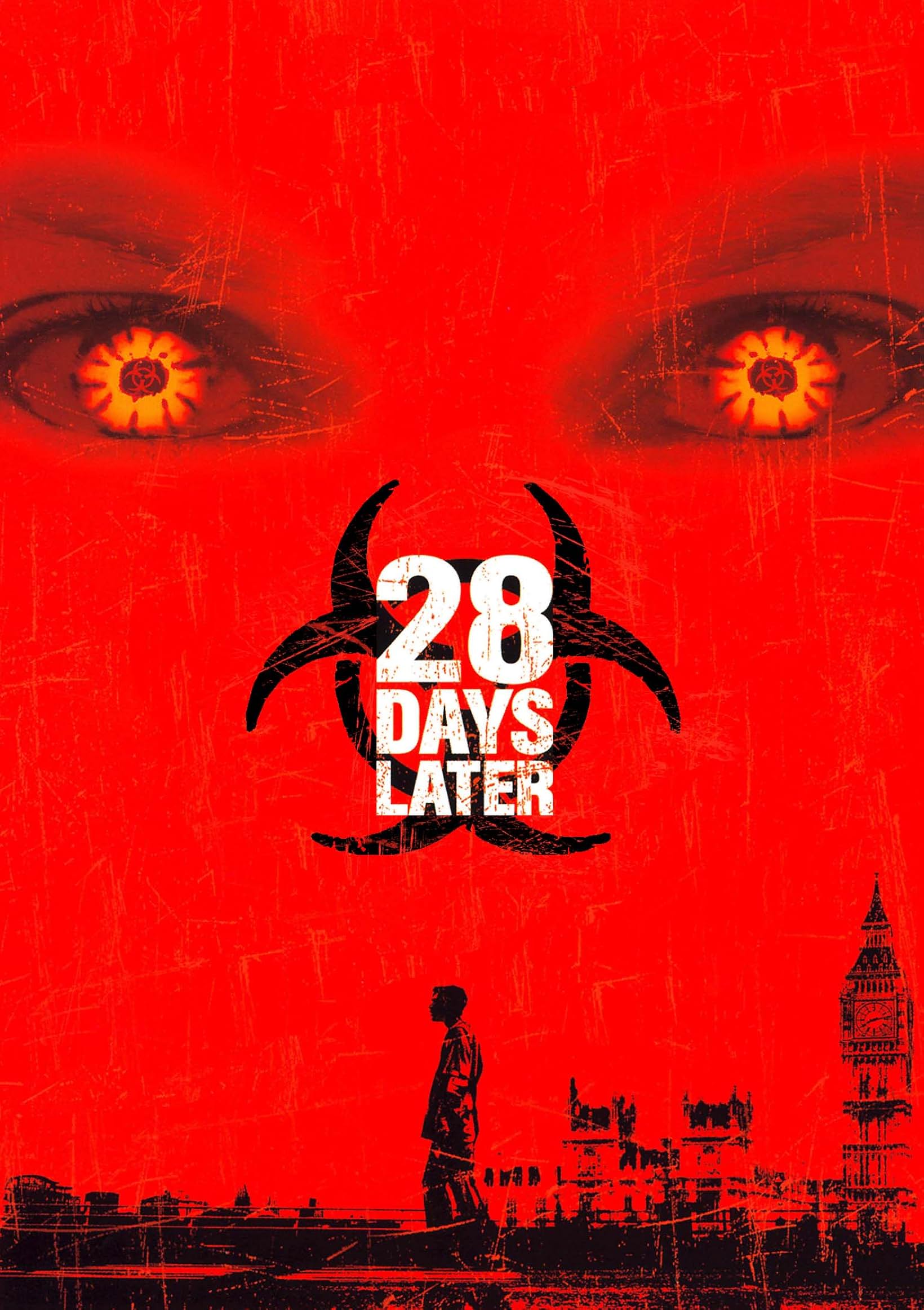

“28 Days Later” (2002) starts with Jim (Oscar award winning Cillian Murphy and one of Ireland’s greatest gifts to the world) waking up alone in a London hospital. Looking for human beings, he wanders for a long time before finally finding tons of bodies and one person stumbling around with red eyes making feral sounds. Transmitted through blood, the Rage Virus either killed or infected most people. Eventually a pair of survivors, Selena (Naomie Harris) and Mark (Noah Huntley) orient Jim on the rules of survival, which he occasionally disregards. Does Jim have what it takes to be one of the last men standing? Yes, yes, he does.
First things first. The infected are not zombies! They are alive, and the virus is a hemorrhagic fever like Ebola that carries the Rage Virus. There is not a lot of explanation about the virus, but the opening scene shows a chimpanzee staring in the simian version of “A Clockwork Orange” (1971) forced to watch people riot on the news. Somehow scientists were able to capture the biological essence of what makes human beings violent, extract, intensify and infect simians with the goal of finding the biological cure, i.e. world peace in a test tube. So technically every person is infected, but the Rage Virus just amplifies. When I watched “28 Days Later,” it had not occurred to me that chimpanzees regularly go to war and have a penchant for ripping human faces off, but thanks to “Nope” (2022), I realize that it was not exactly a heavy lift for the scientists.
If you watched the first episode of “The Walking Dead,” you will realize that the television series owes writer Alex Garland, who would later go on to have a notable directing career with “Ex Machina” (2014), “Annihilation” (2018), “Men” (2022)—which feels inspired by “28 Days Later,” “Civil War” (2024) and “Warfare” (2025), and director Danny Boyle (my personal favorite Boyle film is “Sunshine”) their entire bank accounts. Jim is a relatable everyman, a blank slate to relate to, the perfect audience surrogate to figure out what is going on with the world. It is also one of the few times that Murphy is not scorching hot for an entire movie. When he wakes up, he resembles a caveman wax figure from the American Museum of Natural History, and his famous dark locks have a reddish-brown tinge to them. He is often naked or shirtless, but not in a sexualized way, but a primal way that reflects the loss of society.
Selena is easily one of Harris’ top three movie roles ever because she does not get enough work that matches her talent. Hell, maybe top two because only “Moonlight” (2016) allowed her to stretch her acting muscles. Her role as Moneypenny in the Bond franchise could be done in her sleep, and while she is memorable in the “Pirates of the Caribbean” franchise, Tia Dalma is not the kind of role that lets an actor go on a nuanced emotional journey. Selina starts as a two-dimensional survivor on automatic, but as “28 Days Later” unfolds, she rediscovers her humanity and leans towards protecting the group over sheer living. She also faces the worst-case scenario any human being can face with incredible courage and ingenuity.
That change was not just because of Jim, but Frank (Brendan Gleeson), a gentle giant, and his child, Hannah (Megan Burns). Instead of being alone, they become a family with Frank as the father, imperfect but a protector. Occasionally Frank ignores advice and barrels forward because he oversees the resources and has a plan. Frank contains the seeds of their destruction because of his impulsive leadership. Earlier Selina correctly tells Jim that plans are not as important as living, but their desire to have someone in charge allows them to loosen up and is a major mistake. The Rage Virus has one common factor: it strikes whenever enthusiastic consent is absent among the group. Even one dissenting voice should be heard because it may have the answer. Hannah has a decisive voice in their decisions without reprisals, which denotes why this group was as good as it was going to get with one leader.
If you have never seen “28 Days Later,” the rest of this review could be a spoiler, but the plan is to go to soldiers broadcasting a signal to survivors. If you are a zombie expert, then one rule applies in this universe as well: human beings are always more dangerous than the infected. The soldiers are not obviously a bad choice, but there are signs in the way that they respond to the infected, especially one of their own, Mailer (Marvin Campbell), whom they leave chained in the backyard of a grand estate while living in the mansion. The weakest member of the troop, Private Jones (Leo Bill), has been femininized and become the butt of ridicule. They immediately ask Selina if she can cook and claim that they will protect her, so she no longer has to carry a machete, but they are leaving themselves out of the equation of whom she needs to protect herself from.
I was still young when I saw “28 Days Later” and immediately got horrified when Major Henry West (Christopher Eccleston) said women are the future, and he was not talking about to insure the future propagation of humans. Their plan was so grotesque that they classified Hannah as a woman. There was something worse than the Rage Virus, and it was shortsighted, rapey men who saw women as a product, not people, to be consumed without considering that raping the only two uninfected women would actually destroy the future. They were more interested in preserving a system than survival. Watching it now, I noticed Sergeant Farrell (Stuart McQuarrie), the only one who dissented from the group, was Scottish and an intellectual. He was gradually losing his mind witnessing how things were dissolving, but willing to risk his life for strangers. Watching West rebuke Farrell for being the best of his men and reinforcing/encouraging bad behavior was the real destruction of society.
Throughout “28 Days Later,” the silent question is whether Jim has what it takes to survive. The principle of good people guides him, but he has moral qualms about hurting people even after they become infected. When he brains a priest with a plastic bag filled with full soda cans, he repents. Mark, Selina and Frank take turns. His first kill is cowardly though an act of mercy. When he must make the hard choice because no one is around, the soldiers appear and save the day. Every time he tries to fight the soldiers, he loses. It becomes a test of manhood. Does he have what it takes to kill and be a protector?
I used to think that “28 Days Later” was a Rube Goldbergian apocalyptic setup to determine who is the best man with Murphy coming out on top as the new patriarch, but he is never the leader of the group. Now I wonder if it is a yearning for a primal sense of justice in pre-colonialization society. Murphy’s physicality during the denouement mimics the infected. The Rage Virus is not all bad, and the infected become unwitting allies. The infected do not rape and kill for resources and dominance. Sometimes when people riot, it is against injustice. Remember “Serenity” (2005)—maybe the cure is not to create world peace, but to quell dissent. It is also an interesting image to see an Irishman conduct guerilla warfare and destroy a bunch of British troops with only a Scot as an ineffective ally.
“28 Days Later” still slaps over two decades later. It is still one of Boyle’s best films and a gold standard (not a) zombie movie. Next, I’m going to watch “28 Weeks Later” (2007) to see if it sucks as much as I remember, which is the only reason that you will not hear me complain that there was never a 28 Months Later. “28 Months After” (2012) is unrelated to the franchise, but kudos for coming up with a great movie name to cynically get more viewers to watch your movie. Let’s see if “28 Years Later” (2025) is closer to the first or second movie.