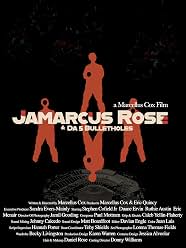

While a bit tropey, “Jamarcus Rose & Da 5 Bullet Holes” (2026), Marcellus Cox’s most recent short film, balances Cox’s proclivity towards bleak trajectories with hopeful, inspirational stories about Black men’s struggles. Seventeen-year-old Jamarcus Rose (Duane Ervin) just wants to play baseball, hang out with his friends and meet girls, but his grandma, Esther Linwood (Ruthie Austin), signs him up for the Big Brothers of America Program and expects him to hang out with his mentor, Jasper (Stephen Cofield Jr.). Will their first day together be as disappointing as he expected or be full of surprises? On Wednesday, June 24, 2026 at 5:30 pm, the Roxbury International Film Festival will show Cox’s twenty-three-minute film, which is my favorite after seeing “Mickey Hardaway” (2020 and 2023) and “Liquor Bank” (2025).
Even though “Jamarcus Rose & Da 5 Bullet Holes” is another sports movie, it is not a heavy lift if you are not a fan of America’s most favorite pastime. The characters may be archetypical, but the actors imbue them with an energy and uniqueness that grounds them in authentic emotion. Austin is the standout here as her sense of urgency over her grandson’s future drives the momentum of the story and pairs these two. Without her, there is no story. The biggest plot twist is that Austin plays the titular character’s grandmother, not mother. There is instant chemistry between Jasper and Jamarcus although Cofield may be too physically familiar for a first meeting. Ervin looks older than the character but manages to have an age-appropriate energy.
Cox’s dialogue sounds like it belongs in a play, but visually Cox definitely shows why it needs to be a movie. Still the antonym to Tyler Perry, Cox could find financial success if he took a similar boots-on-the ground approach to his work with stage productions of his films in reaching an audience and cultivating a fan base so he could continue to finance his films. The colors were incredibly vibrant this time around, and he is remarkably talented at excelling at nighttime shots, which is usually the stumbling block for most filmmakers, including those with way more resources. It is likely due in part to his continued collaboration with cinematographer Jamil Gooding. There is an incredible sunset shot on a baseball diamond, and the only drawback is that it is shot through a chain link fence with a handheld camera. A steady tripod without an obstructed view would have worked better though the shot likely adds a deeper significance to the story. The furtive shot with the mailbox in the frame in retrospect makes sense but while watching it, felt awkward.
Sound designer Matt Boardfoot really captured the crisp diegetic sounds of birds or crickets. Composer Paul Mottram’s soundtrack during the baseball scenes emotionally soars to set up the audience to have high expectations and wonder over Jamarcus’ talent and potential. During that scene, “Jamarcus Rose & Da 5 Bullet Holes” comfortably fits among the pantheon of baseball game movies such as “Field of Dreams” (1989) or “The Natural” (1984) without sounding as if it was on a budget.
“Jamarcus Rose & Da 5 Bullet Holes” will have audiences talking about it long after it is over and comparing Cox to some classic Black filmmakers such as Eric Monte, John Singleton, and Michael Schultz. It will be sure to spur reflection on how to interpret the movie through the lens of the opening quote.