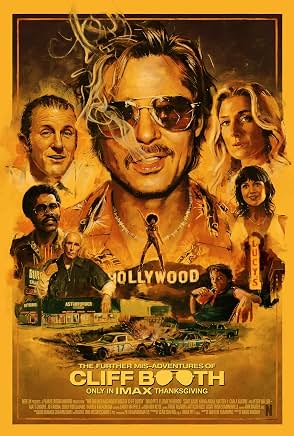

“The Further Mis-Adventures of Cliff Booth” (2026) is the sequel to “Once Upon a Time in…Hollywood” (2019). Set eight years after the events of the first movie, during June 1977, from Tuesday night through Sunday night, the story catches up with how the titular character (Brad Pitt) occupies his time now that he can no longer be a stunt double for Rick Dalton (Leonardo DCaprio, who does not make a cameo). Talent agent Karen Crosby (Elizabeth Debicki decked in white) reaches out on behalf of famous television actor Charlie Peters (hilarious and good sport Scott Caan whose mother’s genes surrendered unconditionally to daddy James), but he does his own stunts. What does Charlie want from Cliff? Director David Fincher takes a gorgeous, deliberate walk down memory lane in his Netflix swan song, but writer Quentin Tarantino does not pull off the catharsis of the first film and ends on a note that could take away the best, foundational asset for the future of this franchise.
“Once Upon a Time in…Hollywood” worked because Tarantino took a well-known, tragic crime, meandered with quirky invented characters to set up the bit then tweaked it enough to change the outcome thanks to the magic of the movies, i.e. aspirational history, which he did before in “Inglorious Basterds” (2009), which also starred Pitt, with great success. Tarantino sets up a Rube Goldberg machine filled with cinematic and silver- screen infused nostalgia, predilections and routines for hours only to spring the trap on the historical bad guys, um, gals, for a satisfying and cathartic ending that makes the journey worth it. “The Further Mis-Adventures of Cliff Booth” does that without the payoff that simply going to the movies launches its audience into a more redemptive timeline. It is just a movie and a love letter to the Seventies, pulpy movies, the entertainment industry, California and cool men. Tarantino’s imagination is dying, and he is no longer capable of imagining a better world, only boosting his ego.
The first act of “The Further Mis-Adventures of Cliff Booth” establishes Cliff’s life after losing his job. He is a fixer who gets a huge cut of the blackmail money, works as a projectionist and a bartender, and takes care of his dad, Gus (Peter Weller), a pawn shop owner who loves to watch television, and his dad’s cat, Derwood. No mention of Brandy. The second act introduces Karen, Charlie and Charlie’s wife, Toni or T (Carla Gugino looking better at fifty-five than most people look their entire damn lives), into Cliff’s life. They exist to admire and provide more back stories about how cool Cliff is. He is a ladies’ man, a man’s man, and a good son with an appreciation for the simple things in life. The third act is when the rubber hits the road, and Cliff begins working with Charlie to solve the latest threat to their community. The ensemble cast has great chemistry and presence, but let’s hope Debicki got extra money or a stunt woman for all the upskirt shots, which was unnecessary. It is a sexy movie without the sex, but considering how many, including me, yearned for director David Fincher to get swapped out for Aaron Sorkin’s ogling camera in “The Social Reckoning” (2026), it is kind of hilarious that simultaneously Fincher was recreating the aesthetic of sexploitation Seventies films. The audience and good taste are never going to win, huh.
If you recall, there was a lot of outrage over Cliff beating up Bruce Lee (Mike Moh). Charlie even refers to Cliff as “The Great White Hope.” Tarantino ups the ante, doubles down and uses it as the favorite descriptor of Cliff. The N word never gets used in “The Further Mis-Adventures of Cliff Booth” because Tartantino has a new obsession: bodying various men of color. Aspirational fiction has lost its allure. Instead of the Manson family, a couple of out of towners from the Philippines, the Verdusco brothers, Eddie (Matt Groove) and Fernando (JB Tadena), are the menacing threat. Preferring a sledgehammer called Esmeralda over a gun, they are terrifying, merciless and brutal.
Honestly, the Verdusco brothers are scarier than the Manson family ever were, and their three sequences are instantly memorable. In a standalone movie unrelated to any story, they would be an awesome terror, but without the historical veneer, it lacks an epic impact for everyone who is not Tarantino and getting no vicarious joy out of his customary self-indulgence. The Verdusco brothers’ victims start as anonymous though their second act of violence is supposed to reveal how dangerous they are to movies, but instead it feels random and like in “Pulp Fiction” (1994) an excuse to emasculate a certain type of character thus elevate the person who avenges them. It feels random and contrived but clicks if you tie all the themes together. On one hand, it is thrilling to have Asian actors getting a major spotlight to show off their talent in acting, physicality and appearance, but on the other hand, if this theory is correct, it is icky. You know your taste. Judge accordingly. It is not obvious, but after “The Further Mis-Adventures of Cliff Booth,” the reaction was overall anti-climactic though appreciative and entertained with a handful of thrilled and satiated moviegoers. Tarantino put his finger on the pulse but missed and was touching too far right of the vein and misjudged what people loved about the first movie.
The denouement features some amazing old school stunts and is an emotional journey that works though it is limited to one scene. If you decide to see “The Further Mis-Adventures of Cliff Booth,” don’t miss the beginning because it is crucial to compare and contrast the flow of this scene. Throughout the film, there are tons of moments signaling how everything could unfold, and while it could be the end of a two-entry franchise, Tarantino is not exactly known for realism or restraint. After watching “The Matrix Revolutions” (2003) and being overall disappointed after all that buildup, the real issue was messing with the hottest actor’s face. Thanks to movie magic, no one got stuck with Reeves wearing a bandage over his eyes in “The Matrix Resurrections” (2021), but one of the fun aspects of a Tarantino movie is that there are some long-term physical consequences after the final fight. This sequel better be the end of a short lived, uneven franchise because while Pitt has improved as an actor, most people do not watch his movies for his acting. He needs the face and the body to headline.
Is “The Further Mis-Adventures of Cliff Booth” worth watching if you wanted a sequel that continued in the same vein as its predecessor? The movie feels like a time capsule to show the future how things used to work: a film reel, a rotary phone, a thick map binder on a dashboard, a close up of a pen on a paper, payphones that require change to work, a clunky remote the size of a bar of soap, beverages that no longer exist, magazines, photographs, contact or proof sheets, car lighter socket. There is a reverence over lost ways of living that really resonate for those who lived during that time. It also does not feel over done in the same way that people recreate the Eighties into a gleaming, upbeat playground. There probably should be more smoking and smoke-filled rooms.
Using AI is wrong, but I’m not going to pretend that I will catch every time someone commits the cardinal sin, so here is an AI rule that feels enforceable. AI is especially wrong if it does not function in the intended way. Apparently in post-production, Fincher replace dialogue and adjusted the actors’ lip movements. The wig and constant, generous soft lighting on Pitt were more glaring so congratulations, Fincher, you made the cut. Purists, consider yourself warned.
Do you need to see “Once Upon a Time in…Hollywood” to watch “The Further Mis-Adventures of Cliff Booth?” No, and you would probably like it more, but that is like passing on eating a pizza from a local spot that knows what it is doing and has been doing it for generations and instead going to a chain eatery to try your first slice. Why would you do that? The exception is a single scene between Caan and Timothy Olyphant, but again, more enjoyable if you do not know the context of the real life actor whom Olyphant is playing. So, if you decide to watch “The Further Mis-Adventures of Cliff Booth,” you must at least watch its predecessor second. The sequel is better on the big screen, but at most, pay matinee prices, get a deal, or use a gift certificate.