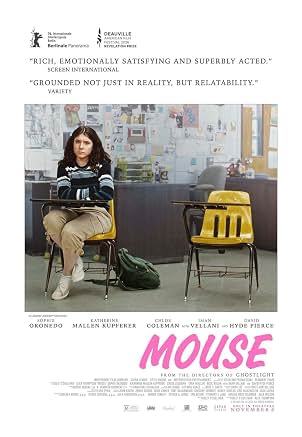

Starting on the last day of school in 2002 in an Arkansas suburb, “Mouse” (2026) follows Minnie Dunn (Katherine Mallen Kupferer), who is the best friend of Callie Bell (Chloe Coleman), a theater kid with the personality to match. When Callie dies, Minnie and Helen (Sophie Okonedo), Callie’s mom, are individually gutted then gradually find comfort in each other’s company until they realize that their relationship will never fix their other issues. Will Minnie and Helen find a way to move forward without trying to be someone they are not? 2026 is a banner year for Americans making realistic films about grief, and codirector and writer Kelly O’Sullivan and codirector Alex O’Sullivan prove that practice makes perfect in their second film after “Ghostlight” (2024), a widely acclaimed film that pales in comparison to their latest entry. It is a small, but mighty film.
Though young, Kupferer is an experienced actor who has appeared in “Widows” (2018), “Are You There God? It’s Me, Margaret.” (2023), and “Ghostlight” (2024) as the on-screen daughter of her real-life parents. While watching Kupferer play Minnie, a girl happy to stand in her best friend’s shadow and enjoy the vicarious perks of being next to the most popular girl in school, if you know her background, you may wonder if she is actually closer to Callie than Minnie in real life and if it is a heavy lift to smother her nature and nurture gifts. In the scenes when she is singing, can she sing and is she acting as if she cannot or can she not sing? It does not feel as if Kupferer is playing a role but is Minnie. For the first time, Minnie wonders who she is if she is alone and who she can talk to without her best friend.
One option is a daughter substitute for Helen, but it is not as if it is initially a conscious decision. As a best friend, Minnie has habits that she had to abandon when Callie died, and “Mouse” captures how grief is not just about losing a person, but routines and the general fabric of life. Callie had more socioeconomic advantages to Minnie, and Callie’s home became a more populated and comfortable refuge for Minnie. When Helen resumes opening her home to Callie’s friends, Minnie and Helen create a new routine that is so similar to the former that the unfolding feels organic, not forced. The tension of the story begins when Minnie and Helen realize what is happening, and how they react to their new dynamic.
O’Sullivan does an amazing job of almost refusing to make villains. Barbara (Tara Mallen), Minnie’s mom, does some amazing work of realizing that she needs to do better precisely at the point when her daughter has written her off and chosen a new mom. Barbara is severely guilty of parentification and compulsively helping everyone before her daughter, but the filmmakers gradually show her side of the story to show why her neglect is sympathetic as opposed to being a mess. Editor Mike S. Smith does an amazing job of intercutting and thus parallelling the lives of Minnie and Helen when they are apart, but also Minnie and her mom when they try and fail to connect. There is such an unremitting gentleness in the collaboration between Mallen, Smith and the directors over how they handle the role without minimizing Minnie’s real hurt.
There are moments that are not verbalized explicitly on the page that the directors and the actors capture on film to convey the sweeping, turbulent emotions of the characters. Drama teacher, Mr. Murdaugh (an almost unrecognizable David Hyde Pierce) does a movement acting exercise with a class, and for the first time, he sees Minnie and understands everything. Also compared to another superb film about grief, “Girls Like Girls” (2026), which shares many themes with “Mouse,” it feels grounded. Kids feel like kids. Teachers feel like teachers. The Christian culture seeps through every pore of the community, including among the kids. O’Sullivan mostly manages to steer clear of melodrama. There is a goofy innocence when Minnie has her first kiss. And then there is Okonedo’s performance.
Before she opens her mouth, Okonedo conveys everything about her character with zero words. There is a scene when Callie takes her mom for granted in the best, living room child way, interrupts a meeting and commands her mother to prepare for guests coming over that night. Okonedo just smiles because Helen is clearly thrilled. Later Okonedo navigates the nooks and crevices of grief, especially when Helen realizes that Minnie is trying to swap moms, and she has made Minnie too welcomed resulting in no space for her to mourn without someone else leaning on her. Okonedo transmits her character’s need for space from other people’s needs, which includes communal expressions of sentiment regarding her daughter.
It is almost unnecessary for “Mouse” to include dialogue to explicitly express this sentiment, and it is the one point in the story when O’Sullivan decides to tell and show. If anyone but Okonedo and Mallen were in this scene, it would have seemed heavy handed, especially compared to what O’Sullivan and Thompson did before, but if this creative choice is the way that they make amends for Mallen being underutilized in “Ghostlight,” so be it. The filmmakers overall execute an efficient and consistent job of establishing tone, character profiles, interpersonal dynamics and overall development arcs that it is easy to be generous when they indulge in their playwright leanings more than filmmaking. They earned it after all the exquisite preceding subtle and nuanced acts.
It also is not a surprise that even though Minnie prefers to stay behind the scenes or the camera, the stage becomes a pivotal turning point for her to express herself. These filmmakers love the stage as part of a Chicago theatrical community. Instead of taking a conventional turn with Minnie becoming a star, they remain faithful to realism and their character and showing what a real tribute to Callie would look like if it was not about the performer behaving like a vulture borrowing some of Callie’s shine. It is a powerful performance because it is a counterintuitive yet perfect embodiment of who Callie means to Minnie. It is also a cliffhanger because up to that point, performative grief has taken center stage thanks to frenemy and opportunist, Cara Moorehead (Audrey Grace Marshall), framing herself as Callie’s best friend, which has largely gone unchallenged. What does public expression of grief look like for Minnie? Cara becomes a symbol of the shallowness of this community and the other mothers’ discomfort with Helen and polite, chilly niceness seem like Cara’s future.
“Mouse” is one of the best films of 2026. Bring tissues because if you start crying, you are not going to be able to stop. Let’s hope that it is an auspicious sign of O’Sullivan and Thompson’s trajectory as filmmakers. If you love movies about mostly appropriate intergenerational friendships, do not miss this one.