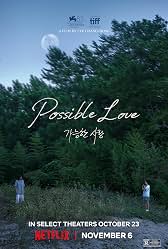

Two married couples cross paths when Ye-ji (Yeo-jeog Cho), a documentarian, meets Ho-seok (Kyung-hu Sul) and Mi-ok (Do-yeon Jeon) while filming. Using her husband’s resources, Ye-ji thinks that Ho-seok would be the perfect subject for her movie, but settles for Mi-ok, who leverages her past for access to a better life. Meanwhile Ho-seok is still unable to talk about the past, and it is ruining his present. Sang-woo (the objectively hot In-sung Zo), Ye-ji’s husband, goes along to get along, but unlike his wife, does not pretend to be closer to the couple than they are. What will they do for love, and who is the wealthiest of them all? “Possible Love” (2026) is director and cowriter Chang-dong Lee’s latest film that remains unpredictable and riveting for most of its two-hour forty-four-minute runtime.
“Possible Love” shows how to tell multiple stories and themes while simultaneously defying and fulfilling expectations. The present-day story involves the couples, and Mi-ok is the main character, and her family is dealing with something that has rocked everyone in their sphere. This trauma is gradually revealed throughout the movie and fully spelled out, almost in redundant detail with Lee’s only minor fumble in not trusting the audience to connect the dots or to intuit what he already showed them. Ye-ji knows exactly what happened, and her first appearance is rather vulture-like with her filming people without their permission at a heightened emotional time. The two women carry the momentum with their families in their wake because they both want something from each other. It is an individual character study of the four characters and Mi-ok and Ho-seok’s son, Cheol (Seol Jung) and a character dynamic study to see how their interactions and different combinations reflect different aspects of their personalities.
There are also flashbacks of Mi-ok and Ho-seok’s memories as told in interviews. There is some ambiguity regarding what Lee is showing the audience. Is it memories that Mi-ok and Ho-seok experienced it or as Ye-ji imagines as she hears their stories? There is this line casually mentioned in the first act that Ye-ji really wants to make scripted features, and documentaries are her entry into that world. Here is where overthinking may be playing too much of a role in this analysis. Most filmmakers do not shoot from the point of view of the person who experienced the past event, which would mean that the audience should not be able to see that person, but what they observed, a point of view shot with a handheld camera. The memories are filmed like the present-day scenes so the storyteller is still visible instead of missing in action for huge swaths of the movie. Usually, it is a logical problem that is not consciously factored into the movie’s framework and just accepted, but here it is notable because Ye-ji and Sang-woo tell stories about the past, which Ye-ji never films, and their memories are never shown on screen like a flashback in a movie. Implicitly Lee and all the characters in “Possible Love” are making an implicit judgment about authenticity and whose stories matter, i.e who has a soul or inner world. In the final act, the big tip-off is to observe which couple can commune together without technology as a substitute for social lubricant or fill the gaps in the void of their interior lives because they have nothing to unearth to share with their partner. This schtick is not the usual noble savage crap that dates back to Rousseau if not further.
South Korean films are so absorbing because the stories are obsessed with the texture of what dominates most of our daily lives: work. Work is where people spend most of their time, offers a social framework, and is the source of what we can have and enjoy. There is no pretense that class does not exist, but South Korean films hit it head on, especially the danger inherent in classes mixing instead of a fairy tale of upward social mobility. It is depicted as an exchange and the inherent risk of shortchanging. The ones who are good at taking will be just as deft when the person with the fewer advantages think that they have stumbled on good fortune. Is it better to remain in your place or aim higher? Krzysztof Kieslowski’s “Dekalog” (1989) inspired “Possible Love,” which only meditates on one commandment, thou shalt not covet, but it takes that entire movie to fully absorb what each character covets. Both women are willing to exploit their husbands to get what they want, and both husbands play along, but only one of them wants something that a person cannot provide. The huge tension is what happens when Ho-seok talks, and everyone can potentially get what they think that they want.
“Why would you take something that is not yours?” But what belongs to a person: their soul, their ideals, their body, their family, nature, even the ocean? Mi-ok has transcendent moments, which get revisited like a reprise, and the test becomes what kind of mother and wife will she be. As a wife, she uses a deceptively playful evasive move to maintain her husband’s dignity while exercising her will, which gets used in an unexpected way during the denouement. One childhood memory is waking up early and connecting with nature. A young adult memory is just being satisfied looking at the moon. An adult memory is hearing a bird. A pivotal memory is the job of using a hose, which is a contained symbol of water and rainbow, but also a function of class, limits, etc. How should she react to Cheol using a hose? Even if she tells people her memories, the texture of living within that experience cannot be acquired. She is the most mercenary character, but she also has a sense of awe and understands her place in the universe.
Ho-seok may seem like the saddest person in “Possible Love,” but if you know that you have a problem, you can solve it. His last line about his former employer, SP Heavy Industries, is a practical lesson that the heartbroken can take from this story and apply to their lives. The 2009 SsangYong Motor Strike inspired his story and encapsulates South Korean’s distrust of police, government and business. Sang-woo accepts himself, and when the couple arrive at his house, it is almost like a daytime, contemporary Gothic. There is a Japanese whistle that his grandfather used as a policeman. While watching this movie, think about what role the police play in South Korea, especially during colonial times when the Japanese occupied Korea. They are always the bad guys in a South Korean film, and it may be a nice quick way to allude to how Sang-woo got his wealth and kept it. It is even implied that Sang-woo may be tenuously connected to Ho-seok’s former employer. Lee uses long shots and distance in a brilliant counterintuitive way to symbolize the effect that he has on people who want to close the distance.
The saddest person is Ye-ji, who is unaware that she is a vampire and wants to hang around churches with lots of crucifixes and people who are reeling from vampire attacks. Unlike her husband, she never has a moment of thoughtless ease or carelessness. She is aware of what she lacks, which makes her feel less belonging in all spheres, but refuses to accept what she has and enjoy it. As a director, Ye-ji is the closest onscreen proxy for Lee so this portrait is not condemning, and there is an acknowledged decorum to the limits that he imposes on himself: keeping the camera in an interior while the action unfolds outside, vice versa with the audio suitably muffled. He shows what the interview looks like but also unveils how the production renders it less intimate and more like a spectacle. There are also the security cameras that capture action in nature where no cameras would be expected. There is a tacit acknowledgment of the limits of the profession, empathy and experience and an inherent lack of consent. There is a thick layer of unarticulated guilt. The title does not refer to romantic love, but Ye-ji’s idea of how to love her film’s subjects. Is she honoring or exploiting them? Being seen is a double-edged sword. If both movies were not so long, “Possible Love” would make a great double feature with “You Can See Everything” (2026).
“Possible Love” is coming to big screens before Netflix. It is not a casual movie that you pause or multitask to. See it on the big screen so that you can absorb everything. It is a bleak movie that imagines the worst, the complete downfall of society and trust, but also shows how life can go on even in the face of a quotidian dystopia. They cannot take everything away from you even if you try to give it to them.