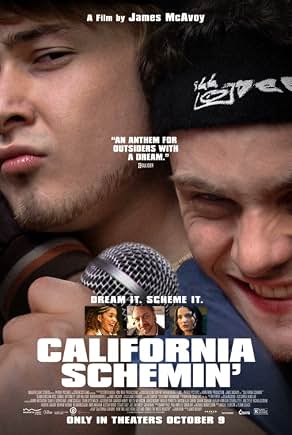

“California Schemin’” (2025) adapts Gavin Bain’s 2010 memoir, “California Schemin’: How Two Lads from Scotland Conned the Music Industry,” which was later re-titled as “Straight Outta Scotland.” Bain was one of the two members of the group Silibil N’ Brains, and he was the brains while Billy Boyd was Silibil. Staring in 2003, Dundee, Scotland, the movie is a loose adaptation of the book condensing three years into a shorter period with Seamus McLean Ross as Gavin and Samuel Bottomley cast as Billy. To become successful and/or to expose the bias of the record industry, the two Scottish lads pretend that they are from California and succeed, but along the way, the lies tear them apart. Will they lose who they are pretending that they are someone else? James McAvoy’s directorial debut is a visual success, but cowriters Elaine Gracie and Archie Thomson’s feature debut is uneven and takes around half of the movie to find its footing leaving Ross to fill in the blanks, which he does successfully, but makes the music biopic harder to get invested in.
It is a surprise that Bain wrote the book that the protagonist is based on because Gavin is severely underwritten. He is a character in a vacuum who only raps, skateboards and looks mournful during his sales day job even though he gets to spend it with his best friend, Billy, and Mary Boyd (Lucy Halliday), Billy’s supportive girlfriend. In contrast to Billy, he is on the outskirts of society. No one likes a prose dump, but the audience needs to be invested in Gavin as a person and/or his talent needs to be so palpable that they are invested in the story. Instead, Gavin feels like the incel of music. Because he wants it badly enough, he should get it. That description is too harsh, but there is no sense of Gavin’s home life, what made Billy cotton to his awkward friend, or why even children declare open season on Gavin. While he is not without talent or showmanship, the music is not memorable, and the on-stage performances are not rewind worthy. He is a mystery, and he only brightens when in the spotlight then his desperation and pathetic ruthlessness take centerstage, but it is mostly thanks to Ross’ hard work. Ross ends up crafting an implicit story of internalized bias against his origins and wanting to be anywhere else like London or as any other national or ethnic origin than Scottish.
Here is where McAvoy’s visual work does the heavy lifting and wordlessly develops that theme. It may be heavy handed, but during the first act, Scotland has graffiti that says, “It’s Shite Being Scottish” with a spray-painted drawing of a guy on a huge brick wall screaming. By the end, the wall is beginning to be painted over. Throughout the film, McAvoy uses recreated home video footage that is supposed to convey their initial excitement and idealism, but visually, it is not as compelling as the rest of the movie and is redundant because it does not add anything that is not already apparent throughout the first half of the movie. The recreated home video footage could have been ditched entirely except for a bus scene with the older women passengers. It was likely an homage to a documentary about the rapping duo called “The Great Hip Hop Hoax” (2013) with clips shown at the end of “California Schemin’,” which offer more details about the two’s friendship than the entire movie so now I feel compelled to see it. Darn the completist compulsion. Otherwise, it is a vibrant movie that you will want to watch because of the colors, the urban vistas, the energy. I saw this on a screener on my desktop, the worst way to watch a movie, and it still looked terrific. McAvoy is clearly committed to Gavin’s story, but Billy’s story dominates and is not about fighting against self-hating tendencies.
Bottomley depicts Billy as a socially well-adjusted guy who has more at stake at home so more to lose. He is part of the community, is in love and great at his job. For him, it is fun, and he is keen to throw musical success away. “California Schemin’” follows familiar beats with Billy’s story and would fit right in on VH-1. The story gets interesting once fame hits, and Billy finally feels tension between maintaining both lives. When Billy can no longer hustle, and refusing to let it go, Gavin snatches the opportunity to stick to their deal of exposing the music industry away from him, the movie changes course, introduces a threat that the friendship could end, and finally tightens the focus instead of just rehashing the usual underdog making it big then finding trouble at the top story.
“California Schemin’” wants to be about a lot of things, and all the subjects are worthy of attentio, but they are just noted, not deeply explored. There is an amusing bit with James Corden that ridicules the industry. The movie also wants to expand the thread about self-hatred and include British bias against the Scottish to include a preference for American music. Things get further complicated when they realize that the owner of the label that signs them, Anthony (McAvoy), is Scottish. It also takes an admirable stance at showing how the Scottish may be the have nots in one arena but are forced to face the possibility that as Scots, they are simultaneously complicit in appropriation thanks to the scout who discovered them, Tessa (Rebekah Murrell), a Black British woman who is not their intended target for exposing the music industry’s hypocrisy. This story has more intersectionality than films begging for complexity.
“California Schemin’” would have been stronger if it started with Tessa discovering them since most of the first half does nothing more than the traditional storylines about two crazy kids trying to make it big. Mary as the debunker just fits into the nagging girlfriend trope, but Tessa’s critique in the last act is exactly what is implicitly missing from the first half of the movie when depicting the guys’ ascent. For whatever reason, the writers decided to not reveal much about Gavin, so watching them through her eyes would have been more interesting and could have given the audience more time watching McAvoy kill it as the tyrannical music producer. He is so good that it feels like a crime not to get more from him as an actor.
Normally if it is not Scottish, it is crap, but the Gaelic film “Kneecap” (2024) did a better job of introducing unfamiliar viewers to the individuals in the music group and their music even if moviegoers were not interested in either. Both movies have one thing in common: if you have a hard time following accents without subtitles, you better be up for a challenge or wait until you are. If more time was spent on Gavin and Scotland before shifting the action to London and the lie, “California Schemin’” would have been a stronger movie.