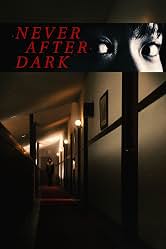

“Never After Dark” (2026) follows Airi (Moeka Hoshi) at her latest gig at an isolated, former hotel located in the countryside. Owner Teiko (Tae Kimura) enthusiastically hires Airi to communicate with a ghost (Mutsuo Yoshioka) and help him transition to the other side. Gunji (Kento Kaku, who is also a producer), Teiko’s son, views the proceedings with a smidge more skepticism, but plays along. Airi is the real deal and has a special inherited process, which includes the use of reflected surfaces and mirrors, including a zoetrope framed, rounded mirror, a well-worn thick melted candle resting on a candlestick with a scale attached to one side to burn a lock of her hair, which she snips off with a pair of scissors. She only pierces the veil between the spirit and living worlds during the day to ensure her safety, but this time, this spirit is different. What does he want and will Airi be brave and finish, not run away from, the job? American writer Dave Boyle pulls off several neat hat tricks with this clever, surprising and creepy movie, which is a feat considering that it opens in medias res.
Boyle convincingly writes women characters without sexualizing them or suddenly centering male characters, who remain supporting characters. Hoshi’s approach to Airi is seamless. Shy and reticent around the living, but loquacious and fun loving around the dead, she behaves almost like a hungry ghost in a liminal space constantly eating and drinking. Those cans are not soda, but alcohol, and acting drunk is harder than most believe. A lot of the peril of the first act is the weight of wondering whether she is going to accidentally hurt or kill herself dancing around the hotel or on the grounds. Without spoiling anything specific, the prior listed characters are not the only people that Airi interacts with, but the alcohol is not just someone letting loose in a vast estate or pulling a Tom Cruise in “Risky Business” (1983). Airi is self-medicating and her lack of reaction to chilling in the same room as a ghost with a gaping maw of a face is just one of many symptoms that she is numbing herself to the inherently disturbing quality of her life and gift, which comes with some trauma. Her journey is to stop numbing herself from the pain and have capacity to react normally to her unusual circumstances instead of running away from a problem without confronting it.
A face is one of the most powerful tools that an actor possesses, and Yoshioka does not get to use it for most of “Never After Dark” yet he must imbue his spectral character with enough specific traits that the average movie goer would recognize him regardless of which plane of existence he appears. He is first depicted in one of Teiko’s paintings, which Mizuka Tanpo actually painted, and it resembles a Francis Bacon painting. Boyle, Lighting Director Hidenori Nagata, cinematographer Patrick Ouziel and production designer Yuji Hayashida collaborate with Yoshioka to depict the ghost, who is distinguishable based on his routines, his Michael Myers coveralls, his room preference and lamp flickering in response to his agitated emotions, but also his proclivity to disappear and reappear, communicate furtively and physically interact with Airi, which indicates that his face wound is not accidental, but fits into a violent pattern of behavior. Yoshioka is the kind of actor that is a little too good at playing this role. Ugh, the nails against the wooden panel.
The supporting characters in “Never After Dark” make a meal out of a morsel. Kimura looks too young to be anybody’s mama, and Teiko’s demeanor is similar whereas Kaku plays Gunji as if he is older and the more responsible of the two. Neither takes Airi’s warnings seriously. Teiko wants to know about life after death, and Boyle’s lingering depiction of her in her final scene may seem excessively extended but it is a great way to close the loop on a character. Gunji’s arc is a bit more inscrutable and reduced to an attraction towards Airi. Maybe something is lost in translation, but nevertheless, his arc is riveting. There is a duality to his character as if he is at war with himself, and his truest self without inhibitions may make him an entirely different person. A sense of duty (parentification is abuse) results in Gunji being a bit more uptight verging on cruel but ultimately is well-intentioned. Mother and son seem like individuals, not archetypes who are easy to dismiss when the proverbial crap starts to hit the fan.
Boyle invents a mythology and blends genres seamlessly in a way that is wholly unpredictable until he is ready to offer a hint to the audience. It is nothing short of brilliant and original to be able to surprise audiences, especially in a saturated subgenre of the horror field, the ghost story. It felt reminiscent of Irish filmmaker Damian McCarthy’s work and made me wonder if Boyle was merging Irish and Japanese supernatural folklore, but nope, he is just a former Mormon missionary who went to Japan. Boyle made a movie set in Japan with a Japanese cast and subtitles that does not feel as if an American made it. What do Japanese film critics and moviegoers think of “Never After Dark?” His characters’ relationship with the supernatural did not feel American since there is no fear of death or dead people, but a sense of death as warm, comforting, pain free and ordinary whereas life is starker and more dangerous. The details matter from the use of sheets as a healthy wink to a child’s concept of haunting to a ghost crying leaving condensation on a mirror.
The mythology introduces a concept of Airi and others possessing special powers distinct from other movies such as “The Sixth Sense” (1999) or the “Insidious” franchise. “Never After Dark” feels artistically superior yet in the same vein as the “Insidious” franchise and would have made a better standalone sequel than “Insidious: Out of the Further” (2026). Airi does not completely have a handle on her visions, how to interpret them and the oneiric logic behind them, but by the denouement, all the random imagery of people, including the mother and son, appearing during the day who are in other locations, fits together like a perfect puzzle. Boyle uses the camera movement to imply that someone is watching Airi as well, so it creates this tension of whether these characters are violating her instructions or something else is going on.
A movie set in a former hotel during autumn in the woods naturally invites comparisons to “The Shining” (1980), especially considering the visions of dead people, but oddly enough, “Never After Dark” visually resembles the jail house scenes in “Shelby Oaks” (2025), particularly with the second floor hallway and row of bedrooms and (hear me out) in spirit, “Halloween H20: 20 Years Later” (1998) in terms of choreography, direction and composition, especially with the little church in the backyard. Possible homages aside, it is also a terrific gory ride without becoming distasteful or cheap, and it definitely evokes dread.
“Never After Dark” also feels like a period film and lived in, not stylized or created. There are no cell phones in sight, only landlines, i.e. cords. Teiko’s clothes have an angular puffiness that speaks to the boxiness of Eighties fashion. Airi’s outfits are baggy and asexual. The suitcases are not on wheels but are sturdy. There is a vast record collection. Costume designer Arata Kobayashi and production designer Yuki Hayashida succeed at evoking an era with no prose necessary. Boyle, composer Jonathan Snipes and vocalist Sharon Udoh invent a music group (“Radio Activity”) for the characters to discuss and groove to, specifically a song called “Silhouette,” which if this movie becomes popular, may enter the zeitgeist as much as the “Manhunter” (1986) soundtrack.
Even if you do not watch movies with subtitles, “Never After Dark” is definitely worth the effort, especially if you are a horror fan, and makes for a perfect first foray into foreign language films. If you are tired of commercial movies, franchises, or sequels and yearn for more original fare, this movie is the real deal. While not as merciless and bleak as J Horror, it is definitely a notch above standard American horror gore in terms of not pulling punches and looking realistic. You will not want to leave the characters after the credits roll and actually worry about them long after the movie ends. Stephen King’s stamp of approval is valid for this one.
S
P
O
I
L
E
R
S
Are teeth the home of someone’s soul? No. Boyle said that he invented the mythology. Egyptian and Assyrian mythology are mentioned. In Assyrians’ Code of Hammurabi, “a tooth for a tooth,” knocking out someone’s teeth could be a sign of justice and retribution, and in “The Legend of the Worm,” demons caused teeth problems. The ghost is not a demon, but it was my second guess. My first was correct. In ancient Egypt, the teeth and mouth helped souls speak and take other actions to traverse the afterlife, and possessing someone else’s tooth meant controlling another person’s mind and body.