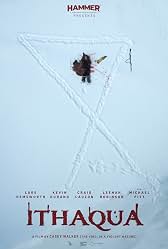

“Ithaqua” (2026) translates to “the wind with teeth,” but by the time that you find out, you may no longer care. The term originates from August Derleth’s short story, “The Thing That Walked on the Wind,” which was published in “Strange Tales of Mystery and Terror” on January 1933 and was intended as a Cthulhu mythos story to continue the Lovecraftian legacy after the author’s death, whom Derleth knew. Set in 1821 at Fort Thomas Remote Fur Trade Outpost in Ontario, Canada, there is nothing to hunt, the food stores are bare, and spring is far away. American Cole Franklin (Luke Hemsworth, oldest, stockiest, and shortest of the famous hot Hemsworth brothers), British Lieutenant Walker (Kevin Durand), a Métis man Nicolette (Craig Lauzon), and an ailing Hendry (Aaron Poole) set out to the nearest civilization to see if they can trade for food, but instead only find carnage. What is killing people indiscriminately and what is the illness spreading through the camp? The story is all over the place, and it never truly comes together despite everyone’s best efforts. Watch “Ravenous” (1999) instead.
It is only fair to use “slow burn” when there is a big payoff. Typically, the longer it takes to get to the action, the more that moviegoers should learn about the community before it falls apart, but most of the British soldiers are not individuated so in the last act, when each one suddenly becomes important, and Walker starts using their names, it is more like “who, what, huh?” The first act is the worst of both worlds. It does not use the time to lay down the foundation of what people were like before the proverbial crap hits the fan, and it takes too long to get to the good stuff. Instead, it has a historical, superficial “Star Wars” cantina vibe with a lot of people who speak different languages and are from different nations tensely coexisting that it does not leave much margin for things to deteriorate. On one hand, it is cool to remember the diversity of yore, but on the other hand, they do not feel like substantial supporting characters.
Cole is the protagonist, and Nicolette is his best pal albeit with a knack for getting into precarious positions that requires others to rescue him. I came for Durand, and Walker’s first shot of him may be the best with wardrobe outfitting him in a pompous British uniform, which includes a tall hat with a feather on top on the already giant Durand so he has to duck to go through a door and tower over everyone. Walker sees Cole as a bad soldier who cannot fulfill his duty to the company. Eventually the three becomes bickering buddies after Magistrate McKellar (Michael Pitt) orders them to hit the road and do not come back empty handed or Cole’s Ojibwe wife, Ahnung (Leenah Robinson), and her grandmother, Nokomis (Pamela Matthews), would pay the price. McKellar uses it pronouns for the two women. During the trek, the three men get backstories. Cole and McKellar are perfect foils based on their respective relationships with their wives. Hemsworth and Robinson have so much chemistry that it succeeded in me setting aside a kneejerk reaction that old man, war crimes Cole should leave that young, indigenous woman alone. Nokomis’ opening line to Cole did not help, but that is how good the two are with their dynamic that they overcame these turnoffs. They seemed like a genuine love match.
If “Ithaqua” makes a crucial mistake, it waits too long for the women to offer specifics on the evil that seems to be threatening everyone’s existence. It does not create suspense, but confusion because director and cowriter Casey Walker, cowriter Pascal Trottier (“A Christmas Horror Story”) and cowriter Peter Scott Vicaire, who is Mi’gmaq, makes the monsters seem like a zombie-vampire hybrid with unclear rules of how they are related to the titular monster. While strong on atmosphere, the story is weak on details. Because of the cold environment, I kept associating it with “Ravenous,” especially because two of the three men were veterans with complicated relationships involving indigenous people. Unless a viewer is familiar with the title or indigenous mythology, it is unlikely that any viewer will associate the phenomenon with the Winnebago (out of respect for Native Americans, I heard that we are not supposed to use the real word, and now that I know better, I try to do better, but I’m sure that I have not in the past, and the movie does use the word so consider yourself warned.)
The writers also have Ahnung and Nokomis have some contrived exchanges that seems out of Ahnung’s character just to keep the clock running and to tie into Cole’s past, which is depicted in his dreams. Also, it requires the moviegoers to believe that Cole, Ahnung, and Walker’s priority would shift in such a dramatic way towards one person who was not their original raison d’etre. What does this monster want? How does it operate? How is it connected to the illness? It is obvious how people contract the illness, but the final scene obliterates any possible clear relationship between the monster and the infection. As a big fan of inexplicable evil, this is not it. These are supernatural beings that are supposed to follow a formula, but the formula does not get firmly established, and it is especially aggravating because all the indigenous characters already are forearmed with knowledge but never act like it. Instead, they are treated like red shirts. Did “Sinners” (2025) teach filmmakers nothing? When a story twists itself in pretzels to make the trio into the most effective threat to the monster versus people with experience, it rarely works. Even though it was probably the point, it takes too long to get there.
Monster logistics and logic aside, the execution of the monster and the infected is phenomenal even if it is more derivative than original. The sound effects of the infected are fun because they sound more like animals than people. When an infected dies, the special effects are very Buffy coded, but subtle. Whether it is the actors, stunt people or special effects, the infected’s animalistic moves are well done and terrifying. The gore is top notch. The atmosphere works. When Pitt’s name appears in the credits, it is obvious that he is going to chew the scenery, and he does not disappoint. It was obvious who the Big Bad was, but the movie treats it as if it is a M. Night Shyamalan twist. The image of the monster in the dream and real life were great visual foreboding elements leading to the ending resolution, but again, the bait and switch felt obvious though as a possible power of the monster, it works well. If you are not as picky with story quality, then the horror elements will keep you happy, and it is one of the reasons that “Ithaqua” gets a good rating despite its narrative flaws. Some scene compositions flub the implication of what is happening and may leave some viewers in the dark, but the movie’s strength is its execution of the horror.