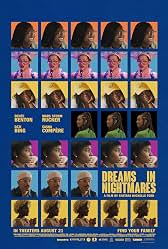

“Dreams in Nightmares” (2024) is about three queer Black women who are friends from college but now in the throes of financial crisis after joining the ranks of 600,000 Black women being laid off and in search of employment. Instead of despairing, Z or Zuleka Matthews (Denée Benton) leaves LA and heads to Brooklyn to hang out with her college friends, Lauren or LoLo (Dezi Bing) and Tasha or TiTi (Sasha Compère), in Brooklyn. After comparing notes, they realize that they have not heard from their friend, Kel (Mars Rucker), in months so they decide to go on a road trip to look for them. Will they find them and along the way, find the place where they are supposed to go? Writer and director Shatara Michelle Ford’s sophomore film joins the ranks of filmmakers with visions of a quotidian utopia at a time of despair making this slow burn movie into more than just a feel-good road trip movie, but a countercultural call to another great migration towards realizing the American dream in unexpected ways. Even if you cannot relate to the characters on a granular level, the emotional journey and destination are a universal fulfillment of desire for belonging, safety, joy and personal growth.
While watching “Dreams in Nightmares,” there will be several times when you may think, “Oh no, I did not realize that I was signing up for an experimental film.” The opening sequence appears to be black and white with film clip montages following photographs overlaid on an image of a dirt road and field. Then there are montages of nature before color starts to emerge. Soon a black space with a rectangle described as a door leads out to a brownish orange field with Z walking into the frame wrapped in a red blanket. Ford is showing Z’s dream, which Z is describing to her long term, supportive lover, Reece (Charlie Barnett), and they are in a relationship with his wife and all live in the same house. These images appear off and on but are cryptic until the end of the movie. Later, a Pittsburgh poetry event introduces a new character, Toni (Joss Barton), who gets a huge chunk of time devoted to their performance while showing images that do not correspond to the poem, but appear to show a day in Toni’s life to contrast the performer with the person. If a scene feels as if it is going on longer than expected, you do not know what you are supposed to glean from the images provided, how it fits into the overall story, or you feel ready to check out because you do not know what or who to hang on to during these cryptic or theatrical narrative beats, just go with it. It is not so experimental to be unknowable, but not so conventional that it is immediately discernible. There will be answers, and all will be clear. Ford’s most accessible, abstract narrative device is to have Reece and Z talk and start in separate locations, then use the phone call to depict their spiritual intimacy as literal and show them cuddling in the same place.
When the fictional California University of the Arts lays off Z from her short form creative writing job, it is easy to trust “Dreams in Nightmares” because soon thereafter, a Black woman student runs up to her with praise and advice on how to be a writer. Ford is not just an artist with her head in the sky. She is taking the pulse of today before showing us how to navigate tomorrow, and she is not sugar-coating things. Meanwhile in Brooklyn, MBA consultant Tasha is walking home defeated and takes it out on poet Lauren, who is technically still gainfully employed as a cleaner, but not earning enough now that Tasha is likely going to be in the red. Cue cancelling their planned trip to the Dominican Republic to save money.
The scenes with Kel’s parents, Bernice (Regina Taylor) and Virgil (Robert Wisdom), are like a Rorschach test for each of the women, how they approach life and what they want. Without learning about anyone’s background, it is easy to infer and glean information about each of the trio’s personal history from this scene. Interestingly, the journey reveals more about Tasha’s inner conflict, which is more acted than verbalized thanks to Compère giving a master class showing how her character wants to conform to conventional markers of success, but is more at home and happy when she is able to let go of her inhibitions and be her full self. Ford does not give Tasha any easy resolution, which keeps the story honest, not a fairy tale.
Z is stuck in the middle of politeness and conformity then umbrage and refusing to lose sight of the parents’ stubborn refusal to see their child’s reality and thus their own. Meanwhile Lauren is defiant from the outset and gives no quarter. Lauren’s journey is not about discovery, but about revealing more of her true self as she is further from home and cultivating liminal spaces that maximize realizing a world where she and her friends belong, which includes patronizing Black women owned businesses, a wonderful cinematic take on the Green Book which will hopefully inspire movie goers to visit similar establishments as “The Drama” (2026) did with Andy’s Diner. (Mattie’s Food is already closed, and I could not find Mercie’s Restaurant.) No trauma here. Soft life.
Lauren’s itinerary functions as a kind of Goldilocks tasting test for possible American lives they can lead but wind up being a Dickensian warning of the life they could settle for. Toni’s Pittsburgh is filled with community and support, but it is a one night only situation, an extracurricular, not the full-time agenda. Iowa City’s Sabrina (Jasmin Savoy Brown), Kel’s ex, and Jamie (Molly Bernard), Sabrina’s current romantic partner, offer the most comedic relief, but also feels more like a performance than a life. The aforementioned parents live in a world of strained politeness and hospitality but is not full and fresh. If you are wondering why Ford lingers on Bernice emptying out the refrigerator to feed the trio, Bernice is generous, but what they have to offer are leftovers.
Catharsis comes with Kel, who may be an onscreen surrogate for Ford. Is she in crisis or in contentment? “Dreams in Nightmares” is amazing because there is no way that movie goers will anticipate the destination or how everything will come together without being spoiled. It also further touches on how Ford’s artistic instincts are on the pulse of their targeted audience and more. A lot of people are considering pulling a Kel in an echo of how early twentieth century Black Americans considered their options at home before broadening their scope.
Visually “Dreams in Nightmares” is a gorgeous film, but I could only play the screener on my desktop and had the most difficulty distinguishing images during the nighttime scenes in the first act. This film must be seen on the big screen because it is otherwise luminous and colorful. “Nickel Boys” (2024) felt like an inspiration for the oneiric sequences. The score picks up the pace in moments of tension and will probably end up on soundtrack wish lists. Ford is not suffering a sophomore slump and has made more than a film. She made an instructional manual on how to live a full life.