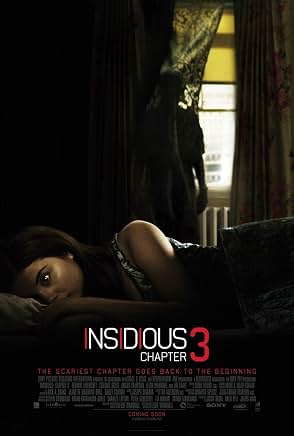

I decided to watch the “Insidious” franchise in chronological, not theatrical release order starting with “Insidious: Chapter 3” (2015) to prepare for “Insidious: Out of the Further” (2026). It is the origin story for former paranormal investigator, Elise Rainier (Lin Shaye), who is too spooked to fight the supernatural, until high schooler and aspiring actor Quinn Brenner (Stefanie Scott) is in danger after trying to reach her mom who died a year and half ago, but instead The Man Who Can’t Breathe (Michael Reid MacKay) answers and decides to try and kill her. While it is not top shelf horror, it does get legitimately frightening, the metaphor is strong, and any movie starring Shaye is worth the time and cost. It also does not hurt that writer and director Leigh Whannell (“Upgrade,” “The Invisible Man,” “Wolf Man”) is in charge behind the scenes. It is astonishing that it was his directorial debut.
Shaye is terrific and exudes immediate authority even at her character’s lowest. “Insidious: Chapter 3” is an emotional journey for Elise from withdrawn, mourning recluse in a robe looking eternally cold, to hesitant but willing to fight and finally a complete bad ass owning everyone, living and dead. It was unexpected that in her spiritual form, she was going to rumble. Say what! It was also nice to see a veteran not struggle to identify the bad guy and easily get overwhelmed or deceived. She shares a wonderful scene with Steve Coulter from “The Conjuring” franchise where he delivers a decent pep talk that establishes her motivation and willingness to risk her life. Also, she enlists two lesser paranormal investigators, Tucker (Angus Sampson, sporting the same attitude as he did in “Deep Water” except a good guy) and Specs (Whannell wearing yet another hat), who are popular online as Spectral Sighting, but find themselves in over their heads when the Brenner family calls them. The newly minted trio’s dynamic was cute. Who does not love an intergenerational relationship! There is even a brief apology and recalibration scene with Elise still in charge, but without ego.
Of course, some people may believe that Quinn is the protagonist. It is not long before a spirit is tormenting her, but he skipped the line behind parentification culprit, her dad, Sean (Dermot Mulroney), and her annoying little brother, Alex (Tate Berney). After meeting the men in her life, it makes sense that she would risk tangling with the dead to stop being saddled with them. It seems obvious that this entity feels like an extreme manifestation of how they are sucking her dry and destroying her forward momentum in her journey to become a normal adult who would move out. This part of the story felt like an homage to “Requiem” (2006). Scott gets to have some memorable creepy scenes.
The crisis enables Sean to confront his issues and fight for his daughter’s life. Mulroney uncharacteristically struggles with the material because when Sean is awful, he is irredeemable, and the transition feels sudden though it is supposed to be gradual. He even gets an adorable older Black couple, Harry (Jeris Poindexter) and Grace (Phyllis Applegate), to help Sean get in touch with his feelings. Sean’s most crucial characteristic is his dedication to quality construction thus ensuring that his apartment stays in good condition. It was kind of funny that he initially was more concerned about the damage to his ceiling than his daughter’s well-being.
The mythology of “Insidious: Chapter 3” feels as if they are building the plane while it is flying, but it mostly works. Is The Man Who Can’t Breathe a demon or a ghost? Whannell could not seem to make up his mind, but because he is effective, it kind of does not matter except to figure out how this supernatural world works considering it is a franchise, and hopefully there is some logic to all of this. There are other entities that play an important role in the story, specifically Elise’s nemesis, the Bride in Black (Tom Fitzpatrick), so it would be nice to know what they are dealing with. In this franchise, do the dead become demons if they are evil? Are The Dark and The Further the same or different realms? Maybe The Dark is the reference when you are alive in your body and calling to the dead whereas The Further is when the spirit goes into that realm? The kid was having an emergency, so orientation had to be brief.
The Further had an anti-climactic haunted house vibe. When Whannell relied on more than one entity for scares or the architecture, it felt more like a homage to “The Shining” (1980), but when he was doing his own thing with the horror, his creative juices started to flow. The scenes with the living were far more frightening: the waving, the accident, the grasping coming out of nowhere, the window scene, the aforementioned possession scene, etc. The scene when Quinn breaks her legs will make most jump out of their seat even though it has been done before.
There are some cute notes throughout “Insidious: Chapter 3.” Warren (Owen the Golden Retriever), an intentional reference to the Warrens in “The Conjuring” franchise, is the best boy ever for defending his human from the entities when he would clearly prefer to just chill in his doggie bed. James Wan, who directed the first two movies in the “Insidious” franchise, makes a cameo as the theater director whom Quinn auditions for. There is also room for poignancy, “Loving someone is just delayed pain.” While the line is referring to dead loved ones, it also refers to a theme that could have been further explored: Sean using parentification so he would not have to lose his daughter.
If “Insidious: Chapter 3” dropped the ball, it was when all of Quinn’s peers disappeared. What happened to Hector (Ashton Moio), the next-door neighbor who had a crush on her? He went to grandmother’s house for the weekend, but did the story span only a weekend? Unlikely. Where did Maggie (Hayley Kiyoko, who would later direct “Girls Like Girls” and Scott appeared in the music video for the song), Quinn’s best friend, go? On one hand, her appearance on the laptop was a terrific set up to a terrifying scene, but she just disappears. Isolation explains why Quinn is vulnerable to spiritual attack, especially since her family was not a source of comfort.
“Insidious: Chapter 3” is not the best quality horror franchise, but it is starting off stranger (compliment) than “The Conjuring” franchise and many others. Acting strength, chemistry and an authentic emotional foundation are this installment’s main reasons for watching. The drawback of watching this movie first is inadvertently getting spoilers about unwatched prior installments and retroactively realizing that a casual reference to an earlier case is actually an allusion to these films and a verdict on Elise’s actual efficacy. Ouch.