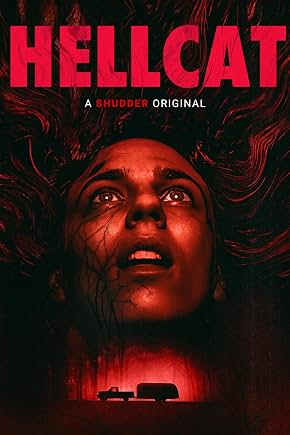

Set in Tennessee, “Hellcat” (2025) starts with Lena (Dakota Gorman) waking up inside a locked mobile home and a man’s voice informing her through the intercom that she is infected and needs to stay calm while he heads to the doctor. Obviously not trusting him, Lena tries to figure her way out of the predicament, which just seems to get worse. Is the man (Todd Terry) telling the truth or a dangerous, delusional man who kidnaps women? With the vibes of “10 Cloverfield Lane” (2016), horror fans should alter their expectations for a heightened drama, better billed thriller using a horror atmosphere to meditate on grief, disagreements and family relationships or prepare to leave angry.
Gorman has a heavy lift since she is onscreen for most of “Hellcat,” and the film is predominantly shot on location in a tiny space. Gorman does a great job emoting and conveying Lena’s internal journey as Lena determines how to get out of this predicament, reflect on her past relationships and struggle to recall what happened. For most of the movie, writer, director and editor Brock Bodell in his feature debut is coy about the culprit: dangerous human beings, aliens or the supernatural. To be fair, the end is a little cryptic too, or it is one of those movies that it is hard to see in the dark so the answer could be blatantly on the screen but suffering from technical issues.
Bodell occasionally gives Gorman a break when he cuts away to montages of photographs or videos from the past, which are implied as stored on Lena’s phone and Lena was looking at when the proverbial crap hit the fan. These precious memories are singular common ground shared between her and her captor, Clive. Clive’s interior is decorated with personal touches, including family photos. Terry’s voice is her only acting partner for most of “Hellcat,” and Terry must retain enough warmth to maintain and extend the ambiguity and heighten the tension but be edgy enough that he makes you nervous. His go to description of himself, “I’m a good man; I’m an honest man; I’m a hunter,” sounds as if he is trying to convince himself as much as her, and it always seems hypocritical when a kidnapper chastises his captive about touching his belonging inside the trailer that he locked her in.
Well, the inside of a trailer can only be explored for so long, so Bodell expands the cast of characters and the liminal space in clever ways. When Lena mentions someone or has a flashback, Bodell sets the action and the person from her past in the trailer instead of the original location. For instance, the trailer briefly transforms into a nightclub with her best friend, Diane (Meg Elsier), appearing to express concern. This creative choice evokes a surreal logic that lends credence to the idea that she may be sick along with the black veins encroaching increasingly across her body originating from her wound. It is also the only note of humor along with the likely AM radio broadcast that Clive listens to that talks about spooky crap and further adds to the cast list. Also, there is the open road and other vehicles so more people who can notice and get interested in the drama within that enclosed moving space.
“Hellcat” provides an elaborate psychological and fantastical premise, but is actually about family relationships with each person’s issues probably leeching into their interactions with each other. Here is where Brock hits a speed bump. Lena is a daughter surrogate for Clive, and Clive is a father surrogate for Lena, but no, Clive is a stranger, and serial killers have families. It requires a lot of suspension of disbelief that just because Clive is a father, it is possible that he can be trusted. Fathers do bad things daily. No matter, he still has a gun and is hella suspicious considering that he is a frequent caller into that radio show. By the end of the movie, they are supposed to resolve their respective issues and be at peace with the next chapter whatever that may be.
Once a plausible answer is given, and the montage is further intercut with the other images along with Lena’s increasing convulsions, the end certainly feels a bit like a rip off or the beginning of a more quotidian nightmare. “Hellcat” ends just when more practical and dramatic dynamics arise. It is one of those movies where even the character who appears to be a villain gets a backstory of trauma to exculpate them from being dehumanized, which is good because aren’t we all just doing the best that we can under confusing circumstances, but it brushes aside a fairly huge complication.
Also, there is one revelation about Clive that either validates the mythology raised in “Hellcat,” or everyone needs therapy and a doctor, but it is just taken for granted. Once a horror reason is given, there needs to be at least some token horror. Instead, it is psychological horror that does not fully explore all its themes but is mostly effective in its melodrama on wheels. If there was not such a plethora of films with a similar denouement recently, it would probably resonate more so people who do not watch tons of movies will be at the edge of their seat.
S
P
O
I
L
E
R
Clive’s wife and Lena’s mom are dead so there is this idea of motherless daughters with inadequate fathers. So Clive learns how to stop being controlling and butting heads with the daughters on the best way to protect them, and Lena starts relying on her dad instead of her mom. There is one catch: all the fathers, all the mothers and all the daughters are not explored, and there are not that many of them so leaving them out for random dudes with grief issues feels like a creative choice that fails the protagonist. It feels as if Lena exists to complete Clive’s story. Clive’s foil is Officer Crump (Jordan Mullins), and his interiority is given more consideration than Lena’s eleventh-hour development and another person (Liz Atwater) entangled in this story.
Atwater’s character, who is Lena’s foil, is more described than shown. To end the movie just when Lena and Atwater’s character are finally able to discuss their shared experiences feels like more of a letdown than the actual shell game of not showing anything horrific. Also, it feels as if there is a vaguely gendered theme where women are in sync with nature, just go with the flow and their feelings, and the guys are superimposing only semi-irrational theories on inexplicable tragedies to cope. It is not exactly a revolutionary concept for a woman to suddenly feel hyperaware of the moon then show an extreme close-up of the craters during her convulsions, but visually, it works.