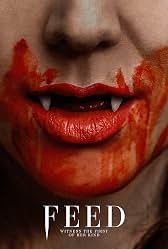

Marco van Belle is having a banner year with two films released in one year, but the catch is that one is “Mercy” (2026), and the other is “Feed” (2026), his third writing feature and second directing feature. A group of five social media influencers rent a house from Nora (Charlotte Bradley) and her weird granddaughter (Sadbh McMullin) who spooks them upon arrival. Unfortunately for them, the house is near the burial place of the Dearg Due (Niamh Hogan), who is looking for their next willing host. Will they let them in? While van Belle deserves points for exploring a lesser-known type of vampire found in Irish folklore, with no characters to root for, it is a bit like going through the motions. It is a mid-horror movie, but points for originality in mythological references.
Orla Ryan (Grace Collender) is supposed to be the main character but is deliberately underwritten and a bit of a bump on a log to hint at her tragic past and how she is handling it, which gets alluded to in some dialogue and a social media post that shows why she is no longer about that online life. On one hand, it is better to show and not tell, but there is no sense of her as a person. There is no through line of her before and after the tragedy. Only the change in her demeanor and appearance reflects her grief, but it does not feel visceral. Collender screams a lot as her character starts having visual and auditory hallucinations upon arrival. There is no one to root for when Orla is only a theoretical character and already an empty vessel. The most intriguing feature of Orla is that when her pals take a photo of her on a professional level digital camera, she is blurry. “Faces of Death” (2026) crafted a better character who understood the danger of social media, experienced tragedy and has another brush with danger that she must battle to survive.
The weekend combines business and pleasure. All the friends are too shallow and invested in their influencer careers to be able to help Orla grapple with her depression and offer insensitive solutions that are their love language but are Orla’s horrors. Nessa (Daisy Jelley) is still in the social media game, and everyone revolves around her. “Feed” sits on the fence with her and makes “The Devil’s Mouth” (2026) seem daring for creating a more complex, realistic and nuanced toxic friendship dynamic. Nessa could have been a great character because Jelley’s performance reflects a fierce defense of her friend and solid instincts, but van Belle wastes her potential. Even Orla’s overprotective boyfriend, Lorcan (Clinton Liberty), thinks it is a good plan. Lorcan is Black but does not act like it in this horror movie. Points for not killing him first though he has zero survival instincts. Sporting lipstick and a face beat to the gods (he looks glossy) with eyes that make him seem like he is related to Meg Foster, Seanie (Oskar Smith) is the only singleton in the group, and Nessa treats him like a servant. Nessa’s boyfriend, Austin (Rhys Mannion), is the newest member of the group, a successful influencer and an audience surrogate because he is the only one who does not know Orla’s backstory.
van Belle is not strong at creating characters or character dynamics, but it is obvious that he put in a lot of work to flesh out the Dearg Due’s mythology. A rewatch of “Feed” reflects how much of the opening act involves the vampire’s influence, and it is the strongest element of the movie. Orla finds her burial place then pricks her finger because the Dearg Due is controlling her. The Dearg Due’s eyes move like a slot machine while she breathes rhythmically so she can see people in her immediate vicinity then stop when she finds a person whom she can influence then makes them see things and despair. She often makes people commit suicide, which actually works with the story because everyone thinks that they are unlike Orla, but they fall apart just as easily. The fallen angel origin story is stated but not validated. If angels are all eyes and do not look humanoid, glimpses of the Dearg Due’s true form in the opening and closing act could be akin to it but really looks more like the T-1000 except instead of metal, she is a viscous black fluid that sometimes looks like blood.
“Feed” gets old when human characters run from the Dearg Due in slow motion while the vampire runs at full speed. van Belle uses some twists on new technology to revamp common mythology tools about fighting a vamp while constantly and simultaneously using the dialogue to remind his audience that this vampire cannot be killed. Turning is more like a possession with the spirit in the form of that weird liquid. The liquid enters the body of the prospective vessel so the Dearg Due can have a physical form, which is very “Supernatural” demon fallen angel. She possesses some snakelike characteristics, which she leverages to make human familiars.
Hogan does not bring an ounce of sexuality to the role, which is a nice change. Instead, her first onscreen word is power, and she seems completely unrelatable, more like an Eldritch god in humanoid form. Dearg Due means crimson thirst or sucker so blood sucker (credit to @AuthorMichelleFranklin, who references two other famous Irish vampire types: Abhartach, a Derry County fifth century chieftain who was dwarf-size, practiced dark magic, became undead and drank his subjects’ blood until a yew-wood sword pierced his heart, and he was buried upside down with thorns over his grave; and Leanan sídhe, which means fairy lover, and W.B. Yeats wrote as a vampire who feats on artistic men’s life force). The real legend of the Dearg Due is based on a woman forced to marry an abusive chieftain. She becomes a vampire to get revenge and likes to feast on men. It is frustrating that films like “Feed” or “The Morrigan” (2025) leave the best bits of lesser-known mythology untouched, and the filmmaker underexplores the mythology that they create.
Social media is equated with power and money, but this is a concept touched upon in the dialogue and is not visceral. “Feed” maybe needed to start before they left for the cabin or depict the characters as more successful. Every human character misunderstands the nature of power and feels entitled to it, but their drive for power ignores the price of power and their inability to safely wield that power. The Dearg Due is a confrontation with pure power, and it becomes apparent that it is absurd to believe that anyone can control her. van Belle had good instincts to raise this issue, but the execution will probably elude most viewers who will instead dwell on the grief, suicidal ideation conflicting with the desire to live. Power does not automatically equate to death at least immediately, so van Belle seemed stuck on how the Dearg Due gets consenting victims and erroneously took a detour that undercut a more provocative concept. Power must flow, not be banked otherwise it will ruin its container and make it rotten.