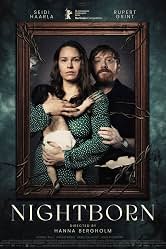

If “If I Had Legs I’d Kick You” (2025) and “Nightbitch” (2024) had a horror baby, it would be “Nightborn” (2026). Set in an isolated Finnish forest, Finnish Saga (Seidi Haarla) and Brit Jon (Rupert Grint) return to her decaying family home to start their life together and have a family. They get right down to work, but their idea of having a child contrasts severely with the reality. Saga feels that something is wrong with their newborn son, Kuura (10 various babies), but everyone else thinks that something is wrong with Saga, and she is damaging his development. While there are traditional horror elements and a mishmash of allusions to European folklore, the real gore comes from the quotidian toll of having a baby on a woman’s body and mind. Aspiring mothers, consider yourself warned. No one can say that cowriter and director Hanna Bergholm is suffering from the sophomore slump. Still need to see “Hatching” (2022).
“Nightborn” straddles the fence regarding whether Saga is suffering from post-partum psychosis, or Kuura really is not human, but some mysterious creature of the forest. Haarla plays Saga as a bit of an untamable, wild woman from the beginning complete with tree hugging and screaming into the void. The movie is shot from her point of view, and Saga is undoubtedly the protagonist. It is amazing that both Saga and Jon, who is a follower, just thought crazy, open air sex on moss would translate into a traditional mother, a staid baby and a conventional homelife, and they did not realize that they literally signed up for some primal hijinks. Have they met each other or realized what they are doing?
Unlike most stories involving newly married couples, the husband does not drag his wife into unfamiliar territory with no support system. Jon is underwritten and comes more into focus when his parents (John Thomson and Rebecca Lacey) appear. Grint is not given much to do except have his character quietly contradict anything Saga says, but initially when the baby does not cry in response to his executed suggestions, he seems helpful and maybe even a natural. Soon it becomes obvious that his behavior is less about the baby, but being better at the public performance, which he nails. Soon he becomes the supervisor in the relationship. Saga was a bit of an exotic detour, but he is straight and narrow to his bones complete with an Anglican priest father who makes puzzling gift giving choices that felt shoehorned to highlight the mythology. “Nightborn” is too coy in alluding to a variety of folklore elements that do not add up to a clear cut, cohesive whole to point to a likely cryptid suspect, but Jon’s parents utter the most concrete theory. The mythology is not the point, but the ambiguity regarding how to explain what is happening to this family.
The family home and woods are like a character. Cinematographer Pietary Peltola makes the woods seem fecund and verdant. If the trees featured in “Nightborn” are not naturally like that, production designer Kari Kankaapaa makes them seem like people covered in wood. One tree resembles Saga after she gives birth, complete with the gnarly, deflated stomach resembling bark. Set decorator Mindaugas Juodagalvis makes the interior of the house look as if the human beings made concessions to the forest in hopes of keeping it out, but with the floorboards bursting with life, it was a futile gesture. The interior of the nursery makes the film seem more like a fantasy or fairy tale with a catch and feels like an organic version of “The Ugly Stepsister” (2025).
Saga is trying to recreate the childhood that she idealized, and Jon is game though he finds everything Finnish a bit puzzling. Saga’s fantasy of the past and her vision of the future blinds her to reality that they are in the middle of nowhere in a rotting house. Being a mother, wife and homeowner is harder than a job. This wakeup call starts with the delivery. The delivery functions as a splash of cold water or blood that awakens them from their fantasy. Blood splattering into faces happens a couple of times in “Nightborn,” and it starts in the hospital. Bergholm’s film is biologically graphic and simulates a baby coming out of a vagina, a soaked, large sanitary pad from a still bleeding body after birth, the way that babies physically hurt their mothers when they chomp on nipples or use their sharp little fingernails to dig into arms. If you are familiar with these natural side effects of having a child, then you may be shocked, but not surprised. This film seems like a great public service announcement for anyone glamorizing the physical realities of motherhood. Like “If I Had Legs I’d Kick You,” the baby’s face is not shown until the end of the movie, and like “Obsession” (2026), the face shrouded in shadow becomes more sinister like a menacing monster.
While Saga is an image of a dangerous mother, “Nightborn” is also a war between her aspirations of what a mother and child should be based on societal norms versus the natural phenomenon, which is anything but civilized, and she resists. She sees the baby as unlike her whereas her mother (Pirkko Saisio), who is also a doctor, keeps reassuring her that Kuura takes after her as a child. The story’s momentum depends on Saga accepting herself through accepting the baby instead of judging him like others judge her. It becomes obvious that she decided to model herself to be her mother’s opposite, but in a vacuum, her mom is super cool and was my favorite character in the movie though not the warmest mother in the world. Saisio’s facial expression and matter-of-fact reactions to craziness makes her the most credible character pooh-poohing Saga’s concern based on her experience. She just keeps it pushing then lives her life. At least she practices what she preaches and is nonplussed.
Saga’s sister, Taru (Pamela Tola), is the person that Saga modeled herself after as the ideal mother. She compares Kuura to her niece, Anna (Silvia Saloranta), who is far older so naturally better behaved. There is a garden party set in the backyard which emphasizes the sisters’ and their children’s differences. It felt as if the sororal relationship was not used enough to further elaborate on how Saga is an unreliable narrator in the present thus her view of the past and her motivation for returning home was always flawed. Taru comes across as a supportive, loving sister who genuinely enjoys spending time with the family until she does not.
If you find yourself yelling at the television, it becomes a running gag that no matter what symptom Saga reports to medical professionals or others, people reassure her that it is normal and find a rational explanation for it except when Kuura does something that defies any normal baby behavior, then they switch gears and blame mom “Nightborn” is like the supernatural version of “We Need to Talk About Kevin” (2011). Mom is clearly the problem, but so is everyone for not noticing before the parents conceived the baby and being content with letting her continue to do all the labor.