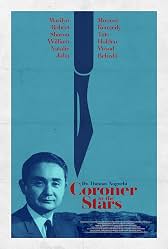

“Coroner to the Stars” (2025) is a documentary primarily about the career of Los Angeles County’s former chief medical examiner-coroner Dr. Thomas Tsunetomi Noguchi, a Japanese immigrant and high-profile government official who conducted autopsies on numerous famous people. In their feature debut, codirectors and cowriters Ben Hethcoat, Keita Ideno and cowriter John Henry Hinkel excel at laying out a clear story and offering context to an audience unfamiliar with the area, the people or the era, but teeter on the verge of hagiography when refusing to give details about the controversies that beset him and missing an opportunity to refute them. Still, you should bring a box of tissues because at the end, you may find yourself crying or need to kick out whoever is randomly cutting onions in your vicinity.
“Coroner to the Stars” conducts exclusive interviews with Dr. Noguchi, who starts with describing his first encounter with death, his interest between the intersection between medicine and law, and his career. People who are currently working in the same field are proud to sing his praises such as the current chief medical examiner-coroner in LA County, Dr. Mark Fajardi, former Deputy Medical Investigator Vidal Herrera, former chief medical examiner-coroner from the Commonwealth of Virginia Dr. Marcella Fierro, former student and chief medical examiner-coroner Dr. Lakshmanan Sathyavagiswaran, former President of the American Academy of Forensics Dr Cyril Wecht, former Chair World Association of Medical Law Dr Richard Wilbur, and LA County former Senior Criminalist Steve Dowell. Without being pedantic or macabre, each makes the profession understandable to the ordinary viewer who may have no understanding of LA County’s government structure, the duties of the office, science and politics. That is a lot of material to cover in a short amount of time, but the film makes this high wire world with its competing areas of expertise comprehensible at the ground level. A lot of these people are former colleagues, employees, students, and they support Dr. Noguchi’s account with their own perspective without sounding rehearsed or identical.
To illustrate the story, the filmmakers use a plethora of black and white and color photos, press conferences, newspaper clippings, movie clips starring the autopsy subjects when they were alive, glossy movie stills and lots of archived footage. There is never a point in “Coroner to the Stars” where anyone could possibly be confused about the year and location of the events being discussed. There are often contemporary establishing shots with the orienting information written on screen.
The documentary predominantly summarizes the events of his most high-profile cases and controversies in chronological order starting with Marilyn Monroe, Robert F. Kennedy, the 1969 civil service hearing, the Manson murders, William Holden, Natalie Wood, and the 1982 civil service hearing. Even if you do not know the actors, the stories are innately interesting because the method of determining cause of death and Dr. Noguchi’s approach to his work are absorbing. The RFK story provides information that is not commonly known today. For movie lovers, you may find yourself dying laughing because the archived footage reveals that no one knew Christopher Walken’s name though they refer to him as some kind of newbie. To be fair, all the archived news footage mispronounces Roman Polanski’s name.
“Coroner to the Stars” feels as if it gets furtive around the first hearing. There are lots of references to jokes and charges, but no specifics whereas in the second one, the allegations are slightly more detailed, but still vague. A current elected member of the LA County Board of Supervisors Janice Hahn bolsters the credibility of the arguments because naturally his lawyer, Rosalind Marks of Isaac & Marks, is going to argue in favor of their client. Still the reason for the omission does not have to be innately evasive or suspicious. The film never got around to explaining what kind of artist he was and did not appear to show his work. There were only brief clips of him cooking. A good rule of thumb is not to reference anything without at least briefly depicting and elaborating on that reference.
“Coroner to the Stars” is admirable because it clearly aims to give flowers to Dr. Noguchi while he is alive and can enjoy them but is torn between being thorough and understandably refusing to entertain spurious allegations. The proof is in the pudding. If Dr. Noguchi did something truly egregious, he would not have had a long career after the controversies, and his students would not then become officials, but be eyed with suspicion. The US is trying to revert to its original settings where even the whiff of difference comes with accusations of being woke. The documentary will be a Rorschach test to determine how familiar people are with racial dynamics in the workplace and how many will be triggered at the idea of having someone different from them with an accent talk about tribulations even if he is successful. Only you know which category that you belong to so decide whether you want to watch this film according to your preferences but consider yourself warned.
Still the best disinfectant is sunlight, and the trial portions of “Coroner to the Stars” are not as thorough as the rest, but it does nail providing the socio-cultural context. University of California Asian American Studies Professor Renee Tajima offers great insight into Japanese American activism that mobilized in Dr. Noguchi’s favor, specifically JUST, Japanese United in the Search for Truth. George Takei took an active role in defending Dr. Noguchi’s reputation at the height of his “Star Trek” fame and provides an exclusive present-day interview, which is only a fraction of the film’s content, not the majority as some detractors claim. Further popular culture context is offered such as references to Dr. Noguchi being the inspiration for “Quincy,” a television series starring Jack Klugman, who is also famous for “The Odd Couple.” Race bending usually happens in favor of majority culture, not reality, because the assistant in the series was Japanese. Isn’t it nice that such casting is a thing of the past?
This documentary embeds a sneak attack of the feels and evenly distributes throughout the personal intimate account of how Dr. Noguchi met his wife, Hisako, a Japanese American, who steels him with love and good advice on how to prepare for the American experience. There is only one video appearance of her, but plenty of photos. Dr. Noguchi cannot stop talking about her, and his relationship to death implies a yearning and acceptance of the loss of his wife. Family friend Masako Easton also attests to her memory and provides a first-hand intimate account of what it was like to witness the couple face his travails together.
“Coroner to the Stars” should have spent more time on Dr. Noguchi’s life after the high-profile career ended, and he was able to become well established without attracting as many haters. He says, “I don’t need this.” Love! Attorney Marks thoughtfully describes him as a coroner to the people, and his fight for funding plus discussion from others who worked at the office substantiate this more honorable title. Knowing what people have studied about workplace dynamics, it seems obvious that a lot of factors were at play in his persecution. He was the professional who did not respect the hierarchy but only cared about the work so drew the ire of powerful people within the government who may prefer a more hierarchical performative standard of working. He was the sizzle and the steak which made many jealous eyes target him because they saw the spotlight as their birthright though they were mediocre in comparison (the interviewees are merciless in their judgment and name names while the film offers faces). If the joke issue during the first trial was elaborated on, it could be that they were taking veiled digs based on prejudice. In the end, the real story is about love, endurance and support from a personal and professional community.