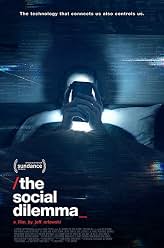

Normally I am behind the crowd and struggling to catch up, but finally I am right in the middle of the herd and watched The Social Dilemma at the same time as everyone else because a member of my small group recommended it, and we planned to have a discussion afterwards. I love watching documentaries and normally would not have the opportunity to talk about it afterwards, which is a factor in why I write reviews. Once I saw that it was a Netflix documentary, I groaned a little because they are usually the weakest documentaries. They always feel gimmicky and miss points that other documentaries would instinctually make. I have seen a handful of them so I was just relieved that this one did not try to insert a random, unnecessary detective into the narrative.
The Social Dilemma tries to persuade its audience of the dangers of social media, and I largely agree with its substantive points. I often think of these types of documentaries as preach to the choir documentaries because you have to agree to find it interesting enough to watch for the entire ninety-four minutes; however if a person is really far gone as a social media addict, I would not substitute this movie for an in person intervention. This review is not about its content, but how the film was guilty of manipulating audiences while criticizing companies for using artificial intelligence to manipulate us. When my cat meows at me, I know that I am being manipulated but I go along with it because it appeals to an emotional response that I cannot reason my way out of similar to Blackfish, which hits me in the heart and never stops marrying my feelings with outrage. This documentary never succeeds at squeezing my heart.
The Social Dilemma wants to borrow some elements from documentaries that express outrage for corporate wrongdoing, which results in victimizing ordinary people, without explicitly laying blame at anyone’s feet. If you read the news, you will be aware of which companies have acted inconsistently or in bad faith with their declared purpose, but the fact that this documentary omits this fact is a cop out. Documentaries are generally informative and do not assume that the audience brings a certain amount of knowledge to the table. This omission is the equivalent of wanting praise for actually not doing anything brave at all. For instance, when the movie introduces pioneering, high level titans in the social media industry, they talk about their personal concerns, but there is no follow up question about what they did in their official capacity to change the problem that they think is an existential threat. As a lawyer, I can assume that they have signed nondisclosure agreements, but that fact could have been explicitly expressed. It is the equivalent of having Sunday brunch while bemoaning racism, but going to work with a certain level of power and remaining silent. At least hint to me that you tried.
I also noticed that documentaries that want to be persuasive will avoid even using anything vaguely liberal or Democratic. I immediately was suspicious during the opening sequence of The Social Dilemma when they managed to find a one-sentence clip with Tucker Carlson being reasonable. Later on, there is a sequence that occurs around a Congressional hearing and a montage of politicians complaining that people are ostracized for the way that they vote. Marco Rubio and Jeff Page get lines. The documentary omits what that vote is actually for. Then during the same sequence, it shows various people, including a woman that I did not recognize on social media whereas Tim Scott, another Republican, is shown actually interacting with people and being friendly. The Social Dilemma is using false equivalencies so it does not seem biased. It even goes so far as to go to Myanmar to illustrate how the internet could take politics to the extreme when we could stay home though Russia is alluded to, but not those Americans who worked with Russia to propagate that propaganda. There are only a handful of people of color who appear as experts, but only two actively participate in interviews and archival footage is used for one.
There are people of color in The Social Dilemma, but they are disproportionately in the fictionized portion and are usually negative actors; thus creating another false equivalency, but more harmful because it is totally fabricated to create a reality that does not actually reflect the real world problems that people face on social media. This documentary does not trust its audience to understand the concepts that the academic experts or the industry leaders opine on so they create a fictional family to illustrate the dangers of social media in the vein of Sid Davis’ social guidance films. I would have preferred if they interviewed people who actually struggled with the problems that the dramatizations ridiculously illustrate.
Please note that most of these social guidance films did not age well though they can be amusing so maybe if you liked this narrative device, call it the Afterschool Special portion of the documentary. I am not a fan of putting explicitly fictional elements in documentaries with the exception of recreations in the vein of The Invisibles or Unsolved Mysteries to show us something that was not recorded so The Social Dilemma turned me off. This family consists of a black stepdad, a white mom and two older kids and youngest child is a person of color, who is specifically Native American and Indonesian in real life, but most viewers would presume that she is a biracial. She does something so outrageous that would definitely get you in trouble if you had a parent of color. To be fair, I do not have a black dad, but as a person with a black mom, she would be done. She may even get in trouble with her siblings! Also in the sequence that shows the son listening to crazy people, it is a pretty even split between white and black people when we actually know that white supremacist groups are trying to radicalize young white boys online based on mothers and former white supremacists talking about it. Does the movie try to find any of these people and get them to speak for this film? I will give the casting director points for getting one Mad Men alum to play the AI. Get money and allude to popular culture to make the AI seem subconsciously more powerful!
The Social Dilemma also had a moment of such striking dissonance. Roger McNamee says that when he is online, everyone agrees with him. Where is this wonderful world, and how can I get there? The documentary never even considers that the AI suffers from implicit bias that specifically alienates and consistently punishes people who do not share a majority view such as people of color who then find ways to still use the technology in subversive ways that even the AI cannot anticipate.I really enjoyed the last five minutes of The Social Dilemma, including the credits, which give practical tips on how to stop being manipulated by social media. I am not sure if I am ready to try them all, but I will definitely start to introduce them into my life. A member of my small group also suggested the following films if you are interested in this subject: The Great Hack, which is in my Netflix queue, and Agents of Chaos, which is available on HBO.