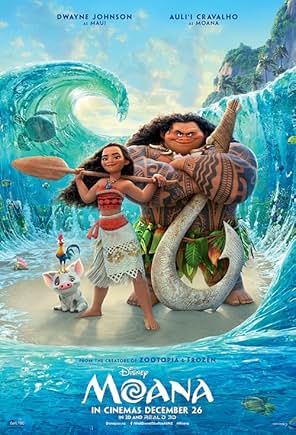

“Moana” (2016) is about the titular daughter of a chief (Auli’l Cravalho) who feels drawn to the ocean, which her paternal Gramma Tala (Rachel House) encourages. Moana tries to heed the warnings from her father, Chief Tui (Temuera Morrison), to stay on their island, Motunui, where all their needs are provided. When their crops begin to fail, and the fish disappear, the legend of demi-god Maui (Dwayne Johnson) needing to restore the stolen and lost heart of Te Fiti begins to seem like the only answer. Is Moana the one who can solve this problem? The ocean and Gramma seem to think so, but are they right? Too many cooks do not spoil the broth in this writing room with a consistently unpredictable story embedded with some timeless lessons.
Cravalho’s first role was as the voice of Moana, and what a way to begin a career: as an instant icon heading a franchise. “Moana” distinguishes itself from other animated movies because Moana is already the chosen one as the next chief in an ancient Polynesian village and has a pretty perfect life, but the end of the world and starving to death are convincing reason to leave her comfort zone. Also, she has no unique powers per se except the ability to see and believe the visions of the past and not wait until she learned everything before embarking on her journey. (Side note: why did not the ocean choose Gramma?) It is surprising that there were no complaints about the imagery, which starts like a kid’s first visit to the aquarium when Moana as an infant first wanders into the ocean that moves so she can see inside the water safely while surrounded on three sides, before transforming in the denouement when to the waves parting in a fashion that would make Cecil B. DeMille jealous.
Johnson sounds surprisingly good as a singer. From the opening narration, Maui seems like a villain, but it is off set in the way that he appears. The animation makes him seem childlike: soft and curvy instead of angular and muscle bound like the Rock. His physicality is more like Jack Black. As animals, he does not seem exactly like the animal but has the same rounded edges as the demigod in humanoid fashion. Let’s just say that I was not exactly sold considering how he treats Moana, whom he believes is eight years old, in their first encounter. His actions are tantamount to attempted murder. “Moana” lets him get off easy, and his rehabilitation was not long enough. His origin story and ensuing coping embeds an important lesson about the dangers of trying to earn love, but the lesson does not entirely resolve the issue. He is vain and selfish, then in the denouement, he acts selflessly at potential great cost to himself, including risking the loss of his magical powers and death, but his story still feels unfinished. It is also interesting that his origin story also shares elements with Moses’ origin story and Prometheus but are not derived from them. The real story of Maui does not characterize him as a demigod, but the exploits listed in his introduction song, “You’re Welcome,” are accurate. Great use of folklore!
In an unexpected upset, “Shiny,” while not the best song, stylistically stands out from the rest. Jermaine Clement sings in an early David Bowie style when playing Tamatoa, a giant crab who has Maui’s hook, which allows Maui to shape shift. The rest of the songs sound more like Disney and probably have brought tears to many people’s eyes. Lin-Manuel Miranda of “Hamilton” fame penned the songs, but it was unexpected for him to pay homage to a rock star. Co-composers include Samoan Opetaia Tavita Foa’I and Mark Mancina. The most random cast member is Nicole Scherzinger from the Pussycat Dolls and later Tony award winner, who plays Moana’s mom, Sina, but her individual, impressive vocals do not get center stage though she delivers a moving, insightful dialogue scene with her daughter. If some part had to be cut, let it be the Kakamora, the hostile coconut people. It would have been nice if Hei Hei (Alan Tudyk, the only non-Pacific Islander voice actor) played a more pivotal role in the denouement. Many movie goers would probably share the bird’s reaction to discovering that he is a stowaway on Moana’s maiden voyage. Relatable fowl.
The denouement twist is incredibly powerful and unexpected. While watching the film, it was easy to get distracted when it took a left turn and get lost because the emphasis on important threads could be lost and make the overall tapestry unclear in the moment though it does come together.
S
P
O
I
L
E
R
Te Fiti transformed into Te Ka when Maui took her heart! They are not two different entities, but the same. The ensuing darkness was because Te Ka was trying to retrieve her heart, and Te Ka was rightfully fighting Maui probably because she was angry and worried about what else he was going to take from her. Moana was the chosen one because healing requires community. Maui returning the heart would have only resulted in his destruction, and Te Ka would probably remain. If Te Ka had retrieved her heart or the ocean returned it to her, the result would be the same, and creation would be unlikely.
Moana is the chosen one because of her wayfinding ability, which applies to life as well as navigating the oceans. She can see what happened and the present clearly, bring both elements together then find a way to move forward. Because she understands Te Fiti’s transformation and how Te Ka is not a monster, she can distinguish herself from Maui and approach the goddess without being aggressive or afraid. Te Ka’s anger is justified. Once Te Ka is brought back into society through acknowledgement and recognition, she can become Te Fiti again.
If “Moana” has a flaw, it is impossible for a person to return to who they were before an injury. It would have been terrific if the storytellers and animators could have found a way to meld Te Fiti and Te Ka in appearance. After all, there are active volcanoes with surrounding communities. Also, it was puzzling that while Te Ka was a lava monster, neither Maui nor Moana were ever burned, but that is the magic of the movies.
The injury felt very serious almost like a rape metaphor, which is surprisingly mature content for children. It may not have been the storytellers’ intent. Te Fiti returning his fish hook was incredibly generous, and the live action movie does a better job of conveying that she is still incredibly angry even though she restores his powers.
It seems incredibly incisive that an environmental disaster is the result of violence against a woman because disrespect for one life that is the symbol of the creation indicates a similar deteriorating ripple effect because *gestures wildly around the general world*.