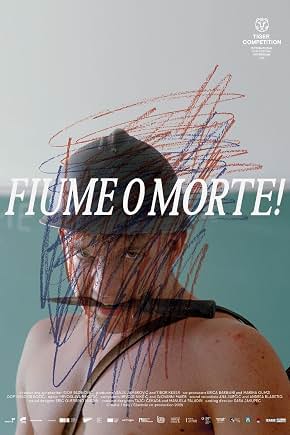

“Fiume O Morte!” (2025) translates to “Fiume or death,” and Fiume is the city currently known as Rijeka, which is currently in the Republic of Croatia. The meta docudrama is the equivalent of Croatian writer and director Igor Bezinovic breaking the fourth wall and showing how a movie is made while delivering a history lesson of that region from 1897 through 1920 with a special focus on Gabriele D’Annunzio, a World War I Italian vet and alleged coked up writer who gave a preview of fascism when he decided to invade the town and claim it for Italy from the Kingdom of the Serbs, Croats and Slovenes, which would eventually be known as Yugoslavia. Bezinovic casts ordinary citizens to make a movie about this occupation in the same locations where the events happened. Basically, he made a period film without the pageantry and accurate surroundings or professional actors. For the average American moviegoer, this film will be a heavy lift.
“Fiume O Morte!” is challenging because an average viewer is learning about an unfamiliar region’s surreal slice of not widely known history in a foreign language in an unusual way. Also, there are subtitles. You will likely need to pause then rewind repeatedly to truly absorb the details coming at you such as the number of countries involved. In the truest sense, it is a foreign film. World War I is a huge turning point, and the world before and after looked very different compared to today. If you do not have the slightest knowledge of history or the region, the narration helps, but it moves briskly through the information that it can often pass before it is absorbed, but you will get a gist.
Bezinovic is not Italian. The tone of “Fiume O Morte!” is to show how the events of that time are still an integral part of daily life though fascism is a potential controversial point. The person on the street interviews may remind you of a late-night talk show skit where they interview people to see what they know except these people are often knowledgeable. It segues into an interview in the Governor’s Palace as he asks the interviewees if they would like to participate, and the only qualms expressed are whether they would be suitable occupying their character’s roles in real life. Unsurprisingly the young men have zero interest in being soldiers, but one older man, a musician who may be neurodivergent, seems receptive to the prospect, and the transition to the title credit blurs the lines between the past and present. Everyone is breathless at the opportunity to be in the movie.
The closing credits name the amateur actors, but the interviews only offer the barest of details: age, profession, the language that they speak. Putting ordinary dressed people in a stately ornate location is a contrast that prepares the viewer for their later transformation doing the opposite: acting and dressed ornately in ordinary locations. Fiumano is a local dialect of Italian, and people who can speak it were slotted into roles to evoke the city at that time. If you are an American who does not speak any of the languages featured in this film, that period accuracy will be lost on you, which is why more filmmakers need to adopt Chan-wook Park’s subtitle technique of using different colors for different languages in “The Handmaiden” (2016).
By just showing the four-digit numbers on a building entrance floor or doormat beginning with 1897 and passing in quick succession through editing, Bezinovic may be the best filmmaker at conveying the passage of time and the tone of an era. When the story lands on 1915, the door closes slowly to convey the somber beginning of World War I. Such a simple, quotidian gesture is surprisingly evocative. There are montages with a plethora of postcards, black and white photographs and some film footage from that era so it is a practical, inexpensive way to feel teleported to that time. Also, he occasionally pauses the archived footage to allow the narrator time to summarize the broader context of the action, and with an audible rewind sound to show how stalled they were. The opening sequence set the stage and juxtaposes the present-day location with the image in the photos and explains what it is during the time of filming. This technique is repeated throughout the film except the interviewees are now dressed in character though occasionally they are shown prepping for the role with setting the stage such as moving furniture. When it is time to profile D’Annunzio, the men who will play him stand on a ladder next to his portrait to see how they measure up.
Once the recreation gets into full swing, it reveals the absurdity of the situation but placed next to footage from the past of seemingly enthusiastic people, it seems chilling. “Fiume O Morte!” also proves that a lack of a budget is no problem for a creative person with an imagination. If it was an expert recreation, it could erroneously convey the wrong message about D’Annunzio’s occupation, but the ordinariness of the actors echoes the lack of true authority of the bad faith actors in the past. The direct violence against the city’s residents who were not Italian is not recreated but discussed. It is a tasteful choice, but if someone is overwhelmed with all the information, it could be missed. This movie demands repeat viewings. The first time is for orientation, and the second time is for enjoying like any kind of movie assuming that you have enough energy to return to the well.
Using multiple actors to play D’Annunzio is a brilliant silent commentary on the nature of fascism. In “Fiume O Morte!,” D’Annunzio is often depicted as if he is like Mussolini and is even described as his John the Baptist, but it is also a commentary on the mutability of fascism, and how it appears in different forms. Though it occurred over one hundred years ago, there are many valuable lessons that can be derived from this story. Do not let armed people without appropriate authorization enter any place and occupy it in hopes that they will suddenly obey social norms with strong words of admonishment. Behind the scenes, there is some big business sponsoring and benefitting from the upheaval. Fascists may talk a big game about doing things for the people or the government, but usually it is neither since they were not democratically elected, and Italy never wanted to annex the city state. It was basically a bunch of cosplayers who were the only ones sad about the end of World War I, and all the people who could stop them were too fatigued to do so. Fascists, along with an alarming number of other groups who profess otherwise, hate free speech, especially if it is in opposition. Fascists were not the majority, but they acted like it, and do not play fair. Fascism leads to lawlessness and unsurprisingly, they managed to attack the French troops who happened to be from Vietnam, which is obviously a coincidence and not evidence of racism. Blinks twice.
Though D’Annunzio was not a failed artist, people should be leery of leaders with experience in showmanship. They know what to show and what not to show, i.e. the abrupt cessation of a vote, which Bezinovic stubbornly depicts in a brilliant photo montage. “Fiume O Morte!” shows how fascism could happen today in literal extremes. You need to be well rested and open minded to process this one.