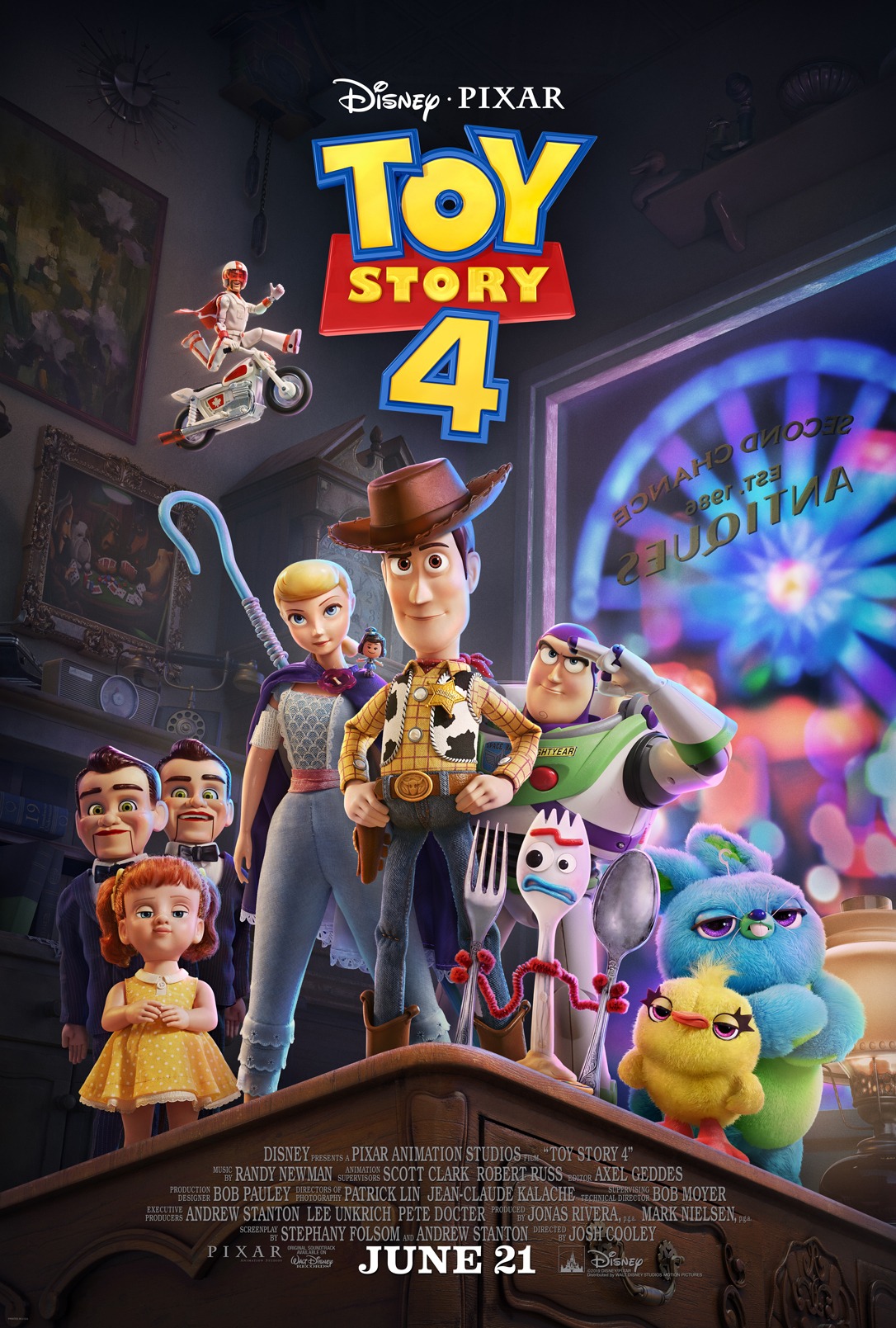

“Toy Story 4” (2019) shows what life is like for the toys now that they are living together with a new child, Bonnie (Madeleine McGraw), and getting adjusted to a new home and new routines. Bonnie’s head toy, Dolly (Bonnie Hunt) is in charge, and Jessie (Joan Cusack) is becoming Bonnie’s favorite toy while Woody (Tom Hanks) is getting left in the closet gathering dust. He decides to disobey orders and oversee Bonnie on her first day of school thus witnessing the birth of a new toy, Forky (Tony Hale), whom Bonnie made from garbage. Forky does not get it and keeps trying to return to the trash. Woody is on permanent guard to ensure that Forky does not respond to the call of the void, but while on a road trip, he loses him, and once reunited, gets distracted at an antique shop. Instead of finding a lost friend, he finds a new toy villain that threatens to keep the toys separated from their child forever. Will they get out alive and unscathed? This installment feels like another action-adventure film rather than an emotionally resonate film that breaks new ground. It also pulls punches on its villains and the implications of the villains’ actions.
“Toy Story 4” has Woody trying to figure out his next chapter. Interestingly the film correctly decides not to explore Woody’s potential regret for not staying with Andy (John Morris) and going to college. With the benefit of seeing “Toy Story 5” (2026), this creative choice was not intuitive, but the exact right choice. Instead, it decides to explore a throwaway line from “Toy Story 3” (2010) about the toys that were no longer with the main crew, which includes Bo Peep (Annie Potts), Woody’s romantic interest, and her sheep, Billy, Goat and Gruff (Emily Davis), whom Woody has zero connection to. This film shows how that separation happened, and while the circumstances were out of the toys’ control, it aligns with Woody constantly choosing Andy over prioritizing himself. Woody is going through what a lot of parents experience when their kids leave home. What do they do with their life? It also prepares the audience for letting Woody share center stage with a strong, adventurous woman toy that likely helped the transition coming in “Toy Story 5” when Buzz (Tim Allen) and Woody become supporting characters.
Once again, the villains are toys, and even the familiar toys are questionable as there is a running gag about getting Bonnie’s dad (Jay Hernandez), Walter (found out his name in “Toy Story 5,” but still do not know her mom’s name), arrested and sent to jail so the toys have time to complete their various missions and return to the RV in time without getting lost. This installment distinguishes itself as the toys at their most annoying and creating their own problems or problems for other people. Up to now, they have largely been innocent caretakers of children with the villainous ones being outliers in toy society driven to desperation from life experience, but everyone was a little careless this time around.
There are lots of sets of new toys introduced in “Toy Story 4,” and none of them have a child of their own. The toys in the antique shop have a hierarchy. Gabby Gabby (Christina Hendricks), a talking doll who feels like the inspiration for “Megan” (2022) is at the top. She has henchmen, a group of identical looking ventriloquist dummies called Benson (Steve Purcell), is manipulative and has an agenda that would make her an immediate pariah in the toy community if the values of “Toy Story” (1995) were applied equally here, but because her motivation is the same as the other toys, the film treats her with kid gloves, not like the monster that she is. It also could be because movies pull punches when it comes to women behaving badly if they pull a sad face. Awww, is the evil woman sad? Make her happy. She is not evil if she is pretty.
The other toys in the shop are not as individuated but are basically trying to avoid becoming a toy for the store’s cat, Dragon (boo to the anti-cat propaganda). Because toys at the antique store are never bought, the only other option is a brief reprieve if the store owner’s granddaughter, Harmony (Lila Sage Bromley), decides to play with them. So some of those toys decide to become lost toys and socialize with the carnival toys. Duke Caboom (Keanu Reeves) is basically a Canadian Evel Knievel toy, and if I had known that Reeves was in the franchise, I may have continued watching the franchise earlier, but it is more sizzle than steak. Officer Giggle McDimples (Ally Maki) is not memorable except in a Jonah and the whale way. Bunny (Jordan Peele) and Ducky (Keegan-Michael Key) are carnival prizes that cross paths with Buzz. Also, there is a motorized skunk toy who remains an object for other toys to use and ride around in, so they do not have to follow their prime directive and stop moving when human beings are around. Brilliant! They introduce the concept that being a lost toy is not bad because they can exercise their autonomy and have a life. It is a provocative idea that kind of goes under the radar and is not fully explored but is punted as choosing one form of love over another instead of some kind of artificial suppression through magic. What governs the magic of this universe?
If Buzz is in a movie, he must illustrate an identity crisis, i.e. the mutability of his character. Maybe it is the Pinocchio Principle or the Velveteen Rabbit. What makes a toy real? Is it because he is made of plastic, easily mass produced or has a power source that he is depicted as not having a soul or a unique personality like the other toys. In this case, it becomes clear that Woody has an inner voice, a conscience, that tells him what to do. Buzz makes it literal and keeps activating himself as if he was a child playing with his features to activate his voice features then he follows what that literal, mechanical, prerecorded voice says. The commands do fit the situation and function the same way, but it is the equivalent of being your own Magic 8 ball.
“Toy Story 4” ran the risk of becoming a franchise that exists to make money with the toys having escapades completely untethered from the emotional richness and authenticity of the first two films because of their fraught relationship to human beings. It could have become a high-quality animation series with no real center or through line in terms of story continuity, and probably its audience would be happy because kids movies do not require that their target audience recall what happened before. The fact that the franchise did not take that route, but instead chose to return to its roots and elevate itself further is a testament to the quality and care of the franchise in a world that usually rests on its laurels.