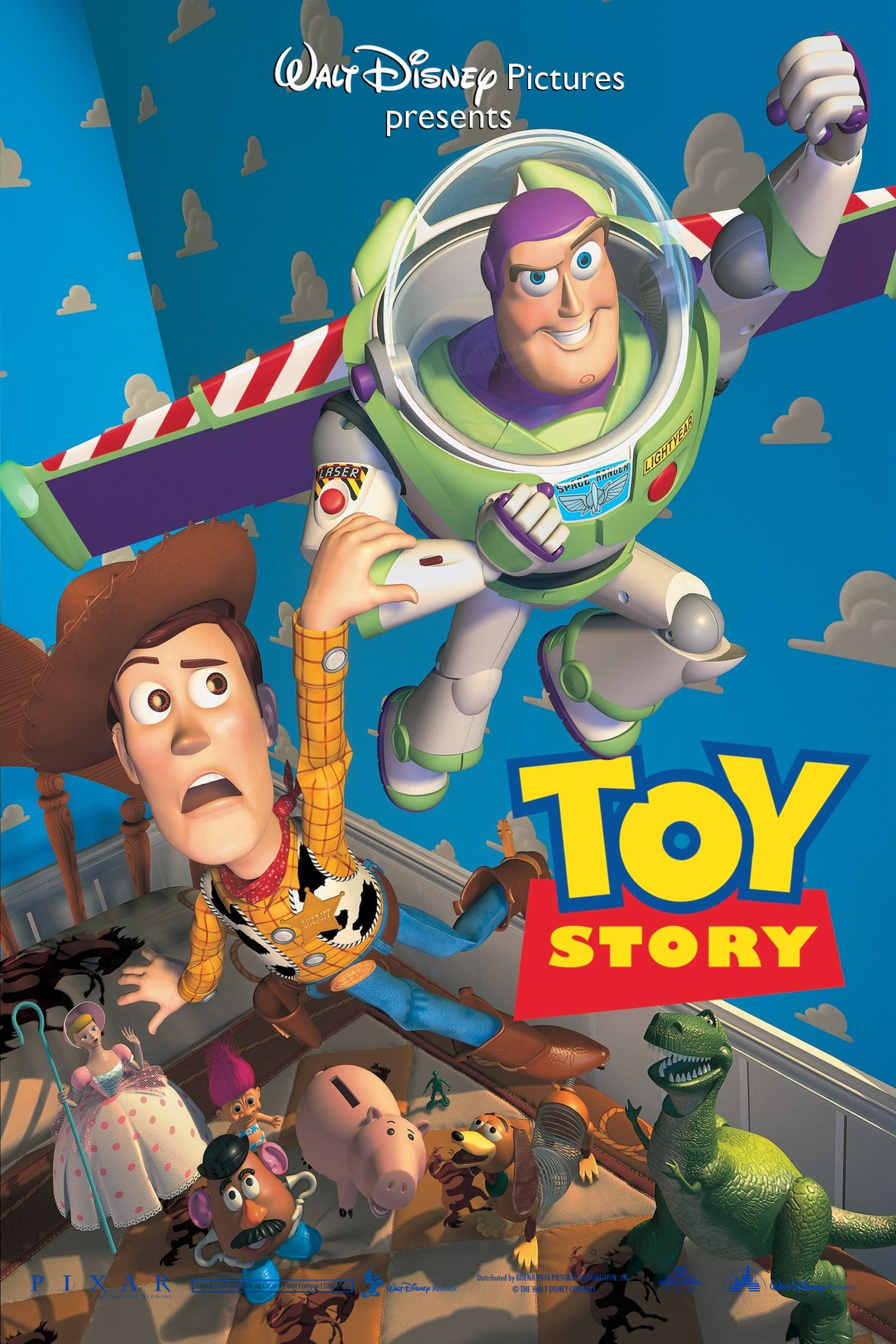

“Toy Story” (1995) is a midlife crisis, workplace or multiple wives drama disguised as a kids movie and heavily borrows the inevitable existential crisis of oblivion that toys faced as far back as “The Velveteen Rabbit” (1922). Sheriff Woody (Tom Hanks), a toy, rules the roost or their child owner’s bedroom. The movie starts with a birthday party and a ticking clock, a big move to a new house. The toys fear being left behind, losing their status if Andy (John Morris), their child, receives a better toy as a gift, or ending up in the clutches of Sid (Erik von Detten), the kid next door. Woody faces his fears starting with the arrival of Andy’s new favorite toy, Buzz Lightyear (Tim Allen), who does not know that he is not actually an astronaut. When Woody tries to regain Andy’s favor, he commits an act intended to be backstabbing, not homicidal, but the other toys, who ditched their leader and fell in line with the new pecking order, are horrified and do not believe him. Woody and Buzz end up far away from home. Will they restore their sense of self, mend fences and find their way home? It is a brilliant movie, but after seeing a movie like “I Am Frankelda” (2025), it feels like wading in a kiddie pool.
Director and one of four writers who received an original story credit John Lasseter (the other three were Pete Docter, cowriter Andrew Stanton and Joe Ranft) and cowriters Joss Whedon, the aforementioned Stanton, Joel Cohen and Alec Sokolow proved that it is not a hard and fast rule that too many cooks spoil the broth. It was brilliant to pit a cowboy against an astronaut. The archetypes evoke two predominantly Western figures pioneering and exploring new frontiers with a sense of adventure, fearlessness and macho connotations, but the reality is far more fragile and nuanced. Both experience identity crisis and realize that they derive too much value from their occupation and external validation, not their relationships or their personal ethics.
Woody falls the hardest because he goes from unquestioned stable leader with a girlfriend to a toy accused of murder confronting his most tenebrous corners alone until he becomes the toy whom he originally thought that he was. Being a cowboy is the past, and facing his impermanence brings out the worst side of his personality. “Toy Story” is powerful for showing how insecurity and creating competition where there is none already turns Woody into a loser. He goes from a toy and leader who wants to ensure the safety of all the toys in the move to a toy who wants to hoard favor and loses it all. It is a valuable lesson that most adults do not learn. Woody goes from a confident toy with experience and a community to a toy alone, in danger and emotionally frayed whose ugliest side, his bias against other toys, exposes his ignorance and inexperience.
Buzz is another kettle of fish. He is not entirely likable because he is delusional, but as an astronaut, in contrast to a cowboy, he is futuristic, the next big, flashiest thing. He is not even aware of his surroundings, sees people as temporary or stops along the way and does not even realize his privileged position. He is always on the clock without realizing that he is in a different time zone. Unlike Woody, he is oblivious to the danger that he puts others in, overestimates his abilities and resilience and takes longer to bounce back.
Fortunately, anyone who has seen a movie will expect that this journey will unite the odd couple and make them best of friends with everyone learning a lesson. “Toy Story” is fun because there is not a single thread left hanging, including threads that never needed the loop to close. It was interesting that Sid’s home life is explored more than Andy’s, and the implicit lessons embedded in there are counterintuitive for a kid’s movie. Andy’s father is never onscreen, but Andy has a younger sibling. So the ideal home to raise perfect children appears to be a single mom, Mrs. Davis (Laurie Metcalf), as the head. In contrast, Sid has two parents, a tv zombie dad and an overindulgent mother, but neither are aware that Sid is a budding serial killer who may blow off his hand before escalating because of Sid’s penchant for fireworks and explosives. Also, Sid’s little sister, Hannah (Sarah Freeman), is not protected from her little brother and must fend for herself. It leads to an inherently abusive dynamic though Hannah seems to be making it work. The traditional family structure is depicted as deviant, but Andy’s home is almost sitcom perfect.
“Toy Story” also brings up the thorny issue of whether animals are competition with toys. In a framework where they are both sentient beings, it works, but it is also shocking. Usually animals are anthropomorphized at the movies. Sid is the only one with a dog, and he is vicious to toys, but the movie ends with Andy receiving a puppy for Christmas with all the toys laughing nervously. Andy’s family is already framed as the ideal family, especially compared to Sid, so maybe the dog will be fine, but there is also a new fear unlocked that they will be chew toys. It is interesting that the movie feels incredibly light but finds a number of ways to explore mortality without being explicit or graphic. Also the prevalent anxiety over change or displacement hangs over every moment. Kids will relate to the toys and think of new additions to the family such as new siblings, stepparents or meeting new relatives who end up staying over. For adults, it could evoke fears of layoffs or remind them of a fear of oblivion. Unlike the toy one upmanship, which is purely about competition, animals make it clear that at some point, toys are not even going to be a classification of entertainment that will survive in the near future.
“Toy Story” is impressive in the way that it can appeal to so many different people in the audience. It is set in a largely suburban area, and neither work nor school enter the equation, but it is simply a slice of life, a weekend, a day off or a holiday. Anyone can relate to being lost, birthdays or trying to evade the bully next door. I remember seeing this movie, but don’t recall if I saw it in the theater or at home. I’m surprised at how little I remembered, and it essentially felt like watching it for the first time, but almost three decades later, it holds up.