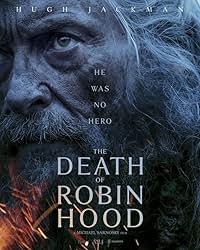

“The Death of Robin Hood” (2026), aka the prequel to “Logan” (2017) (just kidding), loosely adapts and reimagines the seventeenth century ballad, “Robin Hood’s Death,” as an artsy fartsy compare and contrast between the legend and the reality of the titular character (Hugh Jackman, who looks a lot like Mel Gibson in this role) if the descendants of those he killed were able to make Robin Hood internalize their loathing and horror of the man. What would redemption look like for this outlaw? If you are expecting a rousing action movie where a bad man protects women and children from other bad men, consider yourself warned. This movie is going to tank because it will be attracting the wrong audience with its marketing.
Casting Jackman as the worst of the worst is like putting your thumb on the likability scale. Who is the sweetest, hottest murderous brigand? Jackman is. For audiences, movie goers have been watching his Wolverine treat people like human shish kebab without blinking an eye. Indeed, this Robin Hood kills people, some kids, brutally and often, but he also tries to talk people out of their murderous plans. He is mostly operating out of sekf-preservation reflex and obligation to Edward (an unrecognizable Bill Skarsgård and somewhere his brother Gustaf is thinking that he could have played this role), formerly known as Little John, who is trying to rescue his family from (need subtitles to give you more details). The first act of “The Death of Robin Hood” has tons of bloodletting (dad joke, trust me) and hand to hand fights so if you are looking for that kind of thing, drink it in while you can and store it like a camel because you are not getting anymore.
The rest of “The Death of Robin Hood” takes place on an idyllic island with a priory that Sister Brigid (Jodie Comer, a genius chameleon character actor who always disappears into her roles) runs. Robin ends up there with some grievous wounds, lies about his identity and introduces himself as Randalf. While convalescing under Brigid’s soothing, ecumenical and no questions asked eye, Robin gets introduced to a life that he did not think existed on Earth.
Writer and director Michael Sarnoski deserves credit for showing, not telling, though the sparse dialogue prose dumps disproportionate to the space it occupies. In the first act, cinematographer Andrew Mondshein depicts life on the rocky mainland as steely blue cold, overcast grey, or fiery, violent red whereas the island is the first place where the warmth and glow of the sun is revealed along with verdant grounds, which includes a mysterious cave with an impressive melted candle collection on the stone altar and the wall of the cave looks like a man is carved into it or it is a Rorschach natural formation. It looks like paradise, and everyone wears the same color blue as the flowers on the forest floor, but it does not scream cult like “Midsommar” (2019). Robin wears white as does another newcomer on the island: impractical, but heavy-handed symbolic. Get it! He has a brand new fresh start. After a harrowing experience, Little Margaret (Faith Delaney) seeks refuge there and clings to Randalf as the only person whom she instinctually feels safe around even more than Brigid. See, kids like him so how bad could he be.
So “The Death of Robin Hood” comes to a crossroads. Will Robin continue to be Randalf and have a peaceful, loving life or will he stop hiding and admit to his real identity? The tension of the latter is the temptation and burden of what that identity represents and the inevitable death and destruction that follows. Sarnoski is very interested in the theme of stories and how the tool gets used as propaganda to kill or to inspire or to find common ground and communicate instead of kill. Will that part exactly resonate? No. It did not feel visceral. While the resolutions works for the purposes of this story, it is a bit pat and a compromise. The hardest part about redemption is living in the mistake and changing behavior, but instead it feels as if Sarnoski is doing his best Justin Kurzel impression. It does not measure up to Kurzel’s best, but it is definitely better than some of Kurzel’s latest films, which are often meditations on men telling stories as cover for engaging in bad acts, which they would do without the story, but then would endanger themselves with the Damocles sword of guilt.
If “The Death of Robin Hood” has a problem, it is not artsy fartsy enough. It is a cynical move to give away the spoiler in the title and the identity of its protagonist, which makes the film feel longer than necessary as you wait for the inevitable. Don’t hate the player. Hate the game. It is far easier to get people to see a movie about Robin Hood then have the adventurer have an existential crisis for the entire movie rather than introduce him as Randalf from the beginning, let there be a mystery about the reason that people keep attacking him and his family man friend, and shock the audience with the revelation of Jackman’s character’s identity and his real story as seen through the eyes of people who feel like his victims. It would have been more of a gut punch, but without the well-known character creating a built-in audience, there would be fewer people buying tickets. On the other hand, people saw “The Sheep Detectives” (2026) on the strength of Jackman appearing for a hot five to ten minutes. If everyone is doing a prestige, acting, abstract narrative, then lean into it. Do not punk out in the end. Once the first wave sees the movie, they are going to be pissed, and their rage will spread like a wildfire and get people not to see the movie. Also they could have made the character less affable.
“The Death of Robin Hood” is Sarnoski’s third film after “A Quiet Place: Day One” (2024). He wants to be artsy fartsy, but he also wants his films to make money, which leaves his movies feeling fractured but lucrative and critically acclaimed. I’m never watching “Pig” (2021) to determine more. He is still trying to find the “balance” in his stories, but it feels as if this product is who he is. He will never go full blockbuster, so his movies are not going to be satisfying with a message. He is never going to go full artsy fartsy so his movies are always going to fall frustratingly short of being visceral and cathartic on a rapturous level.
“The Death of Robin Hood” creates a man who is the best of the worst from the beginning, lacks any momentum because technically Robin’s internal journey was not that far though gargantuan in terms of action and is more of a showcase of excellent ingredients that result in a lukewarm meal. My kingdom for Sarnoski to find a way to go full tilt artsy fartsy blockbuster and blow everyone away.