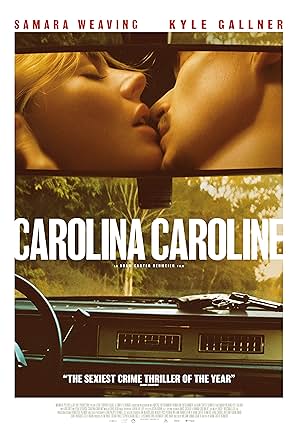

“Carolina Caroline” (2025) is about three pivotal months in the life of Caroline Daniels (Samara Weaving), who is attracted to California born confidence man or con artist Oliver (Kyle Gallner). They run away together and exploit human behavior to get money to finance their trip from Texas to South Carolina, a place that she always wanted to visit. When they get there, will she find answers or just have more questions about where and who she is supposed to be? If you are into outlaw sweetheart road trips, then this movie is perfect for you, but if you are not, even though it is one of the best films coming out this weekend, it may still be challenging to stay invested in the story, especially the obviously ill-advised pairing. If you are a fan of anyone in the cast, especially Kyra Sedgwick, who gets a substantial cameo, definitely check it out.
It is nice to finally see a movie where Weaving’s character is not the target of homicidal plans (“Ready or Not 2: Here I Come,” “Over Your Dead Body”). She plays Caroline as observant, hungry for more, melancholic and edgier than she appears, but not as edgy as she needs to be for the vocation that she chooses. It is writer Tom Dean’s second feature, and he combines a couple of tropes to subvert the overarching one. His take on Caroline is a woman who never left her small town, and her only substantial human connection is with her dad (Jon Gries kills in this underwritten role). She has no other friends or family. Well, even if she did, she is man-centered and bored enough that it is plausible that she may ditch them for her hot ticket out of there.
Gallner is a smooth actor, especially in the “Smile” franchise. Though not his fault after “Strange Darling” (2023), Gallner got associated with quality acting in potentially disappointing movies. “Carolina Caroline” uses his talents to craft a manic pixie dream man, a con man that knows all the cons, but would not con her, a concern that you can release if you decide to watch the film and would like to reduce your stress a skosh. He also kind of appears fully formed out of the ether with zero ties. If you belong in the category of people who do not find it romantic to watch characters make bad decisions while they feel joyous, smug and smart, then you may black out during the first act regardless of the couple’s undeniable chemistry or how Gallner constantly signals that his character sincerely cares for Caroline and is not going to break her heart.
Editor Justin Krohn keeps the momentum going and toggles between their quieter, getting-to-know-each other moments with their higher stake pursuits so the audience can get carried away. Cinematographer Jean-Philippe Bernier keeps these scenes warm and intimate while gradually turning down the temperature to show that the chill is coming for them regardless of the temperature of their romance. Director Adam Rehmeier keeps the cameras moving and dynamic, so when he keeps them still, it emphasizes that the scene is conveying crucial emotional information about the characters.
“Carolina Caroline” interweaves two emotional stories: the whirlwind romance of two kindred spirits and Caroline’s coming of age story. In many ways, the romance is akin to self-medication, an escape from herself, but it becomes a realization of her greatest fear, that her true nature is evil. The movie sets up a challenge that they mostly succeed in overcoming: can you root for them as they commit evil acts that cannot be reasoned away? There is an American, country cultural aesthetic to the film, and Oliver’s rationalization is that he does not feel guilty because he is not hurting people, but the system, which is implied to be corporate America; however Caroline’s experience and Rehmeier’s direction make the actual act exhilarating, but depicts their victims as either dimwitted mugs who are easily snookered or physically harmed.
“Carolina Caroline” obviously worked closely with casting director Lindsey Weissmueller because most of the actors playing the physically harmed characters are people of color or vaguely look as if they could be. There is more diversity in this film than the average Woody Allen movie or “Friends” episode. The camera usually depicts how Caroline sees the world with a few exceptions when it depicts Oliver’s point of view. There are a few scenes where Caroline pauses as if a strong gust struck her when she realizes that Oliver reciprocates her feeling or as if an icy wind stabbed and got through her rough veneer when she sees who gets hurt. It punctures the fiction that people do not get hurt, even if only the couple fall into their own line of fire, but there does still seem to be a condemnation of the culture for creating a plausible, extractive value system for the have nots that abuse their fellow have nots. This system is just as American as their love, their attractive features, their environment because if they were different, would they get the benefit of the doubt and have as long a crime streak?
“Carolina Caroline” does not explicitly interrogate and condemn this system but exploits it to make movie goers sympathize with the two main characters. Weaving is hella attractive. If there was a classification system for actors, she would get put in the same slot as Margot Robbie, Emma Mackey and Jaime Pressly. It is amusing that most of these women are not from the US, yet they are paragons of the mythology of the all-American, in this case, Texan, woman. The crime spree takes place in the South and in small towns, the places that are associated with the real, wholesome America. The movie is using these images to supplement the couple’s story. Oliver and the viewers are understandably attracted to this mythology embodied in a place and a person. So, when you have a pretty, sad woman who looks a certain way, most people are going to allow themselves to be emotionally manipulated and root for her to get away with everything. There will be automatic justification why she is not as bad as Oliver even though she is not only beside him and cosigning most of his actions, but the willing enthusiastic face of the operation, not a front so he can get away clean.
While it is not necessarily the movie’s intention, ask yourself why you feel this way then in the real world, think of how you dismiss women’s bad behavior because of gender or other features, and hey, stop, because it is misogynistic. Women are people capable of the same bad behavior as men without making them into victims or people without autonomy. Learning about her sad origin story is not an excuse for bad acts. “Carolina Caroline” is a perfect example of society’s default system, i.e. how we treat certain people and allow them to commit bad behavior and get away with it. Contrast this movie with “Queen & Slim” (2019).