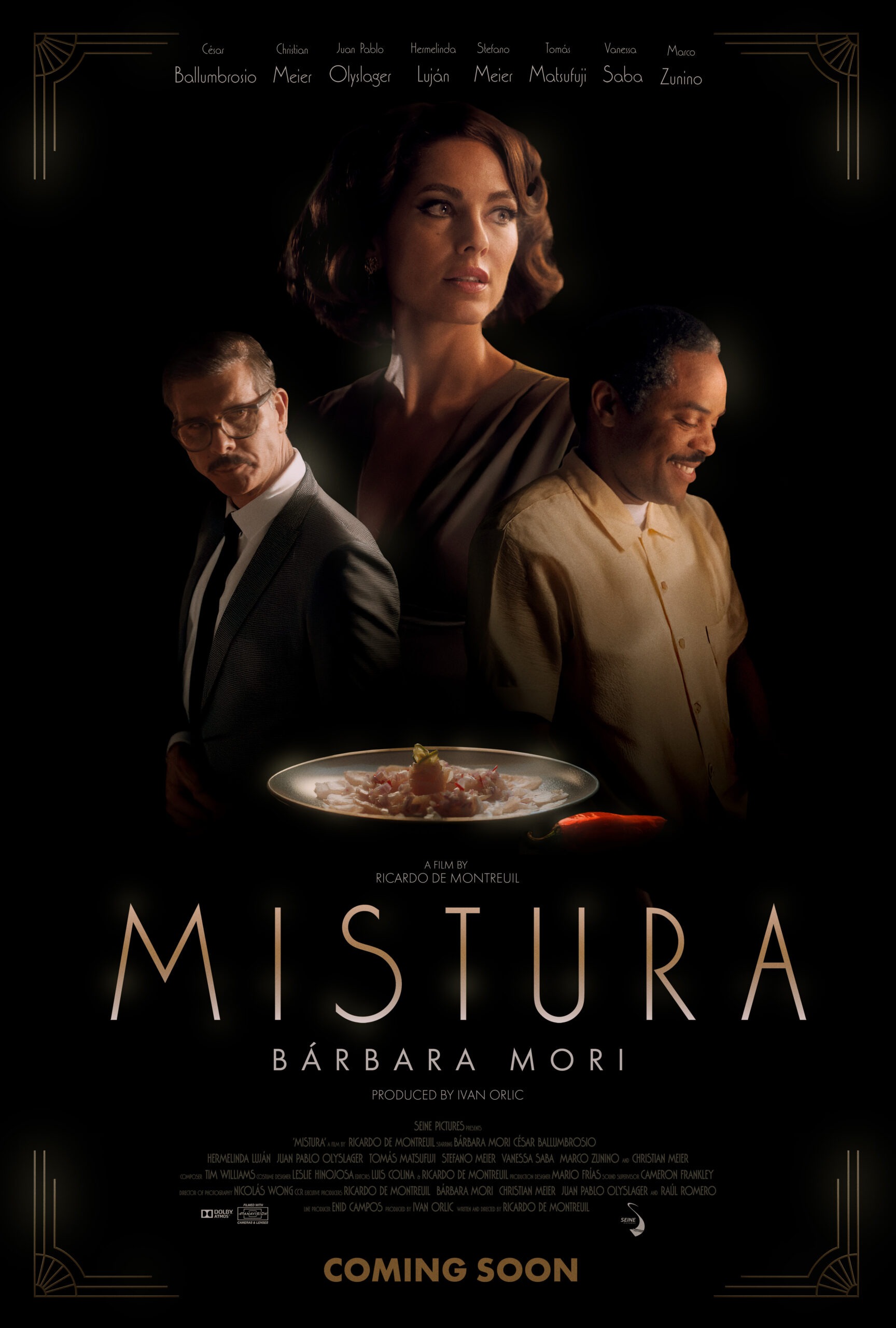

Starting on New Year’s Day 1965, “Mistura” (2025) is set in Lima, Peru as Norma Piet (Barbara Mori) realizes that her life is upended when her husband, Roberto (Christian Meier), leaves her and the house, but no money to pay for anything. With the guidance of her driver, Oscar Lara (Cesar Ballumbrosio), called Osquito, she decides to stop being the perfect society lady and open a restaurant. Will she keep breaking rules and evolving or will she revert to her old ways and cling to the people and society that betrayed her? While the movie mostly sticks the landing and has the best ingredients, it has the same flaws as its main character: struggling with how to move forward confidently with focus. It has the makings of a grand movie, but the story feels as if it belongs to the smaller screen.
The biggest surprise: the real main character is Oscar though everyone revolves around Norma. Oscar is a man who can move among different worlds, so the audience gets to see the employees’ and employers’ real lives, but only in the spaces of the elite. So the servants are franker in the servants’ areas where Oscar plays music, flirts or gossips. The servants’ home life is never depicted, and at most, writer and director Ricardo de Montreuil shows Oscar taking the bus or at a café. Oscar is a well read, bon vivant, dignified musician. During a conversation with Norma, he gets a line or two devoted to his family life. Through an employer’s lens, this kind of knowledge must feel encyclopedic, but as a character, Oscar exists to revolve around Norma and steer her towards the right choices.
Oscar works with the Cóndor family: grandma Rosa (Hermelinda Luján), who worked for Norma for twenty-seven years, and her grandson Octavio, who helps. Rosa is a woman of great dignity and talent. Like Oscar, their home life is never depicted, and they exist to serve Norma though Norma is a complete and utter bitch to all of them when she is introduced. She is the classic woman of privilege who prefers to punch down at the people helping her instead of hitting the people who are hurting her because they have more power. She is fiercely trying to keep up appearances and displays a level of haughtiness and coldness to hide the fact that she is crumbling. The servants make her likeable because if they are understanding then the moviegoers should be too. Ew.
On one hand, applaud de Montreuil’s instinct to show that everyone is in the same boat, especially if they do not hold the most privilege, but no, they are also not the same. His image of a better world is still one where Norma is a decisionmaker and served then she decides to show them respect and honor their work as if she should get a cookie for finally grasping reality and doing the right thing. “Mistura” is a fairy tale with a moral for the privileged set that your servants will love and do anything for you then you should reward them with giving them credit and financial reward for their work, that they could not survive without. If you can stomach that dynamic of largesse, then give the film a chance, but it is kind of all over the place in the struggle for Norma’s soul.
If you watch the trailer, you may expect that Norma is actually a talented chef, and this unwanted freedom from the shackles of marriage will return her to herself. Um, not quite. My kingdom for a script supervisor. At one point, Oscar is shocked that Norma is eating food that she prepared and says that he has never seen her cook. Later, he joyously recalls the roast duck that she prepared soon after getting married. OK. Let’s pretend that she is just rusty except the restaurant is not a success because of any innate talent that she possesses. Nope. She is actually a hack with French pretensions. The good news is that her food journey parallels her societal placement. She has French pretensions, but that world is stale and offers no possibility for financial reward; however, when she embraces traditional Peruvian cuisine from Rosa or her Japanese sous chef, Juano (Junior Bejar), Norma finally finds success. Um, so her talent is cultural appreciation, a big name and a big house on the verge of foreclosing. There will be numerous times when it may occur to you that instead of using money to start a restaurant, a type of business famous for failing, she should use it to pay off the house first, but nope. She has three months to prepare the house for business, leaving one month for the restaurant to turn a profit and pay the bank. What?!? These details are bananas and distracting. de Montreuil does not have a lot of writing experience, and it is his first writing feature. Previously he only wrote a short film and shared an original story credit.
Fortunately, de Montreuil has more expertise in directing, and it shows. The screener only could be played on a computer screen, but “Mistura” was still sumptuous to look at. The production values are on point. There is not one ugly frame. Spilled food looks good in a place like this. The ensemble cast imbue the material with more authenticity than is on the page and make it work even when details get tossed in and feel more like an afterthought. de Montreuil tries to use the notable figures and events of the era to depict a portrait of the country in that era, which may be lost on viewers who are unfamiliar with Peru’s history, but he uses the generational gap between Norma and her son, Gerry (Stefano Meier, whose father plays Roberto), to reflect their differing cultural attitudes. He looks like a hippy in denim and sporting long hair. Mori is stunning and styled to perfection even on her character’s worst day without makeup. Yet, he spends more time in Paris, which, in the story, is equated with old world values. Some ideas needed to be fleshed out or left out entirely, but maybe they are trying to beef up the younger Meier’s resume at the price of cohesion. At the eleventh hour, there is a romance story line, and while anyone could see it coming, it feels rushed and a bit of a stretch to tie things up with a bow, but um, that kind of relationship would get hard knocks now. It is not so pat and easy to create a happy ending.
“Mistura” is a throwback to classic Hollywood women’s movies with an ambition to symbolize the struggle over Norma’s soul as the one for the country. While a well-intentioned film, de Montreuil’s vision of a better future is still one that requires the privileged to have a serious come to Jesus moment where they are willing to give up everything, and employees to be so self-sacrificing that they do not need money and their personal lives remain invisible and off screen as if they only exist for others. So if you leave with a warm feeling, do not get carried away and try this at home.