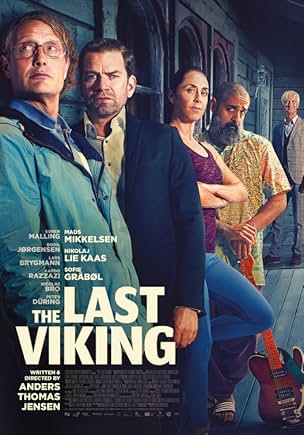

“The Last Viking” (2025) is about two very different brothers, Anker (Nikolaj Lie Kaas) and Manfred (Mads Mikkelsen), trying to reconnect for different reasons but are unable to bridge the gaps in their memory and communication style. If John Irving ever decided to make a violent crime movie and was from Denmark, he would make this movie, the sixth (“Riders of Justice,” “Adam’s Apples,” “Flickering Lights,” “The Green Butchers,” and “Men & Chicken”) collaboration between writer and director Anders Thomas Jensen, Kaas and Mikkelsen. It is my first rodeo with this trio and third with Mikkelsen and Jensen (“After the Wedding,” “The Promised Land”). Though it is off kilter and has some dangling threads, it grabbed and kept my attention.
Anker acts as if he is the only sane person in the room, but he has anger problems and is the only one who ends up incarcerated. Once released fifteen years later, a madman, Flemming (Nicolas Bro), is looking for more money from a heist. Anker also thought it was a good idea to give the money to Manfred, who has a tenuous grasp on reality. Their sister, Freja (Bodil Jørgensen), cares for Manfred and is an underdeveloped character except as a chain smoker. During Anker’s time in prison, Manfred decided that he was John W. Lennon, and if anyone uses his legal name, he attempts suicide, which creates obstacles when Anker takes him on a road trip to their mother’s house and refuses to play along. While Manfred receives treatment, Anker meets Lothar Nielsen (Lars Brygmann) who diagnoses Manfred with dissociative identity disorder and encourages Manfred to treat his brother as if he is a Beatle, which Anker discourages and ditches Nielsen.
A couple bought their mother’s house: Margrethe (Sofie Gråbøl), a former model who boxes and runs for exercise, and Werner (Soren Malling), a former fashion designer with aspirations of becoming a children’s author. When Nielsen catches up, he has the Beatles in tow or rather asylum escapees who believe that they are Beatles members: Ringo (Peter Düring) and Sir Paul McCartney and George Harrison (Kardo Razzazi), who also is Björn Ulvaeus from ABBA, an identity that he prefers. Werner feels cheated that he is not getting more Beatles’ music, and Margrethe is thrilled at the ABBA covers. Anker is frustrated that Manfred is not busy locating the bag of money or seems to care that their lives are in danger. Manfred marches to the beat of his own drama.
“The Last Viking” shifts from the present to Dutch angle, wavy flashbacks with sepia tones to show what the brothers’ childhood was like. It is almost as if they are on a ship. The bookends of the film tell a theoretically heartwarming, animated fairy tale about broken people, trauma and equality amidst an unusual Viking clan. It kind of works until it does not. Even if the resolution is a metaphor, not literal, it is still a bit much. Until Anker can acknowledge that he is a broken person, his priorities will always be broken, and he is needlessly mean to his brother. More relatable is Anker’s astonishment over how bonkers everyone is, especially Margrethe who is perceptive, but a bit delusion when it comes to her relationship with her guests.
Jensen often raises the stakes with the escaped asylum patients, the stolen money, the violence that should always be fatal but is not always and the parole monitoring, but the consequences are so low that it strains credibility. He aims so hard for quirky that when people lash out, it is verging on too serious and alienating. While there is a lot of depicted violence, the least edited and most unflinching, even when implied, is the violence directed against the two women characters. They get some particularly nasty blows and the longest sequences. The guys hit each other with blunt objects then keep it moving as if they are in a live action cartoon, but the women bear the more realistic brunt and one the long-term scars as if it is a recipe for happiness. In the bedtime story, women are referenced in the same narrative category as stupid, ugly and ill. Yup. If good intentions are attributed, it could be about opposites, but the subconscious bias screams through. It is impossible to ignore. While it was not a deal breaker, it is definitely a mark against the film. He does not quite need that many characters so while it works, it is kind of easy to lose the plot along the way, especially Anker since he is a straight man for most of “The Last Viking.”
Anker dominates the first act, but his most memorable sequence is thanks to editors Anders Albjerg Kristiansen and Nicolaj Monberg showing his time of bonding with Nielsen outside of the hospital. It is a hilarious vehicle to reveal what he is like without brakes or family, particularly with alcohol, and Nielsen’s unconventional approach to medical practice, which is appealing in a movie, but not professional or scalable. Kaas is great at wordlessly projecting his character’s astonishment over his situation.
If you are a Mikkelsen fan, it will be no surprise that it is his performance and character that pulls everything together. Mikkelsen does such a great job acting that he almost appears unattractive in this role, which feels akin to upending the laws of nature. He gets deliberately saddled with the worst styling of anyone in “The Last Viking.” Sadly, he never dances, but he does sing; however, it is with a group so do not get too excited at the possibility of discovering whether he is even more talented than you expect. Joel Hesse Johansen’s work as child Manfred feels like a through to line to the present-day version. When you find out what happened in the past, it is predictable but satisfying nonetheless especially when juxtaposed with the present and Manfred’s lack of reaction to physical pain. How does Mikkelsen show no visible signs of emotion on his face yet convey every emotion, including a deep abiding love, a determination to help his brother and a subversive concept that he may be the sanest one in the area. Mikkelsen is one of the best in the biz.
Composer Jeppe Kaas’ score for “The Last Viking” sounds very similar to Thomas Newman’s work on “The Shawshank Redemption” (1994), which makes sense since the brothers seem like they are trying to escape and their movement from the city to the country feels similar though Manfred never wants to be there. It is a compliment, but it would be interesting to know whether he was aware of the influence.
“The Last Viking” is entertaining, absorbing, and overwhelmingly heartwarming despite the brutal content. The elements of the narrative are inconsistent and are not seamless, but it still works thanks to the talent in front and behind the camera. It is not an artsy fartsy foreign film, but an action film with the energy of a crime thriller but the heart of a dramedy that exists to heal family trauma. There is child abuse so consider yourself warned.