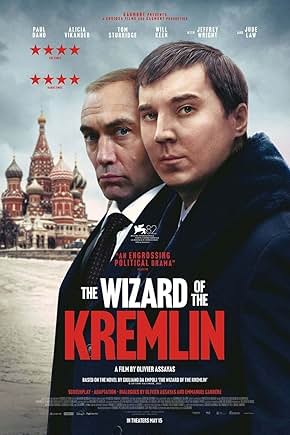

A French filmmaker, a French writer, American, Swedish, British and Latvian actors walk onto a set or a location. It is not a set up for a joke, but the people behind “The Wizard of the Kremlin” (2025), which adapts Italian and Swiss political essayist and novelist Giuliano da Empoli’s first 2022 novel about the fictional Vadim Baranov, a former theatrical and television creative turned unofficial adviser to Vladimir Vladimirovich Putin, which started prior to Putin becoming the President of Russia. Baranov tells his life story to an unnamed narrator. In the translation from the page to the screen, American Paul Dano plays Baranov, who invites the formerly unnamed narrator turned journalist for “Foreign Affairs,” Lawence Rowland (Jeffrey Wright), to Baranov’s spacious, isolated home in the country because of their shared love for real Russian author Yevgeny Zamyatin, his 1924 novel “We,” and Rowland’s article, “Vadim Baranov and the Invention of Fake Democracy.” Baranov decides to set the record straight and bare his soul. His tale becomes one of amoral ascension to recover lost privileges that he enjoyed in his youth. It becomes a cinematic, fictionalized Cliff Notes of Russian history during Baranov’s lifetime and less an insightful character study with the caveat that not a single Russian appears to have worked behind the scenes to develop this project.
“The Wizard of the Kremlin” is a Russian nesting doll of a story. One man tells stories to another, but within that story, occasionally another man, a fictionalized Boris Berezovsky (Will Keen), tells stories to Baranov. These stories are depicted as flashbacks. Dano plays his character in all eras, and it is not his fault that he has not looked like he was in his twenties since he was in his twenties, so it requires some considerable suspension of disbelief to go with it. Dano used to make a great villain, but as he gets older, he started playing more benign or ambiguous characters and ceded the villain role to actors like Dane DeHaan and eventually Barry Keoghan, who despite his talent, seems to be personally buckling under the responsibility and is eager for the public’s love, but people have expectations, and even if they are unreasonable, they tend to lash out if they are not satisfied.
Some are skewering Dano’s depiction of Baranov because the acting is as Russian as the creamy pink, sweet dressing that bears the region’s name. Dano decides to take a soft-spoken approach with hints of arrogance and self-assuredness without being unlikable. He feels like a supporting character, not a protagonist, a smarter, more opportunistic Forrest Gump, resulting in Baranov usually being the least interesting character in any room that he occupies. If James Spader was younger, Dano would be jobless in a corner. Spader could convey a sinister, but amoral lust for access that Dano is too understated and coy to convey. Baranov could be a monk because he seems so unmoved at anything including his breathless wonder at snagging love interest Ksenia (Alicia Vikander). The closest energetic moment is a montage where Baranov elicits the support of disparate interest groups for Putin or when he visits the Internet Research Energy, but that energy dissipates as quickly as it appears.
Jude Law, who plays Putin, nails the physicality and demeanor of the character, but when he is at a dinner that a fictionalized Yevheny Prigozhin (Andris Keiss) hosts, the Brit sticks out like a sore thumb as an actor, not someone who is Russian and is supposed to be the hoped for paragon of Russianness. The Latvian actors like Keiss and Zayats look the part and lack the innate softness and slightness that the Brits and Americans bring to their roles. They are men who appear to be the equivalent of unmovable, granite blocks who only chose a bureaucratic life because physically crushing men got boring, and their minds needed to be occupied. People forget what the Cold War was like, and while whatever this (gestures vaguely) is, it is a reprise of it with all the negatives of capitalism and excess.
Instead of blaming the actors, let’s put the burden on the right shoulders. Movie goers’ enjoyment of “The Wizard of the Kremlin” is going to be proportional to how many foreign films they watch, specifically Russian films. When I was younger and had not seen many movies, I didn’t question when Americans and Brits played Middle Eastern characters in Biblical epics and took for granted that a foreign accent equaled a British accent. If you are still living that life, then this movie will work for you, but you may get lost as it explains historical eras in foreign countries that many will be unfamiliar with. Still that part of the audience will leave knowing more than when they entered, which is a good thing.
As I got more films under my belt, I began watching foreign films not because I wanted to see films from different regions, but because I was attracted to the stories. I can’t say it with certainty, but possibly the first Russian film that I saw was “Russian Ark” (2002) in the theaters. Then in 2013, I got turned on to Andrey Zvyagintsev’s work when I saw “Elena,” which became a gateway drug to his other work. I watched Russian films from more filmmakers: Andrei Tarkovsky, Sergei Eisenstein, Kantemir Balagov, Aleksey Fedorchenko and Timur Bekmambetov before he came to the US and became a pioneer in the screenlife genre. By then, I had seen films from different regions. If you watch the average American films, they are not like British films. Watch and compare the US with the British version of “Law & Order.” A British film has a completely different sensibility from a French film. Russian films have a completely different baseline from any of these regions. As an outsider looking in, Russian films have an organic, overcast, somber tone. Death is always an unspoken character eager to take center stage. So, if “The Wizard of the Kremlin” feels as if it lumbers dutifully along to tick off momentous events, it is probably because it is a chimera of various regions, none of which are Russian.
Films like “Anniversary” (2025), which are made in the US, but have a Polish director and cowriter Jan Komasa, feel comparatively more Russian in the fabric of the story and the innate dread that threads throughout. “The Wizard of the Kremlin” falls short of Roman Polanski’s “The Ghost Writer” (2010), which is a more suitable comparison because it encompasses a lot of regions, is primarily set in the United Kingdom, but has that invisible Sword of Damocles hanging over every moment, which is largely missing from “The Wizard of the Kremlin” though it aims to hit such notes. This film is inert from the weight of chronicling and recreating events without touching the third rail of defamation accusations or getting sued for violating rights to others’ stories all steeped in an emotional void and cultural ignorance. It is slightly embarrassing to reference Zamyatin, their equivalent of Orwell, without hitting any Orwellian notes.
People do not want to read subtitles, but filmmakers can make a film faithful to a culture and region without being from that region or belonging to that culture. The stiff and mechanical “The Wizard of the Kremlin” is perfect for students with homework assignments to describe the change from Soviet Russia to its present-day equivalent, but there is plenty of room for improvement for filmmakers willing to get out of their comfort zone and collaborate with people with more first-hand experience to some facet of the subject.