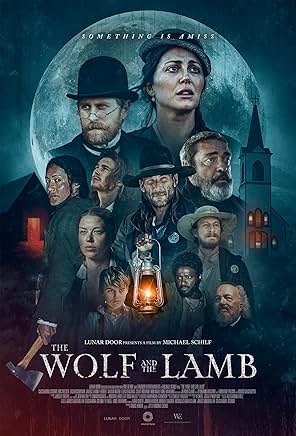

Set in 1873 in Hemlock Gulch, the Montana Territory, “The Wolf and the Lamb” (2026) shows a community facing two crises: a rash of missing children & slaughtered animals and the moneyed interests feeding off the rest of the living. When tutor Jo Beckett (Cassandra Scerbo) loses then finds her son, Henry (Jaydon Clark), everyone elevates their concern. Despite the common goal, everyone winds up warring with each other. Who will win the soul of this community? An ambitious, cluttered movie that wants to do too much and ends up accomplishing little. If it was a television series, it could work, but even the most patient, understanding viewer will feel shortchanged at the end.
The ensemble cast have bills and are determined to pay them. Jo is the default main character because everyone seems to revolve around her for no obvious reason. Scerbo is very beautiful, but her character is not the only looker in town. Dr, Roy Hawkins (Eric Nelsen) seems to be a close friend when he is not busy tending to the sex workers who work for Monsieur Jean Lagrange (Rob Nagle), who also seems to have a crush on the belle of the town. Her devoutness catches the attention of newcomer Reverend Elias Frémont (Angus Macfadyen). She is friends with Buffalo Soldier veteran Sol (Sammi Rotibi) and his partner, indigenous Mary (Q’orianka Kilcher). The only one who shows little interest in her even when it becomes his business is Sheriff Frank Martin (Zach McGowan) and Deputy Jim Cooley (James Landry Hébert), but Deputy Charlie Quinn (Elias Kacavas) is eager to help in the search for her son. Inexplicably Jo and Charlie head to the saloon that Liz (Adrianne Palicki) owns and her bartender, Lucky (Kevin Keppy) tends. For reasons unknown, everyone covets the property that the saloon is on, including Jo’s boss, George Derne (Clint Howard), who wants to claim eminent domain so Chief Justice Everett (William Rothlein) can take it, but Everett also knows Liz and inexplicably goes to the person whom he tried to ruin for help after his conspiracy dinner with Derne, his much younger wife Sara (Hanna Balicki), who self-medicates to endure her lifestyle, and their two children.
Got all that? More is less, and some actors get more time to read reams of elaborate dialogue with counterintuitive emphasis on certain syllables in words. Some chew the scenery. Some overact. Some are naturals. The best actor is Clark, who has no lines, but must use his physicality to convey the terrifying transformation that he endured during his disappearance. It is not a spoiler because it is in the trailers, but he is a vampire, and he is the only vampire that you are going to get until the denouement. If it feels like a ripoff, it is. You will only get three onscreen vampires with the unrealized threat of more. It felt as if cowriter and director Michael Schilf and cowriter Miah Smith decided to throw in vampires because they were afraid that no one would be interested in a movie that reflected today’s socioeconomic issues through the lens of the past, but if you are going to use vampires as an additional metaphor for corruption, then use vampires.
These vampires are anticlimactic. Pros: the smoke monster from “Lost” has a job as a revamped version of fog and mist that the vampires move through. Add to the list the intimidating roar and teeth, the long fingernails and sepia toned skin. Cons: the writers did not think about how they die. One gets shot and seems to be ailing then gets their throat slit to kill them! What?!? Later the traditional killing methods such as beheading and stabbing with a wooden stake are back on the table, but the logic behind this mythology is a grab bag of confusion and convenience without an ounce of sense. They can move during the day, and crosses do not seem to have an effect. “The Wolf and the Lamb” seems to favor using a metal shovel as a weapon for the living and the dead. While the story reveals the identity of the prime vampire, all the collected children do not resurface. It does not even feel as if the film is begging for a sequel. It just feels as if they totally did not think of it as a dangling thread once Henry’s issue was resolved, but more children disappeared and their bodies never resurfaced sooooooooooo………
“The Wolf and the Lamb” seems to buckle under the weight of the well-intentioned, anachronistic themes and over the top characters. It tries to address collusion between money and government, bias against indigenous people, the danger of an unhappy, affluent life, and the corruption in trusted, well-respected institutions. The film is definitely pro single professional women, people of color and the disabled, but should show it and give them more substantial material to work with. The bias story line is underdeveloped and feels dropped in at the eleventh hour to reflect how different sectors of bad faith actors unite as a backlash to those who do not uphold the system, but as it is presented, it seems nonsensical and most viewers are unlikely to get the point since it happens in two seconds. A lot of the physical conflicts generally do not make sense. One good character has the upper hand, but in the next scene, the scene’s antagonist still managed to accomplish their goal and drag someone into town. How? Who knows! Why? So, the underutilized Palicki can kick a little ass. The writers try to give everyone a turn instead of distilling their story to its strongest elements.
“The Wolf and the Lamb” does not fumble its location and the cinematography. The location is transcendent, and Schilf leans heavily on cinematographer Philip Roy to capture it. Blue is used to denote that the characters and environments are good. Red appears infrequently and is used to symbolize society’s sinister elements. Green symbolizes ambiguous characters, who are good, but do bad things. It looks like a Western. There are plenty of guns. While no one will confuse this attempt at a genre film with John Ford’s work, its strongest element is showcasing the landscape. Editor Keefe Kaupanger-Swacker intercuts between the quotidian scenes with flashes of vampiric images from the future and in the distance. Eagle-eyed viewers who can absorb images that swiftly appear on screen will know which characters are doomed to be undead. Let’s be generous and call it a neo-Western thanks to the setting.
Is there a substantial connection to Aesop’s fable with the same title? Eh. They probably just liked what the title evoked, but the story never seems directly connected to it in a meaningful way. I could be wrong. Overall if you decide to see “The Wolf and the Lamb,” it should be to satisfy your curiosity, and your enjoyment depends on what you want from the movie. Because none of the elements are strong enough to enthusiastically recommend or decry it, you probably should look for a sure thing in entertainment, especially since there is so much better content.