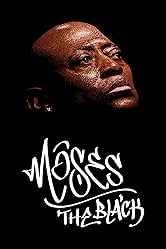

“Moses the Black” (2026) asks the important question, “Where will you go when you die?” If hell is a movie, it would be this one. Initially, I wisely turned down watching this film when it came to theaters despite having a woman director, majority Black cast and vaguely Christian themes because I’m not into movies about gangs or saints, but changed my mind out of curiosity, which did kill this cat, when it came to streaming. Cue my impression of a Saturday Night Live skit, “Coffee Talk,” that this movie is neither about Moses the Black, nor anything else. Writer and director Yelena Popovic attempts to vaguely parallel Egypt 405 AD with contemporary Chicago, and Malik (Omar Epps) with Moses the Black (Chukwidi Iwuji) as some failed, more insulting than inspiring attempt at evangelizing to Black gang members. Pastor David Wilkerson of “The Cross and Switchblade” called, and he wants his schtick back. Even if you are a fan of anyone in the cast, show it and do not see it.
For the majority of “Moses the Black,” an alert viewer with excellent hearing would have a challenging time figuring out the characters’ names. It starts mid story as if it is a HBO series and getting the backstory latter will be rewarding. Spoiler alert: it is not rewarding. Occasional flashbacks in black and white reveal very little about the characters. Malik gets released from jail with revenge on his mind because someone killed a close friend and loyal gang member, Sayeed, while simultaneously not wanting to start a war. He visits the local tattoo artist, who happens to be a single mother whom he helped set up her business, but their relationship is more chaste than an elementary school crush. His grandmother welcomes him back and tells him about the titular saint. The rest of the movie is about Epps looking solemn, statesman like and sorrowful. There are lots of montages of him greeting people warmly. In some communities, gang members are beloved. In others, they are outcasts. It never occurs to this story that these are options, but the entire community is united with gangs, especially the church going, family man Mike (Corey Hendrix), who is important in Malik’s organization. Mike and Malik have the only relationship that feels somewhat fleshed out. Mike parallels Malik with Jesus because the cops want to get both.
Why do the cops want to get Malik? Reasons. Jerry (Cliff Chamberlain) is a corrupt cop who backs opposing gang leader, Straw (Quavo). Jerry is like a brand name, discount, third degree understudy in a Quentin Tarantino movie that maybe supplied funding or is someone’s relative, so no one told him that he is embarrassingly bad. And by bad, I’m not only referring to the way that the character was written, but Chamberlain’s performance. Hopefully it was just a bad day or bad direction. Straw is a part of a new generation of gang leaders who cares more about image. He invests in clothes, posting on social media and hot women draped all over his home as if it was a strip club without the nudity or even off-screen sexcapades. To be clear, I may be the only one who does not want to see titties, simulated sex scenes and blood, but implying it in such a sanitary manner is silly. It is really challenging to distinguish between Straw and Malik’s crew except Lil B (Ahmad Nicholas Ferguson) is embarrassed to be the butt of all the cyber bullying. Straw hatches a plan to ruin Malik, which does not come to fruition.
There is never a concept launched that does not get ditched seconds later. “Moses the Black” is a dumb movie. Does Popovich realize that gangs have societal and financial functions not just shooting, rapping, looking tough and talking back? The aesthetics are important, but not the meat of the gang existence, especially in the circumstances when gangs unite against a common foe and stand up for the community. There is gang history, treaties, etc. that transcends borders. It is like a shadow outlaw governing body, but “Moses the Black” has the rigor of a music video, not sociology with life breathed into it for the cinema.
If you are thinking, “Well, at least I’ll get to learn about the saint,” no, you will not. These scenes are a mix of Malik’s dreams and just standalone scenes with zero dialogue. These scenes get the yellow filter. On a basic level, the visual symbolizes the region’s heat and dry region. On a gut level, it is a way of othering a region and a people and denoting them as dangerous kind of like mainstream media treats Chicago. If good old Moses and Malik have something in common, it is not just their alleged desire to do good while in endemically violent occupations, but in the way that they are depicted as the daily, noble norm of Black people: violent without reason or agenda but yearning towards redemption in death. Ew. Jesus was Black according to US standards or at least a man of color. It feels patronizing to believe that the only way that Black people can relate to a salvation story is if another explicitly Black person is reduced to being a gang member, but nothing else tangible about him is depicted on screen, kind of like the characters in this movie. It is superficial, not a character study, not a theological argument and not a historical tale, which makes it dull as dirt.
These past and present characters are not two dimensional. They are one dimensional. The power struggle is an afterthought soon forgotten. The love interests are perfunctory without passion. The rivalry feels paint by numbers. If there was magically no conflict, these characters would be NPCs. There is too much profound and nuanced material about gang society like “The Wire” for “Moses the Black” to exist afterwards. More importantly, the gospel also gets reduced to aesthetics, not often seen Coptic Orthodox Church iconography, which is the best part of the movie but absolutely never relates back to the gospel of Jesus. Works without faith is dead, and there cannot be an effective evangelical movie if it fails to explain that simply abandoning violence and doing good works are insufficient without Christ as the explicit savior. The evangelical movie genre requires that as a beat, and while Popovic may not be trying to adhere to that tradition, before one can deviate from a standard, one must understand and be able to successfully adhere to it. Jazz is not just noise though it may sound like it to the undiscerning listener or baby musician, but a product of mastering other styles then playing with it.
“Moses the Black” does not work as a character study, a portrait of daily life in a community caught in the crosshairs of gang violence, an educational product to teach more about a saint’s life, or an evangelical tool to get people to come to Jesus. It lacks curiosity or insight about people, systems and the historical backdrop that would influence them if the information was available to them. Most importantly, it continues the mainstream media’s proliferation of images that Chicago is a terrifying place, not a major metropolitan city with problems like any city. It is not even in the top twenty-five most dangerous places to live in the US.