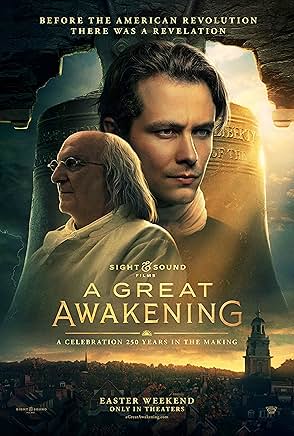

“A Great Awakening” (2026) has the tag line, “A celebration 250 years in the making,” which sounds great, especially with the 250th anniversary of the signing of the Declaration of Independence, but the movie is about how Reverend George Whitefield’s professional and personal friendship with Benjamin Franklin affected the Constitutional Convention (“CC”) in 1787. Released on Easter Sunday, this second film from Sight & Sound Theatres, a Pennsylvania based entertainment company that usually has stage productions of Bible stories, probably found it too tempting to wait a year and decided to play around with the truth enough to not literally lie, but also not precisely tell the truth to attract a broader audience: patriotic Americans, history buffs, Christians, the Venn diagram of the three and anyone who were disinterested in the mainstream movie offerings of Easter weekend. Similarly, the story is appealing in an old fashioned, old orator declaratory fashion, but the story squints aplenty and uses the bombastic style to disguise the pacing issues. With more experience, they could figure out what to cut and keep to still accomplish their goals without opening themselves up to attack from anyone inclined to question their movie’s integrity.
“A Great Awakening” begins in 1787 at the CC with Benjamin Franklin (John Paul Sneed) observing the debate with dismay and concern over the country’s future while he thinks of his childhood when his father let him off the hook as his tenth child from becoming a preacher as a tithe to God to sending him to a printer for an apprenticeship. When Franklin comes home from CC, his grandson, Benny Franklin Bache (JT Schaeffer), who is following in his footsteps, is eager to show him what he has done with the print shop. They start talking about Franklin’s concerns over CC, and the role of a printer to set the tone between soothe or stoke fear in people. Franklin then tells the life story of George Whitefield (Jonathan Blair) since Franklin was entrusted with his memoirs. Most of the film is a rapid run-through of the highlights of Whitefield’s life as a wannabe actor to one of the first evangelical preachers. A secular person could have helped the filmmakers avoid the jokes that may flit through more cynical moviegoers’ minds over Whitefield’s career trajectory.
Unfortunately, because Franklin’s conversation with his grandson keeps interrupting the momentum of Whitefield’s story, which is genuinely interesting from a Christian point of view, it has the potential to prevent the story from sweeping viewers off their feet. It rushes through his conversion and acceptance into the “Holy Club” at Oxford. It may be called something different, but a betting person could wager that even today, a bunch of sincere young Christians are washing feet and going through the similar tasks to talk about Jesus. It is a timeless Bible inspired tradition, but the difference is that Whitefield was actually successful at it. It rapidly becomes a bunch of clips of Whitefield’s quotable speeches, which if more focused on his daily life and quieter moments, could have worked even better. The problem with constantly keeping the tone at a ten, it does not matter if it is a quality ten, it is not a substitute for a story that needs peaks and valleys and variety, so it does not wash over and leave no lasting impression. It is an important message, especially when it is in earnest. Blair never tips into rock star territory though it is tempting considering Whitefield’s ability to attract crowds and Blair’s good looks.
Well, the real-life Whitefield may have been simultaneously less dramatic (siblings, married, father, etc.) and more grievously sinful and hypocritical as a slaveholder. If “A Great Awakening” had done more than talked about this issue and really wrestled with it instead of making Whitefield seem like a man who treated Black people like people, it could have been as complex as the Bible, which tells stories of sinful people without necessarily cosigning their sin and reflecting the complexity of how a person could be a man after God’s own heart while failing God, himself, his family and those he claimed to serve. There is no need for whitewashing. Tell it like it is. While no one wants trauma, and more Black actors getting cast is welcome, it is always disruptive when the past is depicted as superficially, racially harmonious when slavery existed even in the North during that era.
Sneed is pitch perfect as Franklin, but “A Great Awakening” paints him as a wholesome patriarch in a close relationship with his daughter, Sarah Franklin Bache, who is called Sally (Tricia Bridgeman), and grandson. While it is true that they lived together, the father and daughter had less of a rosy relationship, and he took Benny to Britain against his mother’s wishes. While the film accurately depicts Franklin as a friend, but not sharing a faith, with Whitefield, it also parallels them as gifts from God meant to change history and kind of brushes over the fact that Franklin did not even share the same god per se. Also, the only allusion to his libertine ways is a rather chaste, but bewigged and powdered trip to Britain. Maybe it is harsh, but it would have been better to just tell the story of Whitefield with Franklin as a supporting character, not a narrator. If not, again, not telling the whole story only turns the movie into an easy target. Instead, Franklin is depicted as a playful, childlike family man who is into kites.
The CC’s turning point is to pray before convening, and as a climax, it is not much of one. Prayers can be empty if a Pharisee petitions God with an audience for show and powerful when sincere. While the cowriters Blair, Jeff Bender, and Joshua Enck, who also directed, may sincerely see this prayer as what made the Constitution possible, such simplistic storytelling does more damage to God’s work than not when it overlooks the flaws inherent therein. Again, wrestle with the actual story, show the tension between God and reality, then there is a story. Brushing over it only leaves room for attacks.
Chad Marriot’s score is old-fashioned and effective, but occasionally obtrusive in refusing to let the audience decide how to feel about the events onscreen. Again, the silence is as required as the music. Like movies, compositions do not solely consist of crescendos. Is it still soaring? Yes, but it gets in the way of reaching as high as it could. Whenever Whitefield gets cooking, the rumble of a storm sounds. Franklin gets one too when he sics a good burn on Whitefield. It works, but it is also the kind of thing that should be used more judiciously. Blair has the voice and bearing, but the story needed a way to sustain it organically, not with a writing hand that smears the ink as it lays heavy on the page and smudges the past good work instead of lifting so the mark is lighter and does not muddy the better part of the message.
Occasionally the blue screen is discernible, but overall, the period biopic is solid though not for anyone looking for a short cut for completing a homework assignment. “A Great Awakening” is more for vibes, not accuracy, and hopefully not to conflate the nation’s history with God’s agenda, which is unknowable to man. Any God that absolutely cosigns human action is a work of imagination. A Bible believer knows that God never cosigns nations, not even the ones that He allegedly ordained like the Biblical Judah or Israel. Humans and countries are flawed, yet God loves people anyway. Next time around, tell the truth, shame the devil.