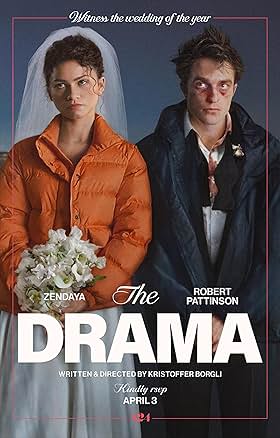

“The Drama” (2026) asks what is the worse thing that you have ever done and how you would react at your fiancé’s answer? What are your dealbreakers a week before the wedding? Zendaya and Robert Pattinson star in Norwegian director’s Kristoffer Borgli second American film, his version of a rom com, but will this movie be his last once Americans realize what the twist is? After all, Americans are notoriously touchy about the topic discussed, but rarely take substantive, meaningful action so they may use all their energy to rail against a movie instead of changing the world. Maybe if it was Paul Thomas Anderson in the director’s seat, they would not mind.
Set in contemporary Boston, Emma Harwood (Zendaya) and Brit Charlie Thompson (Pattinson) have a meet cute at a Tatte with Charlie awkwardly chatting her up, and Emma choosing to give grace. As they blissfully prepare for their wedding, they regale their respective friends with stories about their relationship. Borgli depicts the past as mainstream picture perfect as you can imagine and offers a wicked incisive look at wedding theatrics. Even their two-level apartment is a fantasy for a bookstore clerk and curator respectively. At a tasting, his best man and her matron of honor, Mike (Mamoudou Athie) and Rachel (scene stealer extraordinaire Alana Haim, who frequently works with Anderson), ask the question as a game with the implied expectation that none of the confessions will be too alarming, but scandalous enough to entertain. That assumption gets blown out of the water as better or worse gets tested before any vows are uttered. The rest of “The Drama” becomes a ticking time bomb of what will happen. It is uncomfortable, hilarious, bold, irreverent and probably the closest to secular blasphemy that you can get for the mainstream set without nudity and only the most tasteful sex scenes. Sorry pervy fans.
The writing and performances are so perfectly matched and crisp even without the backstory prose dumps for most of the characters, which proves that it is possible with the right cast and story, a story can be minimalist, but dynamic enough that the actors can flesh it out and fill in the blanks with physical movements, facial expressions and vocal tone. A lot of American actors mistakenly think that screaming or being really normal is the same as having range when it is two limited performances whereas real life is so much more layered along a broader range. There is the real emotion, the acceptable emotion that they are willing to show, the cracks of real emotion that surface to the outside veneer, and the digs used under a close acceptable negative emotion that that they are willing to show.
Zendaya delivers a sophisticated, understated but perfectly measured emotive performance. Once Pattinson surpassed the broken clock rule with “Tenet” (2020), “The Batman” (2022) and “Mickey 17” (2025), I stopped hating him, and he seems determined to stay in favor. Athie has the heaviest lift as the straight man and only adult in the room. Haim delivers a masterclass in acting for showing her character’s entire psychological makeup when Rachel starts the game, and any sober person would say nothing around Rachel since she rats out her husband. Hailey Gates, who was magnificent in “The Moment” (2026), makes a meal out of a morsel as Charlie’s coworker, especially the way that she responds to his impulsive move in his office. Gates needs to be in everything. Borgli encapsulates wedding culture perfectly in each scene then the supporting actors, regardless of the size of the parts, represent three-dimensional individuals whose personalities are perfectly embodied in their moment on screen whether it is the intense dance instructor (Celia Rowlson-Hall), the insightful, ever-smiling photographer, Frances (Zoë Winters, who was magnificent in “Materialists”), or the front and kitchen staff at the tasting. Also shout out to Andy’s Diner, a beloved breakfast spot in Cambridge, which is absolutely not open at night, but waitresses Debbie and Kelly, who gets a line, appear on screen and did better than some professionals. The man in the kitchen was an actor, not Jimmy!
“The Drama” may be Borgli’s best film to date (bold words from someone who has only seen two of them). As the pair spiral individually, Borgli alters Charlie’s fondest memories to reflect the change in the relationship. Emma’s catastrophizing is realized onscreen. Borgli is impressive because while it is indistinguishable from the present-day scenes, it also is not long before movie goers will be able to distinguish between reality and their thoughts. As their imaginations run wild, the most shocking scene is the first sequence imagining what the wedding would look like because initially it is unclear what the audience is seeing, but it becomes apparent as the scene unfolds.
If it was not the worst of times, “The Drama” would be guaranteed to result in a lot of debates regarding what is worse: what we do versus what was in our hearts. At the table and throughout the movie, almost everyone does horrible things, but nothing is as bad as what one person imagined. There is even a statement excusing what one person did because the prefrontal cortex is not even mature until a person is in their twenties, but seconds after that scientific fact is offered, it is ignored after one person’s confession shocks the table. While Borgli may not be an American, he does nail the dynamic of American rhetoric.
Less important than the discourse, “The Drama” attempts to define real love, and how it looks when it becomes difficult. It is easy to love someone when they make you look good, but if they did not, would you still love them?
S
P
O
I
L
E
R
S
Without revealing the twist, “The Drama” proves that you can make a movie that will likely make my life more difficult in the real world (even if statistics reveal that it is complete fiction since only one, if that, Black woman ever did such a thing because thank you angry, Black woman stereotype), and if it is done well and encompasses that person’s whole humanity, there will be fewer complaints. Does Borgli know about existing discourse about how you can tell the demographics of a biracial person’s parents depending on how they navigate the world and the situations that they end up in? If he does not, he nailed it. Emma had no real friendships, which was incredibly sad, still believed that people who hated her should still have a seat at the table, and did not have a substantive relationship until she was thirty years old. Her idea of Blackness depended on media built on bias even when it comes from Black creators. It would take a foreigner to see a little girl as a person and offer the same empathy and compassion that is offered to everyone else. On TikTok, there are real people who actually committed the act described in the twist so it is likely less controversial than it should be.