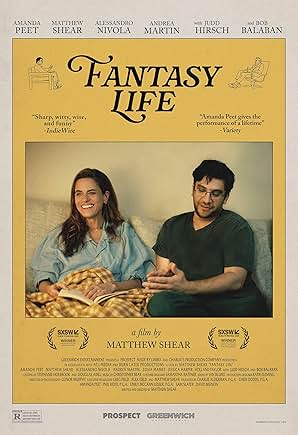

“Fantasy Life” (2025) is writer and director Matthew Shear’s first film, which he also stars in as Sam, a paralegal with mental health issues. After visiting his psychopathologist, Dr. Fred Hinman (Judd Hirsch), Helen (Andrea Martin), Fred’s wife and receptionist, encourages him to work for her son, David (Alessandro Nivola), and his wife, former actor Dianne Cohen (Amanda Peet), watching their kids, eleven year old Emma (Riley Vinson), eight-year-old Zoe (Romy Fay) and six year old Claire (Callie Santoro). It turns out to be a dream job, and he connects deeply with Dianne on an unspoken level, which also becomes part of the problem. It is a pleasant, enjoyable viewing experience akin to being a fly on the wall of what feels like actual people’s lives unfolding in organic and entertaining ways.
“Fantasy Life” features a great ensemble cast. Shear is understated and occasionally feels like a supporting character in his own movie, but it is by design and says plenty about his character’s inability to launch. He fits well into other people’s lives who need his quiet support, but when that support becomes less quiet and more disruptive as a person with a disability, needs and desires, he becomes more of a problem than a helpful presence. Peet is gorgeous and perfect, and it may be her best performance ever. Name another movie in which she gets to showcase her talents as a student of humanity. She plays a talented actress, and in one scene, her character acts in a silly sci-fi scene which she suddenly turns into profound pathos. Peet shows Dianne as an artist who happens to be tortured, but not for her art, but guilt.
Nivola provides comedic relief as a guy oblivious to how ridiculous he can be. Hirsch, Martin, Bib Balaban, Jessica Harper, Sheng Wang, Zosia Mamet, Julie Claire, Holland Taylor feel like they are just playing themselves, not characters, though that is not the case if you are familiar with their work. It is just a bunch of professionals at the top of their game doing their best work with each other. It is a pleasure to see them work with adult material about life. Shear injects humanity into characters that most moviegoers would not think of as innately compelling to watch but are.
“Fantasy Life” feels like “Miroirs No. 3” (2025) in the way that the two main characters, Sam and Dianne, trade places over the course of four acts (Fall, Spring, Summer, Fall). It begins and ends with trips to therapists to talk about problems and medications so while there are no clear solutions, there is incremental progress. They are both people who should not have problems based on outside appearances though the signs are more apparent for Sam than Dianne.
In each chapter, a seed is planted for the next one. In the first act, there is a lot of talk about Dianne going to her parents’ home in Martha Vineyard’s. Dianne is only shown online and in photographs. Her absence is what causes Sam to enter her world. In the second act, Shear shoots her blurred before gradually coming into focus. She is shown in bed, and Helen’s voice indicates that Dianne is not helping the kids get ready for school. It is a sign of depression. Dianne and Sam begin to spend time together since he is still working for her and caring for her kids. There is a brilliant wordless scene when they are sharing the couch together, and she is so comfortable that she unconsciously makes a physical advance that is simultaneously innocent and intimate. Peet and Shear wordlessly register their characters’ mutual shock as Dianne begins to walk it back in the most twenty-first century way ever and offers to call him an Uber. She lives in Manhattan, and he lives in Astoria, Queens, which means it is expensive, but she does not even flinch. It also becomes obvious that there are marital problems, and David blames Sam.
The Summer act is the most pivotal for understanding Sam, and how he got there. It is a terrifically written scene between Sam and a former law school classmate, Lauren (Alana Raquel Bowers), which reveals how others see Sam and the gap between who he is and others’ expectations. It is a very relatable, not often examined phenomenon. While Sam has a crush on Dianne for obvious reasons, there is also an unspoken understanding about the frustration of being kneecapped through no conscious fault of their own and trying to fix something that is not in their control. In this act, Dianne reveals additional reasons why she is attracted, but not acting on it, to Sam though it definitely rises to the level of at least an emotional affair.
Mental health issues come to a head here as Sam’s problems become a topic for discussion. Even though Sam has a close connection to a family aware of his health concerns and hire him, they are still surprised and horrified when he has problems. It becomes a stigma that gets conflated with being dangerous or irresponsible to channel their ire about other issues. Each character’s psychological makeup gets revealed depending on how they react to Sam’s health, and it reveals the cracks in their armor. It is a hilarious comedy of errors that hits a crescendo at a family dinner. Along with Editor Ian Blume, Shear has a real talent for using simple, understated moves like composition, stable camera position and distance to tell the story without a ton of prose or audience handholding. The end of the last scene in the Summer act gets a line in, so the audience is not left hanging and wondering how the family drama ended.
Constantly threaded through the ether is the heritage of the Holocaust, survivor’s guilt, and the politics of survival, especially the guilt of financial privilege and how that happens. It is the distaste of sharing a Venn diagram with Presidon’t and other taboo subjects while not wanting to share it though unwilling to confront it or distance themselves from it. “Fantasy Life” is like a huge gray zone with no one doing anything explicitly wrong, but also not doing much right. It is such a snapshot of real life.