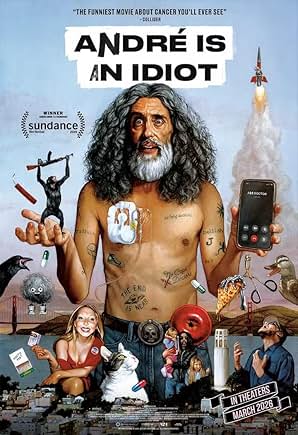

“André Is an Idiot” (2025) may be the funniest documentary about a fatal cancer diagnosis. André Ricciardi is not a household name, but the eccentric San Francisco based ad man has two goals: warn people about the dangers of not getting a colonoscopy at fifty years old and laughing in the face of death. The biographical film does not begin with his birth, but his formative adult personal and professional relationships and captures his extroverted personality, but as his heath deteriorates, the proceeding slows down and transforms into settling into a quieter mode as his body deteriorates and his soul deepens. No punches are pulled, and his physical state is shown throughout. Tony Benna proves that a film can movingly capture every step from diagnosis to death while still entertaining its audience. Considering that most Americans shy away from tackling death in a straightforward manner, the biggest surprise is that is how Benna’s directorial debut, protagonist and others are Americans ready to create a countercultural take without the romanticizing the process or pretending it is easy.
It is easy for “André Is an Idiot” to swim against the tide when Ricciardi is such an unusual fellow though he managed to wind up having the broad beats of a conventional life with personal and professional success. Ricciardi is the main character and tells his story. If he kept anything private, it does not feel like it. Beena and Ricciardi treat the film as if it is Ricciardi ‘s creation as he clicks the clapperboard which functions as chapter titles about what the subsequent scene is going to be about. It is mostly chronological, easy to follow and always engaging mostly because he is a frank raconteur. He admits that making a film is a coping mechanism to filter the devastating news, which makes sense since he is a showman whose default settings is to be outrageous. For instance, he lists his oncologist as “ass doctor” on his phone, signs up for a death yelling course and is into the idea of cryogenically freezing his body.
Ricciardi is not alone on this journey. He and his wife, Janice, have separate interviews about how their relationship developed and their reaction to the news, but Benna also gets exclusive content of them in their home and going to medical appointments, which understandably can end up in tears. There are montages of photographs and clips from when they appeared on “The Newlywed Game,” which they won, of course. His teenage daughters, Tallula and Delilah, also appear and discuss his nontraditional parenting techniques. As his illness progresses, they decide to spend more time at home even if they show affection in unexpected ways. There is also Waffles the Cat who completes the family tableau and is probably the most conventional member performing their feline functions with aplomb.
His brother, Nick, appears in exclusive interviews with a black background and his assessment of the situation is often contrasted with a completely different account from someone else. Nick constantly seems astonished at his brother’s antics despite arguably spending more time with him than anyone else. Their father is a private man, so Tommy Chong plays their father if he was more like Ricciardi, and their actual father only appears in photographs. Though neither their mother nor a surrogate appears on screen except in a home video like rapid montage of family photos, Ricciardi quotes her from the outset of “André Is an Idiot.” Ricciardi’s portrait of himself, this film, is a testament to how far he falls from the tree as he turns his vulnerabilities and private life into something that he sees as truly beautiful. It matches his personal ethos and aesthetics complete with stop animation depicting his whimsical ideas or recreating past events. Benna also depicts the peaceful, separate, togetherness of a bunch of people occupying the same space at the same time without interacting with each other. It is a nothing, forgettable quotidian experience, the kind that they will yearn for and remember fondly before one person disappears from the room. I can attest to when death is coming, just noticing these moments and knowing that one by one, a living being will not be present to recreate this ephemeral moment makes it special and un-replicable.
Because most of the participants in skit-like scenes already gave exclusive interviews throughout “André Is an Idiot,” the more staged and stylized moments still work even if they did not occur organically. His best friend, Lee Einhorn, his brother from another mother who considers Ricciardi to be his soul mate, actually suggested that they have a colonoscopy together. They never mention how they became friends so while it is not obvious, some aspects of Ricciardi’s life, including how the family stays financially afloat while he fought cancer, stay off screen. Lee often functions as a springboard or informal interviewer for Ricciardi to play conversational tennis with. Their scenes are often outdoors, and Benna captures the beauty of nature. His interior and exterior scenes shows that he is more than a filmmaker for hire making a heartfelt vanity project for a client, which may not be what this is. Benna has the goods to evoke the poignant and eternal regardless of whether the environment is nature or manmade. He is a man that captures the golden hour regardless of the circumstances or the absence of the sun.
Ricciardi used to work at Mekanism Ad Agency, and he and Lee visit the agency as his former colleagues’ pitch ideas for PSA advertisements to promote getting a colonoscopy. It is a hilarious detour that comes to fruition during the closing credits. Joshua Harris, Ricciardi’s former boss, only appears during this scene while CCO Tommy Means, CEO Jason Harris, and Stelio Kitrilakis, a former colleague, give brief exclusive interviews about Ricciardi’s work and personality. Even though he ridicules his choice of profession, Ricciardi found a home of people who accepted and celebrated his oddball ways.
“André Is an Idiot” also captures how Ricciardi gradually comes to grips with the physical and psychological pain that is inherent with death. Ricciardi verbalizes his gratefulness for his family and expresses his emotions without the jokes. His therapist, Peter Camochan, has his work cut out for him as he strains to stop laughing and get his patient to get serious. A camera in the cabin of the car captures the moment after the married couple gets bad news. Camochan advises, “You are more than your irreverent humor. So I think part of the process for you is relaxing.” Cue Waffles, the expert, helping their human apply the lesson. “That [grief] is not a destructive thing to do. If it goes well, it is a powerful and deepening process. It is sad isn’t it. Be generous and let them be sad.”
“André Is an Idiot” discloses that AI made Ricciardi’s voice read his final journey entry. If it was not disclosed, a stranger would not notice. While I’m one of the many people who decries the widespread proliferation and lack of efficacy of AI, Benna may have found an exception though Prince would probably disapprove. If you want to laugh while facing death, it is worth paying full price at the theaters to see this one in a crowded room.