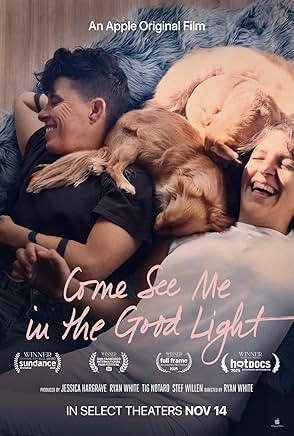

Filmed during 2024, “Come See Me in the Good Light” (2025) chronicles a year in the life of married couple, Andrea Faye Gibson, Colorado’s Poet Laureate, and Megan Falley, a fellow poet working on her memoir. Writer and director Ryan White takes a lyrical approach to this poignant reflection on what life is like as the couple faces Gibson’s mortality and the unknown amount of finite number of days to enjoy together and live fully while fighting for more time. The 98th Academy Awards nominated it for “Best Documentary.”
“Come See Me in the Good Light” is primarily Gibson’s biography, but it is also a love and survival story that started long before Gibson’s cancer diagnosis. The narrative is not traditional. It moves forward during 2024 and intercuts with reflections on the past depicted in photograph montages, home videos and audio of exclusive interviews. At one point, White’s voice can be heard otherwise he remains behind the camera while he observes Gibson and Falley in their natural habitat in their Longmont, Colorado home canoodling with laptops while they work. White also shows them on their way to medical appointments, hanging out with friends and fitting in public appearances before it is no longer possible.
“Come See Me in the Good Light” is a glossy, picturesque tale with White showing fractions of their life to add up to one perfect picture. Occasionally he turns his camera to look outside a car passenger window to show the snowcapped majestic mountains that they see as part of their routine. The logistics of such a documentary always feel awkward. Are they close to White, so they do not feel awkward around him and can act naturally, do they just forget that he is even there or does he just leave the camera somewhere as they live their life? They are performers, spoken word poetry on stage, so it would be more natural for them to be intimate in public than the average person. They are also the kind of people that casually utter the most profound, quotable lines. Regarding an ailing mailbox that Gibson keeps propping up to ensure that the post office keeps delivering mail, Gibson says, “What matters most is the trying.” Someone is straining at their desk for one hour grasping for words to convey what they are thinking, and Gibson is just tossing profundity around while doing chores. On the other hand, if it feels more staged than organic, the deliberate pacing and beatific looks on their faces may lack the narrative form that you may be looking for. White occasionally stages the poems with handwriting on screen as Gibson reads, and onscreen images have the same rhythm and golden hour light as most of the movie. It is nostalgia amped up to a ten to convey the couple treasuring each moment.
“Come See Me in the Good Light” does have a narrative arc, but it could be easy to miss if you just let everything wash over you without pondering the documentary as it unfolds. At the beginning, life does not fit or measure up to how it is supposed to be: heteronormative, gender binary, certain shapes and sizes, limited options. Oblivion either through drugs or death sounds appealing as an escape from the confines of the expected societal self. If one is fortunate, despite this lack, if you are as lucky as these two, you will find a way that never seemed possible where your flaws are features, and your lack is fullness distorted while temporarily wearing the wrong glasses. Society groomed Falley to believe that her body was shaped wrong until Gibson adored it. Gibson suffered from depression, but through discovering that poetry could be a career, love was possible and being genderqueer was reality, it set the stage to find joy in facing their mortality. “I just want to have a body. I don’t care what it looks like.”
If you do not like poetry, “Come See Me in the Good Light” could be challenging. There is no way around the fabric of their lives. One of the cute characteristics of their relationship is how they write and edit each other’s work. Gibson claims that their vocabulary is limited then Falley drops a gem of a word: octopoidal. Gibson’s approachability is probably a factor that makes them “the gay James Dean” and rockstar of the poetry world. Gibson is shown in packed venues alongside stand-up comedian Tig Notaro, who is also a producer. It takes a level of earnestness and sincerity to appreciate their poetry, but we are in an anti-cringe era when caring is not cool, and schools probably are not teaching poetry because of its squishiness. Can you make money from it? Even if you can, is it sensible to feel so much? Gibson and Falley adhere to bird theory as they admire one on their property and theorize the bird’s life story while projecting their story and pending involuntary separation on their feathered neighbor. It feels like a reference to “Ladyhawke” (1985).
In the US, everyone is moving backwards on LGBTQ+ representation and reverting to original settings. If you would put yourself in that category or are just sensitive regarding discussing sexual matters, then “Come See Me in the Good Light” may not be for you. For anyone else, no eyebrows will be raised. There is no nudity, but the one shocking element for people not in the know is the fact that many queer people remain friends with their exes while in committed relationships. While it is a testament to shocking maturity, it is not a norm people expect. The friends are shot from the side so even though they are differentiated, a viewer would be unlikely to recall unique details because it is so tertiary to the main storyline, which is when the end will come and how much will be lost on the way.
“Come See Me in the Good Light” is not a depressing film even though it is about dying. It grapples with the unglamorous parts but is not gynecological about the process. It is unusual for American films to focus on death without glamorizing or minimizing it. The film is an aspirational model for how people, especially in loving relationships, can handle this final journey. Gibson needs a moment to absorb bad news, and Falley gives it to her spouse without putting her own emotions on Gibson so she can get information sooner. It is happening to Gibson, but it is affecting Falley.
“Come See Me in the Good Light” should not be a revolutionary model of love and support, but it is. In heterosexual relationships, men often leave their cancer-stricken wives. In contrast, Gibson and Falley’s issues melted away. The movie ends on a cliffhanger, but Gibson dies a little over a half year later. A cynical person would say their death amplified the movie’s success. It is a poet’s last words captured on film. If so, it is a pyrrhic victory that no one wants to win. It also may be an unattainable image of love and joy in the face of death for the average person to attain, which is the point.