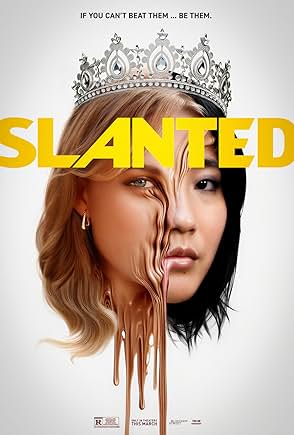

Race is a social construct, and “Slanted” (2025) is already getting criticism for using body horror to explore assimilation, internalized racism and gender norms. While lived experience probably inspired writer and director Amy Wang’s first feature, it easily feels like a scripted feature adaptation of political scientist Andrew Hacker’s “Two Nations: Black and White, Separate, Hostile, Unequal” (1992), which includes an examination of how people from different nationalities sacrifice their national origin and ethnicity to become white and widen the criteria to preserve the category. A Chinese girl, Joan Huang (Shirley Chen), dreams of becoming prom queen, but she only gets the attention of the most popular girl, Olivia Hammond (Amelie Zilber), when she dyes her hair blonde. Bombarded with ads and messages from Ethnos Inc., she decides to accept their offer to undergo ethnic modification. At school, she becomes known as Jo Hunt (Mckenna Grace). Will she get what she wanted? Yes, and it is a nightmare.
“Slanted” is psychological horror, but because that aspect of the story is marketed upfront, there is no bait and switch leading to disappointment when the horror does not hit hard. If you do not like the premise, forgo watching this movie. The film is only shown through Joan’s perception, and she is an unreliable narrator. Her observations of whiteness are depicted from an outsider’s perspective as she transitions into an idea of whiteness. The great gag of the story is that to some degree, everyone is performing a role if they are conforming to sameness and routine. The lunchroom scene is eerie because the teenage boys and girls are synchronize how they prepare and eat a salad. Do people actually do this? No (I hope), but it is the universal agreement on how to perform belonging and unity. It seems as if they are having fun from the outside, but it is staged and artificial. If a white appearing immigrant made a similar movie, it would address a concept called cultural invisibility, which erases the lived experience of an immigrant with assumptions based on accents or regions.
Many aspects of “Slanted” are actualy satire as visually storefronts look like Wholefoods and Starbucks but have different names and most of the images are aggressively sexual and patriotic with eagles, American flags and photogenic all-American faces circa the Seventies to Eighties. It starts with Joan seeing these images as a kid and learning a lesson that she does not adhere to the idealized images surrounding her. All girls and women may get that lesson, but they may apply it in different ways: losing weight, dressing hyper feminine, etc. For Joan, it is becoming a blonde, blue-eyed girl. While it may be understandable that a lot of viewers feel attacked as if the film is criticizing and misrepresenting whiteness, it is actually attacking the desire to conform and sacrifice personal, family history for a commercialized version of sameness.
Joan’s treatment of her parents is the hardest part of watching “Slanted” and having loving adults in the story gives this film the edge over “Grafted” (2024). As Joan, she also suffers internalized misogyny: protects her Dad, Roger (Fang Du), and expresses open contempt, often in the form of anti-Asian sentiment, against her Mom (Vivian Wu). As Jo, it is impossible to dismiss her comments as an average kid who thinks their parents are embarrassing. Because of the dramatic change in her appearance, her comments are more recognizably racist and unacceptable. It is an essential and hard lesson for kids to learn and appreciate their parents more instead of creating a hostile environment at home to live a less textured life. Du and Wu were perfect as the heart of the film and presenting a pitch perfect image of parents who discipline their kid, but do not always get it right. Du embodied positive masculinity as a good father and husband who also expressed sincere love for his mother. Wu is so impressive and plays her character in away that will remind many of their mother instead of a construct. It is rare to see cinematic images of parents that actually feels authentic. They ground the film in reality, especially in the bittersweet anniversary of their arrival in the US.
If “Slanted” lost the plot a bit, it was not sticking to the financial rules that it set up. How did Joan afford this surgery? How is the family going to afford life after her shenanigans? Wang created a world of functional poverty then sacrificed it for the broader themes but should have followed through. It was not possible to omit it entirely because it heightened the stakes and played a pivotal role in how Joan saw herself. There is an economic component to the immigrant experience. The employer’s display of charity then lack of it at home along with appropriating Buddhism chants during a stressful moment for her was the film at its most clever without broadly spelling out its message. The story is generally as subtle as a sledgehammer, and people still did not get it so maybe subtelty is overrated.
Also “Slanted” understandably muted the idea of sexual violence that Asian women face in the US. Joan is sheltered, and when she campaigns for prom queen as herself, she faces disproportionate ugliness in assumptions about the nature of her willingness to work. Somehow cleaning becomes sexualized because of a specific, aggressive form of discrimination and incorrect assumptions that Asian women’s work is a cover for sex work. This film was shot in Atlanta, and that scene was likely a veiled reference to the fear of stigma and sexual harassment that emerged after the 2021 Atlanta spa shootings. Asian women’s bodies are simultaneously sexualized and not desired on their own terms.
Similarly, the friendship storyline with Brindha (Maitryi Ramakrishnan) was potentially provocative, especially when Brindha applies Joan’s logic rhetorically to herself. In an episode of “Under the Radar with Callie Crossley,” which aired on March 7, 2026, guests Director Jenny Korn of the Race Tech, and Media Working Group at the Berkman Klein Center for Internet and Society at Harvard University and Wellesley College professor Elena Creef discussed “The Morning Show” and the painful question for Asian women between choosing to be a person of color or play the game. As I noted in the review of “Wuthering Heights” (2026), there are not enough onscreen diverse collabs between a variety of Asian people from different regions, East Asian and Tamil descent women in this case.
The actual body horror is tame, but psychologically violent. “Slanted” often feels more like an expanded episode of “The Twilight Zone” from Season 2, Episode 6, “Eye of the Beholder” (1960), including a homage to makeup artist William Tuttle. Tuttle reused his practical effects from the Morlocks from “The Time Machine” (1960) to produce the same appearance in that historic horror episode. There are also echoes of “The Stepford Wives” (1975), but too nascent until the eleventh hour. Olivia is the real terror, and Zilber sticks the landing as a manipulative mastermind who transforms into her more terrifying form, a nurturing mentor teaching lessons in popularity and betrayal to Jo.
“Crazy Rich Asians 2” is currently in development with Wang listed as the writer. Wow! That is a big promotion, and hopefully she will rise to the occasion. While Wang has many great ideas, Roger has a speech where the words do not capture the essence of the emotion behind the words. Wang has a lot of potential and hopefully with practice, she will be less on the nose and elevate her work so she can make a powerful piece worthy of the ideas behind it. “Slanted” is a strong start, but occasionally prioritizes the idea over the overall harmony and flow of the story.