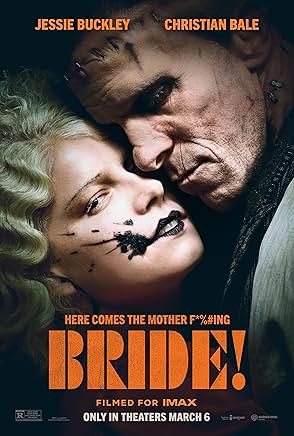

Though it is Maggie Gyllenhaal’s second film, “The Bride!” (2026) has the exuberance and enthusiasm of a first film with pop culture references stitched together like Frankenstein’s Monster. It may not stick to the ribs but is fun as a skin-deep, fever dream counterrevolutionary film bursting with life. Mary Shelley’s “Frankenstein” and Herman Melville’s short story, “Bartleby, the Scrivener,” inspired this reimaging of “Bride of Frankenstein” (1935). Set in 1935 Chicago, the Monster, now known as Frankenstein, Frankie or Frank (Christian Bale), asks Dr. Cornelia Euphronius (Annette Bening) to make him a bride. Cue digging up a dead mystery woman (Jessie Buckley) with no memory of her life, who also goes through a bunch of names trying to figure out what happened to her. Who will she be: her past, his present or their future? Monsters just want to have fun and be left alone.
Buckley plays three roles, but I do not want to spoil one of them, and she is committed and distinct in each one. Before dying, the party girl façade starts to crack, and after her death, those cracks are still showing. “The Bride!” may cause some confusion because of this braided identity, which she does not understand, but still exhibits. Death becomes her, and she has lost any inhibitions, sexual or violent, which is bad news for any guys who dare to get handsy. She is all rage and tired of keeping quiet, and her outcry sparks a vague style and homicidal uprising. The violence seems more like self-defense or manslaughter considering that a lot of the onscreen violence happens after a sexual assault. There is a vague feminist sentiment that is heavy handed (Buckley’s character literally screams “me too”) and slight because it is so personal and individual that it can hardly be scaled up to create systemic, fundamental change. It is the aesthetics of revolution a la hipster, artsy fartsy, Goth girls turned women who probably still socialize with their Presidon’t supporting family members, but hey, everyone start somewhere. It is very Harley Quinn coded. Just don’t get stuck there. Also considering the timing of this release, and how messed up the world is, I’ll sign a waiver for the sentiment alone. There is plenty to be angry at, and one way to solve it is to live on your own terms. Technically the Bride is young so she should not have a coherent policy on how the world should spin, but don’t try this at home. The desire for concrete systematic change feels like an afterthought.
When Gyllenhaal talked about her acting style at a roundtable, she stressed the importance of sexuality. In “The Bride!,” that sexuality happens to be fiercely heteronormative though aesthetically queer. Frank plays a bigger role at the beginning of the story that gradually gets reduced as he becomes her muscle, biggest fan and lover. Because he is over a century old, his manners are more old-fashioned than hers, but he has the mindset of an adolescent because of his lack of real-world experience whereas she has been around the block. There is a parasocial relationship and mental health thread that will make moviegoers want to leap into the screen to protect the big softie Frank, who is used to running and hiding, not fighting back and having someone on his side. It is nice to see Bale let loose and seemingly have fun in a role. Compared to Robert Eggers’ visual representation of Nosferatu, Frank is a model with his patchwork body, gaping wounds, pulchritude and huge staples. Occasionally Bale switches accents, and he almost sounded as if Frankie is a New Yorker though he starts with a Germanic (technically Swiss) lilt. Another waiver! It works as a romance and also as an ode to love of classic Hollywood movies. Hopefully it will inspire people to check out “Metropolis” (1927), “White Zombie” (1932), “Bonnie and Clyde” (1967), and “Young Frankenstein” (1974).
Gyllenhaal tackles head on the problematic nature of their meet cute to make the Bride into her own person, and Frank as her follower, but it does not quite expunge the fact that a bride without a name is inherently a relational noun with a relationship to another as its foundation. Well, “The Bride!” is a romance first, and a feminist outcry second. No friendships here. Power dynamics are not trying to be erased here but reversed. It is a bit of punk princess wish fulfillment and treatment. In this world, Frank is the ideal man who accepts all her messiness and unquestioningly beats down anyone who gives her trouble. Waiver, please! They are monsters because they do not follow the rules of the status quo, which results in an amazing dance sequence. Gyllenhaal plays with their powers and problems, which should lead to more confusion, but just go with the gonzo logic and do not get too bogged down in details, then you should be fine. She definitely indulges in the occasional zombie moves, but there are more inventive details involving the power of their mind and ability to influence people as if there is a hybrid zombie quality. Kudos for trying to pull a Mike Flanagan in reconciling two different types of zombies while not quite sticking the landing. I’ll sign another waiver. Mind control undercuts the pretense of democratic sentiment. The Bride is a queen who rules, not frees.
If “The Bride!” as a film deserves criticism, no one wanted to follow the criminals and law enforcement officials hunting the Bride and Frank down. Not nary a soul. More party sequences! Make the whole movie a music video. Part of a movie is having fun and getting to work with people that you enjoy spending time with so it makes sense why Gyllenhaal would bring her brother, Jake, and her husband, Peter Sarsgaard, along for the ride. Also, who would not want to work with Penelope Cruz and John Magaro?!? Still, I would trade most of them in exchange for more Bening and Jeannie Berlin, who plays the mad scientist’s maid. Cruz’s storyline was a sop to the audience so they could have a relatable character and feel empowered in the resolution.
Visually Gyllenhaal could not succeed without costume designer Sandy Powell, the entire Makeup Department, which includes hair, and set decorator Rena DeAngelo. The Times Square sequence felt as if it was possible that The Bride and Frank would bump into the cast of “Downton Abbey: The Grand Finale” (2025), but not in a bad way. Cinematographer Lawrence Sher switched between black and white and color sequences with the later dominating, but occasionally the color sequences would look black and white. During the beginning of “The Bride!,” Gyllenhaal got that camera too close for my tastes, but I got accustomed to the creative choice.
“The Bride!” may be a mess, but it is a well-intentioned, high energy, fun mess. “Resistance to tyranny is obedience to God.” While it is a bold statement to imply in the opening that this movie will be even better than Mary Shelley’s teen novel, especially considering it is more remixed homage than groundbreaking original, Gyllenhaal’s commitment and infectious spirit fuel the film and empowers the cast and crew to barrel forward without any breaks. It is “Crime 101” (2026) for the freaks.