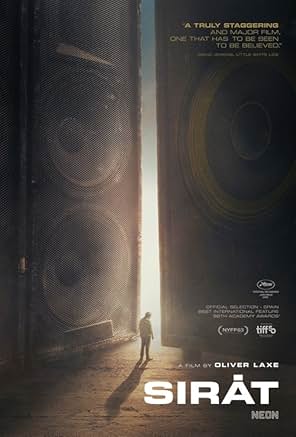

Luis (Sergi López), his son, Esteban (Bruno Núñez Arjona), and their dog, Pipa go to a rave in Morocco to look for Luis’ daughter, Mar. When the military shuts down the rave because of a sudden outbreak of war, the three follow some ravers heading to Mauritania to see if they can find Mar there. An odd couple type road trip in the desert holds many surprises and hazards. Let’s face the music and dance. Director and cowriter Oliver Laxe is equal parts manipulative and audacious. If you do not watch movies with subtitles, and you hated “The Monkey” (2025), then you should probably skip “Sirât” (2025). Spain’s submission to the 2026 Oscars’ “Best International Feature” category is likely to be polarizing among movie goers.
“Sirât” stands out for having a cast filled predominantly with people who are not actors to play the ravers. French Jade Oukio could give Kathryn Hunter a run for her money with her unique gravitas and distinct presence. Jade tinkers with speakers and has a philosophical outlook on discarded ones that echoes the carpe diem theme. “You never know if it will be the last time it works.” French Tonin Janvier seems to be her partner and is missing his leg. The group has a dog, Minnie. Richard Bellamy, nicknamed Bigui, is missing his right hand, prefers to wear a mohawk wig and is a lovable goofball. Italian Stefania Gadda is a steady driver. Joshua Liam Henderson appeared to have limited onscreen experience before and is probably the male group member who could reassimilate back into society easily. They basically adopt the three into their family though they caution them about the perils of their life. It would be interesting to discover if “Family” (2018), specifically the Juggalo scene, inspired the filmmakers to contrast expectations based on appearance versus reality.
Luis is initially suspicious of the group, but Esteban gets comfortable with them quicker. Through spending time with them, Luis and Esteban learn about what Mar may find appealing about their iterant life, but there are never any answers why Mar chose to be a wanderer, or why her family chose to follow her so if that ambiguity will annoy you, skip it. It is a multilingual group without borders. Luis discovers how easy it is to allow the music to sweep a person away, become indistinguishable from the group and erase the day to day. It is akin to a secular spiritual experience. Composer/ DJ name Kangding Ray, government name David Letelliier, makes the music that good.
Details about the individuals’ backstories are not provided, but with the missing limbs, it is possible to deduce that they could be veterans who chose ecstasy over despair, which makes it easier to digest that they feel above following orders as opposed to colonizers who feel above obeying authorities in another country. Instead, they give the impression of people who are opting out of wasting any more of their lives on the latest conflict and other ephemeral issues that seem important but are actually meaningless.
On the fringes, a refugee crisis is unfolding, and troops are mobilizing. The group’s instinct is to shun people so they can be on their way uninterrupted, but they are a bit too successful when they are ready to rejoin civilization. As the denouement approaches, the war may not reach them in a traditional sense, but it becomes impossible to ignore how it affects them and the environment, and they soon accept that they can never be separate from it. They begin to get closer to the refugees. By following presumably European Union citizens, Laxe and cowriter Santiago Fillol find a sneaky way of getting moviegoers to care about the physical and psychological effects of war on people in a way that would not happen if the story followed the locals who belong to the global majority. They succeed where Alex Garland tried and failed in “Civil War” (2024). It shows the best and worst of humanity. Even if people can ignore differences and form community, there is no way to opt out or become immune to forces bigger than them.
There is a scene fourteen minutes into “Sirât” when I had a strong sense of what was going to happen and was right. Right before it happens, it is impossible not to anticipate. Despite the fact that I laughed out loud, not out of nervousness, but disbelief that the filmmakers went where I thought it could go, I’m offering a gracious reading of the movie though the details of the scenes were still shocking. Given the framing with the opening quote, “The Sirât bridge connects paradise and hell. Whoever ventures across must know its path is narrower than a strand of hair and sharper than a sword,” it feels more like a moralistic judgment that was missing from most of the movie. It is unlikely that the filmmakers intended it, but it is a possible reading.
Another uncharitable reading is possible: the filmmakers substituted shocks for substance. I’m not in that school of thought, but it is a fair one. It does not often hide what is happening except for one off screen shot, which offers a hint later in “Sirât” of who is best equipped to survive, but it is not gratuitous or gynecological, and it could be. One could argue that it pulls punches in the last ten minutes to give the audience a break. It is more of a further stripping down for people already living a simple existence free from bourgeois conventions. In one scene, Luis is startled to discover himself asleep smack dab in the middle of the group then surrenders to their hospitality and physical, platonic consolation. They must let go of more just like the refugees, and it happens so suddenly and keeps happening that it feels impossible to get their bearings. War comes to all.
Visually “Sirât” is surreal in its pairing of an ancient and desolate environment with the sudden erection of a wall of speakers and dancers materializing. There is a laser show that feels reminiscent of the finger of God etching out the Ten Commandments on stone or perhaps the bridge referenced in the opening quote. The nomadic lifestyle may sport modern conveniences but has more in common with sacred texts. Cinematographer Mauro Herce makes the desert seem alluring despite the natural and synthetic dangers that it holds.
Even though “Sirât” is as subtle as a sledgehammer, it is still leaving audiences reeling at the spectacle that they still miss the obvious meaning. The final image makes the meaning transcend borders. It could easily be a scene out of South America as Africa. Repeated viewings do not diminish the film. They amplify it. Pedro Almodóvar and his brother, Agustín, are producers so do with that what you will. If you hate it, you were warned, and if you love it, let it be for the right reasons, not just shock value.